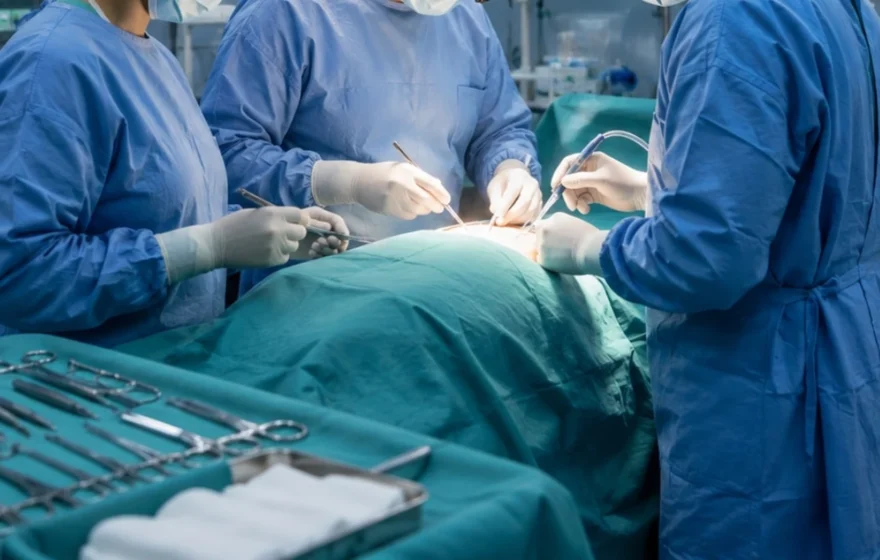
Orthopaedic surgeons at the Pak-China Friendship Hospital in Islamabad have saved a young man’s badly injured leg after a road traffic accident, carrying out a complex operation that has given him a chance to recover without permanent disability. The hospital said the patient was stable after the surgery and was recovering well.
The young man was brought to the hospital with a severe open comminuted fracture of the tibia, the long bone in the shin. The accident had shattered the bone into pieces, and the broken fragments had pierced through the skin. It was the kind of injury that carries a high risk of lasting disability, and in the worst case can leave surgeons with no option but to amputate.
To stabilise the fracture and save the limb, the surgical team performed an Ilizarov fixation procedure under general anaesthesia. The technique involves fitting a specialised external frame around the damaged leg and fixing it to the bone with fine wires and pins, so that the shattered fragments are held firmly in place while the bone heals. Dr Muhammad Danish Khan, the hospital’s Faculty Chair, and Dr Wajahat Kamal, Head of Orthopedics, led the operation. Dr Sidra, Dr Rida and Dr Sundus provided anaesthesia support throughout.
The Ilizarov method is a well-established limb-saving technique for exactly this kind of injury. It was developed by the Soviet orthopaedic surgeon Gavriil Ilizarov, and it is used around the world for complex, open fractures where the bone has been badly shattered. In such cases, fixing the bone from the inside with plates or rods can carry too high a risk of infection, so surgeons instead hold it steady from the outside. The frame of rings, wires and threaded rods keeps the fragments aligned, and the controlled tension it applies encourages the bone to regenerate and knit together. For a young patient facing the loss of a leg, it offers a genuine alternative to amputation, although recovery is gradual and the frame usually stays in place for weeks or months.
The operation is also an early test for the hospital itself, which has only recently returned to service. The Pak-China Friendship Hospital in Chak Shahzad was originally built as the Isolation Hospital and Infectious Treatment Centre during the Covid-19 pandemic in 2020, with Chinese assistance, but fell out of use after the pandemic and remained closed for years. Prime Minister Shehbaz Sharif inaugurated the revamped hospital on October 29, 2026, announcing free treatment for patients from across the country, and the hospital, previously known as Margalla Hospital, was renamed in recognition of China’s contribution to its construction.
The revamped facility has 182 beds, including 50 intensive care beds, and is expected to serve patients from Islamabad, Rawalpindi, Khyber Pakhtunkhwa, Gilgit-Baltistan, Azad Jammu and Kashmir and other parts of the country. The government has promised to bear the full cost of treatment for every patient. The prime minister has also ordered a third-party performance audit of the facility, a sign that the government wants the revived hospital to be judged on the quality of care it delivers rather than on ceremony alone.
The hospital is run by the Indus Hospital and Health Network, a non-profit organisation that provides free healthcare across Pakistan. Under the public-private partnership, the government finances patient care while the network supplies management and medical expertise. The arrangement was settled on July 31, when the Ministry of National Health Services signed agreements with the network to operate the hospital and Islamabad’s Regional Blood Centre, after federal cabinet approval. The network already operates 15 hospitals, 140 primary healthcare clinics, four blood centres and four physical rehabilitation centres, serving around 700,000 patients every month.
The patient’s family appreciated the government and the Health Department’s continued support and investment in modern healthcare facilities, according to hospital sources. They added that the partnership between the government and the network enables patients to receive advanced, life-changing trauma treatment free of charge. For a family facing a sudden road accident, the cost of such surgery in a private hospital would ordinarily be far beyond reach.
The case shows what is at stake in trauma care in Pakistan, where road accidents leave many young people with severe limb injuries every year. The difference between a saved leg and an amputated one decides whether a young person can walk, work and live independently for the rest of their life, or faces a lifetime of disability and dependence. That is why a public hospital able to carry out a demanding procedure like Ilizarov fixation, free of charge, is significant. The hospital’s revival began only a few weeks ago, so this operation is an early indication of what the facility is meant to do. What happens next for the patient is a long period of recovery and rehabilitation, with follow-up care to check that the bone is healing and that he regains strength and movement in the leg. If that goes well, a young man who arrived with a shattered shinbone will walk out of hospital on his own leg, and the revived hospital will have passed one of its first real tests.
