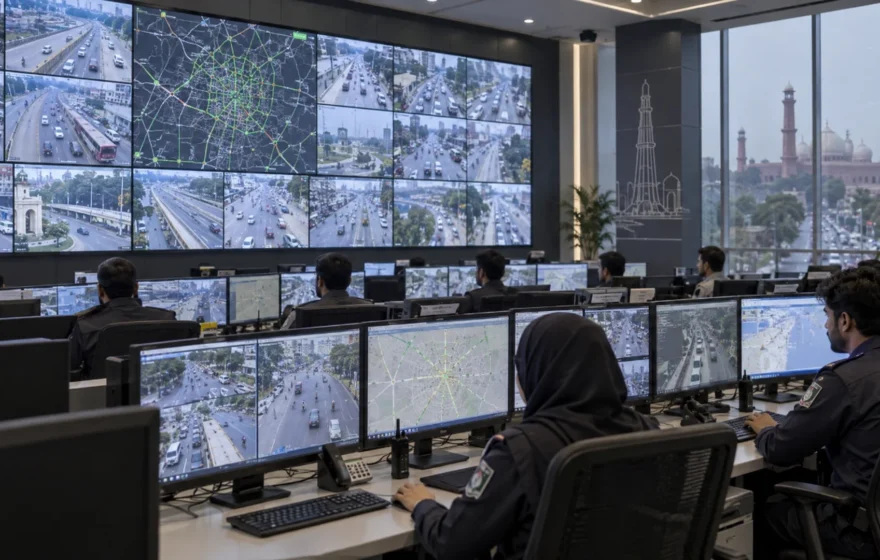
Punjab has approved Rs3.246 billion for a new Traffic Management and Command Centre at Qurban Police Lines in Lahore, giving the provincial capital a dedicated hub to watch over its roads and direct traffic in real time. The facility is part of the Rs126.7 billion development package cleared by the Provincial Development Working Party on Friday, and it is aimed squarely at the daily congestion that slows the city down.
The centre is expected to improve traffic flow and management across Lahore through modern monitoring and command infrastructure. Instead of officers reacting to jams after they form, the idea is to give the city a single place where traffic can be watched as it moves, signals can be adjusted, and trouble spots can be dealt with before a snarl spreads across neighbouring roads.
The approval came as part of a much larger round of decisions. The Provincial Development Working Party cleared 19 schemes worth Rs126.668 billion at its 13th meeting on Friday, 13 November, chaired by Planning and Development Board chairman Dr Naeem Rauf. The same meeting approved Rs18.86 billion for the University of Technology Rasul, Rs11.65 billion for two new hospitals, and Rs75.99 billion for sewerage and street work in 13 cities. The traffic centre, at Rs3.246 billion, is the smallest of those headline approvals, but for anyone who drives in Lahore it may be the one felt most often.
Lahore needs the help. It is Pakistan’s second-largest city, and its roads carry millions of vehicles every day. The busiest corridors are familiar to every Lahori: Mall Road, Canal Road, Jail Road, Gulberg Main Boulevard and the Lahore Ring Road, along with junctions such as Kalma Chowk and Liberty Chowk. Morning and evening rush hours turn these routes into slow-moving queues, and a single accident or a broken signal can back traffic up for kilometres. Manual enforcement alone has long struggled to keep up with that volume, which is why the province has been steadily shifting towards cameras and central control.
That shift is already well under way. The Punjab Safe Cities Authority runs one of the largest urban camera networks in South Asia in Lahore, with more than 8,000 ANPR and CCTV cameras watching the city’s main roads, intersections and highways. The cameras read number plates automatically, catch red-light jumps, overspeeding and lane violations, and feed everything into a control room. When a violation is detected, a digital challan is generated against the registered owner and an SMS usually follows within 24 to 72 hours. The system covers the same corridors the new traffic centre is meant to serve, and it has already changed how enforcement works in the city, with fines now issued from camera evidence rather than depending on a warden at the junction.
A dedicated traffic management and command centre builds on that foundation in a different way. Where the Safe City network is largely about watching and enforcement, a traffic command centre is about movement: monitoring flow across the network, spotting congestion as it builds, coordinating signals, and guiding police and rescue teams to incidents quickly. Cities that run such centres well use them to retime signals during peak hours, clear routes for ambulances, and manage diversions when a road is closed. Lahore’s traffic police have long done this work from scattered posts and control rooms; bringing it together in one purpose-built facility at Qurban Police Lines should make the response faster and better coordinated.
The choice of Qurban Police Lines as the site is practical. The complex sits in the heart of the city and already houses police offices and operational units, so the centre will be close to the officers who run Lahore’s traffic every day. Housing it inside an existing police facility should also make it easier to link the new centre with the traffic police, the Safe City network and the city’s emergency services, rather than building a standalone office that has to create those connections from scratch.
What has not been announced yet is when work will begin, how long construction will take, or who will build and equip the centre. The approval covers the funding, and the next steps will be the detailed design, procurement of the monitoring and communications equipment, and the hiring and training of the staff who will run it around the clock. Those details will decide whether the centre becomes a genuine nerve centre for Lahore’s roads or simply another office with screens on the wall. A command centre is only as good as the data feeding into it and the authority of the people in front of those screens to change signal timings and dispatch teams on the spot.
For Lahore’s commuters, the promise is simple enough: shorter journeys, fewer jams and a faster response when something goes wrong on the road. The city has spent years adding cameras and digital challans; this centre is the next step, turning all that watching into active management. If it is built and run well, the Rs3.246 billion could pay for itself many times over in time saved, fuel saved and accidents avoided.
