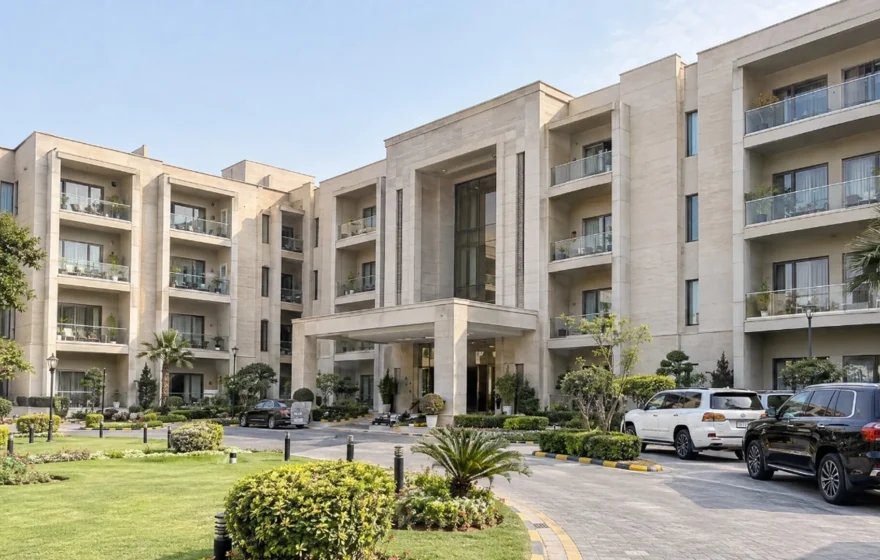
Punjab has approved Rs6.881 billion for the second phase of the MPA Hostel in Lahore, clearing the way for a long-awaited expansion of the residential facility used by members of the provincial assembly while they are in the capital for sessions and assembly business. The allocation was cleared at the 13th meeting of the Provincial Development Working Party, held in Lahore on Friday under the chairmanship of Dr Naeem Rauf, chairman of the Planning and Development Board. The hostel was one of 19 schemes approved at the meeting, worth a combined Rs126.668 billion across healthcare, education, infrastructure, traffic management and industrial development.
The second phase, approved as a revised scheme, will expand and upgrade the hostel for provincial lawmakers. For a house of 371 members, most of whom travel to Lahore from constituencies across Punjab, a place to stay near the assembly is a practical necessity. Sessions can run for days, committee meetings fill the weeks between them, and members from far-flung districts need somewhere to stay while the assembly is sitting. The existing facilities have struggled to meet that demand for years.
Lahore has two hostels for assembly members. One stands in front of the Punjab Assembly building and has 40 rooms; the other, Pipals House, sits next to the Civil Secretariat and has 36 suites. Together they offer far fewer beds than a 371-member house requires, and the shortfall has been felt most sharply by women members, for whom dedicated space has historically been scarce. In early 2020 the then speaker pointed out that not a single room had been added to the facility in a decade, while a new block of 150 rooms was under construction.
The expansion is not a new idea. A second phase was first planned at a development working party meeting in 2005, when the proposal was for 102 apartments near the assembly building. That plan never went ahead, and in 2011 the chief minister of the day dropped it on austerity grounds, after the planning board put its cost at more than Rs3 billion including furnishings. Fifteen years later the same project has returned in revised form at more than double that estimate, a measure of how costs have moved and how stubborn the accommodation problem has proved.
The hostel was not the only scheme cleared on Friday. The working party also approved a Provincial Traffic Management and Command Centre at Qurban Police Lines in Lahore for Rs3.246 billion, a 50-bed hospital at Bhurban in Murree for Rs1.507 billion, and a Children Hospital in Rawalpindi for Rs10.143 billion, both as revised schemes. In education, Rs18.862 billion was set aside for the Punjab University of Technology in Rasul, Mandi Bahauddin. Much of the rest of the package falls under the Punjab Development Programme, covering sewerage, stormwater drainage and street pavements in cities across the province.
The package shows how the working party acts as the gatekeeper for Punjab’s development spending. Schemes it clears move into execution, where departments take over tendering and construction, and where the real test begins. Approvals are routine in the provincial calendar, but they are only the first step. The hostel’s own history makes the point: a scheme first planned in 2005 is only now, two decades on, being funded in its revised form.
The squeeze is not unique to Lahore. In Islamabad, the Parliament Lodges complex has faced the same pressure for longer. A project to build 104 additional family suites for members of the National Assembly began in 2011 and was due to finish in 2013, yet it stalled for more than a decade before work resumed. The existing blocks house 358 family suites against a combined strength of 442 senators and MNAs, leaving dozens of parliamentarians in rented houses or on a housing allowance. Legislatures grow, and the buildings meant to house their members rarely keep pace.
The hostel approval also sits within a broader development push. On Saturday, Chief Minister Maryam Nawaz Sharif approved in principle Rs50 million of development work in every village under the Khushhal Dehat Programme, with 475 villages covered in the first phase at a cost of Rs23.85 billion and a second phase planned for 2,000 villages. From village streets to hospital wards and a new technology university, the government is trying to move on many fronts at once.
What happens next matters more than the approval itself. The revised scheme now passes to the departments that must build it, and the familiar questions follow: how quickly tenders are issued, whether the work stays on schedule, and whether the final cost stays close to Rs6.881 billion. Until the new rooms are actually built, the shortage the second phase is meant to solve will remain exactly where it has always been.
