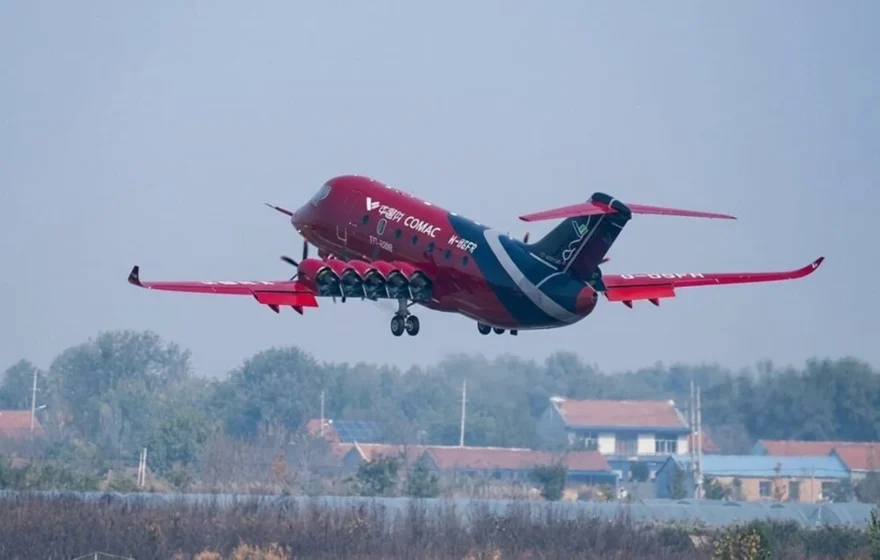
China has taken a notable step towards battery-powered passenger flight after its first electric commercial aircraft completed its maiden journey with a crew on board. The aircraft, known as the CE-25A, flew over Binzhou in the eastern province of Shandong on Saturday, 14 November, carrying two pilots and a flight-test engineer. Its maker, the state-owned Commercial Aircraft Corporation of China, known as COMAC, said the aircraft operated normally throughout the test and that every performance indicator met expectations.
The flight is a milestone for a programme that has so far been tested only without people on board. The CE-25A made its first unmanned autonomous flight on 2 February this year, and COMAC says it has since completed 19 unmanned flight validations. Putting a crew on board for the first time moves the project from remote-controlled testing into the far more demanding world of piloted flight, where the aircraft, its systems and its crew must all work together in real conditions.
The test itself was modest in scale, and the numbers released afterwards make that clear. The whole exercise lasted 57 minutes and 46 seconds, of which the aircraft spent 16 minutes and 38 seconds in the air, covering a distance of 60.4 kilometres. That is a long way short of the aircraft’s advertised range, and it underlines that this was a careful first step rather than a demonstration of what the plane can do at full stretch. COMAC has not announced a date for certification, a launch customer, a price, or a planned entry into commercial service, and the aircraft remains a development machine rather than a certified airliner.
Even so, the design is ambitious. The CE-25A is built mainly for travel between cities, and it is designed to carry 19 passengers, with a maximum takeoff weight of 10 metric tons. Its stated cruising speed is 300 kilometres per hour, its operating altitude is 2,400 metres, and its range is up to 400 kilometres. Those figures point to short regional hops rather than long-haul flying: the kind of journeys that today are made by small turboprop aircraft, or by road and rail over several hours.
What sets the aircraft apart is how it flies. Instead of conventional turbofan or turboprop engines, the CE-25A uses a distributed electric propulsion system, with 10 electric ducted fans mounted along the top of its wings. Spreading the thrust across many small fans is intended to cut noise and to let the aircraft take off and land on shorter runways, which could open up routes that are impractical for today’s planes.
The aircraft was developed jointly by COMAC, the battery manufacturer CATL, Shanghai Jiao Tong University and other partners. CATL’s role is particularly important, because the battery is the heart of the whole idea and also its biggest constraint. Batteries still store far less energy for their weight than aviation fuel, and that simple fact is what has kept electric flight limited to small aircraft and short distances. CATL is the world’s largest maker of batteries for electric vehicles, and its involvement reflects how closely the future of electric aviation is tied to progress in battery chemistry.
The regulatory road ahead is long. The Civil Aviation Administration of China has formally accepted COMAC’s application for a type certificate under transport-category regulations, which begins the inspection process the aircraft must pass before it can carry paying passengers. A type certificate is the approval an aircraft design needs before it can enter commercial service, and earning one means proving, test by test, that the design, its systems and its performance all meet the safety rules. For a new kind of propulsion, that process is likely to be especially thorough, because regulators have decades of experience with jet and propeller engines but very little with large battery-powered aircraft carrying passengers.
China’s interest in the technology fits a wider pattern. COMAC is already building the C919, a conventional narrow-body jet, and the CE-25A shows the same company looking further ahead, towards a form of flying that produces no exhaust emissions at the point of use and far less noise. For a country with many large cities separated by a few hundred kilometres, short electric flights could one day sit alongside high-speed rail as another way of moving people quickly between urban centres.
For now, the honest reading of the flight is that it is a development milestone, not the arrival of electric air travel. The aircraft flew for less than 17 minutes and covered about 60 kilometres, a fraction of its stated range. Commercial service depends on completing certification, and no date has been given for that. But the direction of travel is clear, and the next tests will tell the world much more: whether the aircraft can fly its full range, carry a full load of passengers, and do so repeatedly and safely. If it can, the short hop between two cities may one day be flown on battery power, quietly, and with no fuel burned at all.
