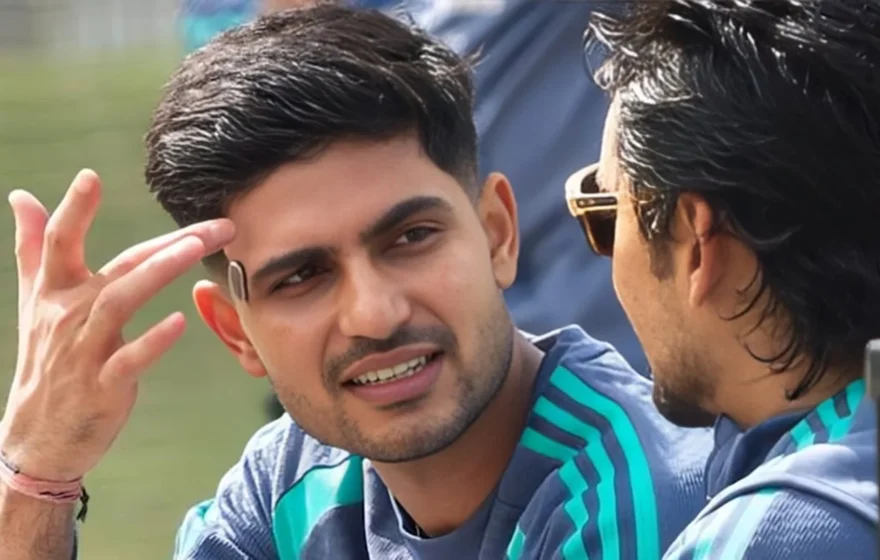
India captain Shubman Gill walked out for the first one-day international against New Zealand at Eden Park in Auckland on November 4 with something unusual stuck to the side of his forehead. It was small, gold-coloured and oval, sitting just above his right eye, and it stayed there while he batted. Television cameras picked it up within minutes, social media filled with guesses, and even New Zealand fast bowler Kyle Jamieson was seen asking Gill about it. The object turned out to be Temple, a new health and fitness wearable developed by a team led by Deepinder Goyal, the co-founder of Zomato.
Gill had not simply put the device on for the match. He was first seen wearing it during India’s training sessions in Auckland after the team arrived in New Zealand on October 29, and he kept it on through the opening game of the five-match series. India won that match comfortably, chasing down their target to win by five wickets with more than nine overs to spare and take a 1-0 lead. Yet the result was almost overshadowed by the curiosity around the captain’s forehead. It was, by most accounts, the first time such a device had been worn during an international cricket match.
Temple is not a watch, a band or a chest strap. It is a tiny sensor, less than an inch wide and weighing under two grams, that sticks to the skin near the temple with disposable adhesive patches the company calls Grips. The patches hold it in place during exercise, which is why it could survive a full innings of batting without slipping. Inside sit light-based optical sensors, an accelerometer and a skin-temperature sensor. Its main selling point is a measurement called BrainFlow, which tracks changes in blood volume and oxygenation near the head, presented as a window into how well the brain is being supplied with blood.
Temple also produces a second number called Entropy, which Goyal has described as the body’s real-time cost of being alive. It is a score from 1 to 250, with lower readings linked to deeper rest and higher ones to greater strain. Exercise, poor sleep, stress, caffeine and meditation are all said to move the number, so an athlete can see, almost live, how hard their body is working and how well it is recovering. For a cricketer on a relentless international schedule, that read on recovery has obvious appeal.
Badminton star P. V. Sindhu, who has also been seen wearing Temple during international competitions including the World Championships, has spoken publicly about exactly this. She said the device helps athletes understand their recovery and sleep patterns, which differ from person to person, and gives them information about cognitive performance, heart rate and nutrition that helps them understand their overall physical condition. Yet Gill himself has said nothing publicly about why he is wearing Temple, and there is no confirmation that it is part of the Indian team’s official fitness-monitoring programme. He may be testing it personally, or the team may be trialling it quietly before deciding whether to adopt it.
The device has also run into serious questions from doctors. Temple opened for pre-orders in India on November 1 at a price of 85,000 rupees, roughly 907 US dollars, with deliveries expected in about three months. But several well-known Indian doctors have publicly challenged its central claim. Their objection is anatomical: the sensor sits over the superficial temporal artery, which supplies blood to the scalp and face, not to the brain, and they argue that light signals picked up from the skin cannot reliably measure blood flow inside the brain. Prominent hepatologist Cyriac Abby Philips has called Temple the biggest health scam, and the evidence so far is two company-funded preprints, neither peer-reviewed nor independently replicated.
Goyal has pushed back firmly, insisting that Temple is strictly a fitness and wellness device rather than a medical one, and that it makes no medical claims and is not meant to diagnose or prevent disease. Temple has said that BrainFlow and Entropy are new metrics with emerging science, and that more research will follow. There is also a question for cricket itself. The International Cricket Council governs the technology players use, and under its rules for the players’ and match officials’ area, communication devices such as mobile phones are prohibited in restricted areas. Temple is a sensor rather than a communication device, and nobody has suggested Gill broke any rule, but its appearance has raised questions about where the line sits between a fitness tracker and a piece of in-game technology.
Whether it becomes a regular sight in dressing rooms will depend on two things: whether athletes find the data genuinely useful over a long season, and whether the science behind its boldest claims can stand up to independent testing. For now, the small gold sensor on the India captain’s forehead has turned a routine one-day international into a debate about the future of sport, the limits of wearable technology, and how much we should trust the numbers a gadget gives us about our own bodies.
