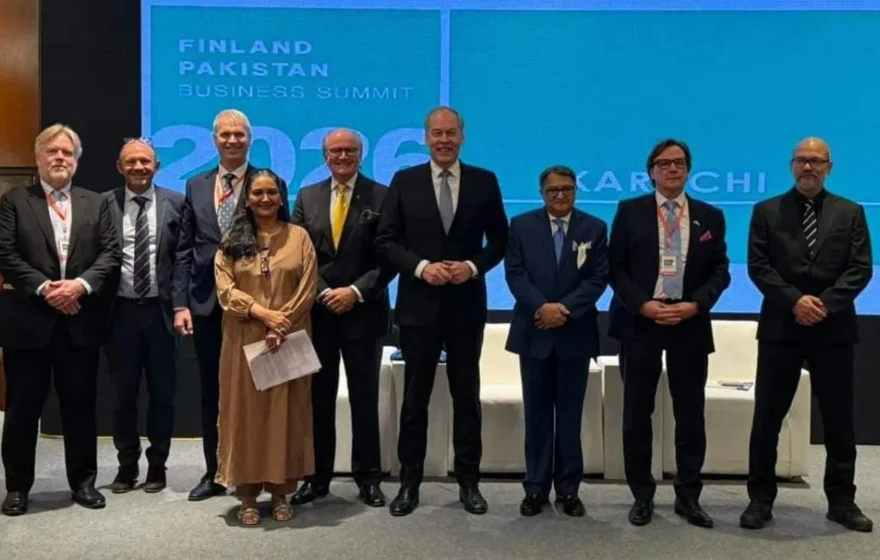
A Finnish business delegation has arrived in Pakistan for the Finland-Pakistan Business Summit 2026. Around ten Finnish companies are travelling with the delegation, meeting business leaders in Islamabad and Karachi to look for commercial partnerships in mining, energy, healthcare, construction and technology. The summit also marks 75 years of diplomatic relations between the two countries, and both sides say they want the relationship to move beyond goodwill and into real deals.
The visit has a historic edge to it. Leading the Finnish side is Jarno Syrjälä, Finland’s Deputy Minister for International Trade and Under-Secretary of State at the Ministry of Foreign Affairs. His presence makes this the first official ministerial visit from Finland to Pakistan in 75 years. The two countries established diplomatic relations in the early years after Pakistan’s independence, but ministerial contact has been rare and trade has stayed modest. That is the gap this summit is designed to close.
The event is organised by the Finland-Pakistan Business Council, known as the FPBC, which has been running the summit since 2012. The council itself was established in 1985, making it one of the oldest organisations dedicated to promoting business relations between the two countries. This year’s gathering is its fourteenth session, opening in Islamabad on 16 November and moving to Karachi on 17 November, so companies in both of Pakistan’s main business centres get a chance to meet the visitors face to face.
Wille Eerola, the Honorary Consul General of Pakistan in Finland and chairman of the Finland-Pakistan Business Council, has been at the centre of the arrangements. He believes the two countries have a great deal to offer each other, pointing in particular to energy and to several areas of technology, including healthcare and construction, where a strong link supporting the transfer of knowledge could and should be created. His argument is that the relationship should rest on shared know-how, not trade in goods alone.
Syrjälä struck a similar note when he spoke about why Finland is paying attention to Pakistan now. He said Finland sees Pakistan as a strong partner in areas such as mining and environmental and energy technologies, and that the two countries have complementary strengths. The opportunity, in his words, is to combine Finnish expertise with Pakistani ambition and entrepreneurship and turn that combination into business opportunities that benefit both countries.
The delegation itself reflects that breadth. The companies travelling with Syrjälä work across healthcare technology, energy, construction technology, weather technology, waste management, mining and education. Pakistan needs investment and modern technology in its energy and mining sectors, better systems for managing waste and water, and stronger health and education services. Finland, a country of only about five and a half million people, has built world-class companies in exactly those fields, and for Finnish firms Pakistan offers a large and growing market.
The visit has also reached beyond the summit hall into Pakistan’s parliament and ministries. Senate Chairman Syed Yousuf Raza Gilani met Syrjälä and the delegation at Parliament House in Islamabad, where he called for the 75 years of friendship to be turned into a dynamic and result-oriented economic partnership. He proposed a structured economic dialogue, a joint economic commission and a bilateral investment treaty to give the relationship a firmer legal footing. He pointed to opportunities in telecommunications, manufacturing, renewable energy, mining and artificial intelligence, and invited Finnish expertise in climate resilience, water management and mineral processing.
The government has been making the same pitch in its own meetings. Federal Minister for Petroleum Ali Pervaiz Malik met the Finnish delegation on 16 November and invited Finnish companies to invest in Pakistan’s energy, minerals and infrastructure sectors, pointing to ongoing reforms and deregulation in the petroleum sector aimed at making it easier for foreign investors to take part. The delegation at that meeting included representatives of leading Finnish companies such as Wartsila, Elematic and Casagrande Laboratories. Syrjälä said Finland was working to bring more Finnish companies to Pakistan and to encourage them to explore the commercial opportunities on offer.
The timing matters for both sides. Pakistan has spent the past two years trying to attract foreign investment into its minerals and energy sectors and to convince international firms that the country is open for business. Finland, for its part, has been looking beyond its traditional European markets as its companies search for growth. A summit alone will not transform a trading relationship overnight, and the real test will be whether the meetings in Islamabad and Karachi turn into signed agreements, joint ventures and investment on the ground.
Even so, the symbolism of this visit is hard to dismiss. Seventy-five years of diplomatic relations, a first ministerial visit in all that time, and a summit that has been running since 2012 all point to a relationship that has been patient rather than spectacular. If the companies that came with Syrjälä find partners and projects worth pursuing, this year’s summit could be remembered as the moment the Finland-Pakistan relationship finally became a commercial one in earnest, built on the simple idea that Finnish technology and Pakistani ambition are a natural fit.
