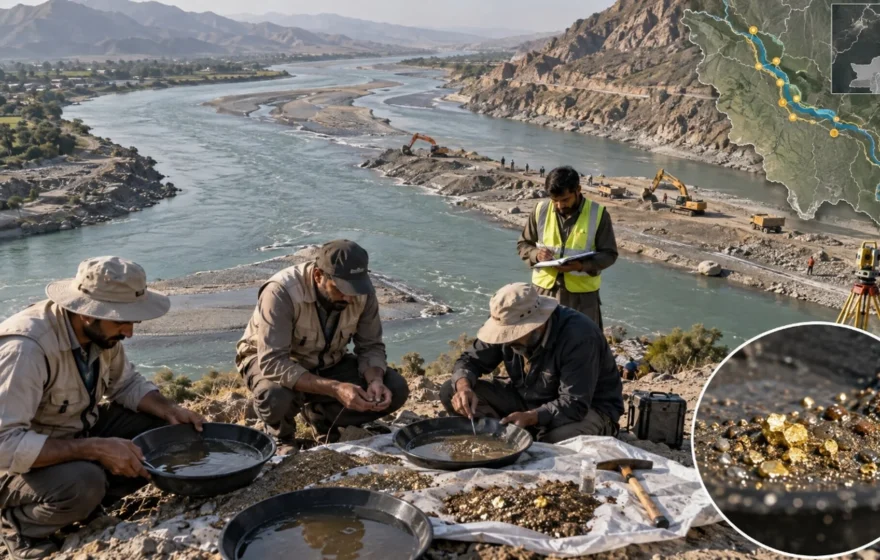
Punjab has taken a major step towards mapping the gold hidden beneath its riverbeds, with a preliminary report from the National Engineering Services Pakistan, known as NESPAK, confirming the presence of 75,000 tolas of gold in a single block. The finding has renewed excitement about a mineral resource that could, if the early estimates hold up, be worth hundreds of billions of rupees to the province.
Provincial Minister for Minerals Sardar Sher Ali Gorchani confirmed the discovery, telling reporters that gold deposits in the Attock and Mianwali districts and along the Sutlej river have been divided into nine blocks for survey and exploration. The block examined so far is only one of the nine, so the full picture will only emerge once the remaining blocks have been studied in the same detail.
The scale of the find becomes clearer when the weight is put into more familiar terms. A tola, the traditional unit used for gold across South Asia, weighs just under 11.7 grams, so 75,000 tolas works out to roughly 875 kilograms of gold, a substantial quantity for a single surveyed block.
Value and Investment
According to the provincial minister, the 75,000 tolas found in the first block are worth more than Rs30 billion at current prices. Extracting that gold, however, will not be cheap. Gorchani said around Rs20 billion in investment would be needed to recover the metal from the riverbed, a reminder that the value of gold in the ground is very different from the money it eventually puts into the public purse.
The minister added that the total value of the gold reserves could reach hundreds of billions of rupees once all nine blocks have been surveyed. That wider estimate is supported by a separate report from the Geological Department, which found 480,000 tolas of gold in two blocks, a figure equal to roughly 5.6 tonnes of the precious metal.
The figures also fit into a longer story that began in early 2025, when the Geological Survey of Pakistan reported a much larger placer gold deposit along the Indus River near Attock. That survey, based on samples collected from 127 locations over a 32-kilometre stretch between Ghazi Barotha and Attock Khurd Bridge, estimated the area held around 2.8 million tolas of gold, or about 32.6 metric tonnes, with a value then put at between Rs600 billion and Rs800 billion. The gold there is placer gold, tiny particles washed down from the Himalayas over thousands of years and deposited in river sand and gravel, concentrated near the point where the Kabul River meets the Indus. Geologists classified that deposit as an inferred resource, meaning further exploration is still needed before anyone can say with confidence how much of it can be recovered commercially.
The Attock discovery also brought problems. Reports of illegal digging prompted the Punjab Home Department to impose Section 144, banning unauthorised gold extraction from the Indus near Attock, and an earlier exploration attempt by a Chinese company in 2017 ended in controversy after allegations of unauthorised extraction. Those episodes explain why the provincial government is now moving through formal surveys and blocks rather than opening the riverbeds to whoever arrives first.
Interest in the province’s rivers has only grown since then. Addressing the Pakistan Minerals Investment Forum in Islamabad earlier this month, Chief Minister Maryam Nawaz said geological investigations showed promising gold deposits beneath the beds of all five of Punjab’s rivers, the Indus, Jhelum, Chenab, Ravi and Sutlej, and that comprehensive surveys were under way to establish the actual quantities. The latest NESPAK report, covering the Attock, Mianwali and Sutlej areas, appears to be part of that wider effort.
The Way Forward
According to the government, NESPAK has now begun surveys to determine how much gold the remaining blocks contain. Once final reports for all nine blocks are compiled, an international auction will be held for the exploration and extraction of the reserves, with mining companies invited to bid for the rights under the province’s mineral laws. The auction model is how the government intends to turn a geological estimate into revenue, jobs and investment while keeping the process open to scrutiny.
Much will depend on what those final reports say. Preliminary and inferred figures have a habit of shrinking once detailed drilling and sampling begin, and the Rs20 billion extraction cost quoted for the first block shows that recovering placer gold from riverbeds is an industrial undertaking, not a simple dig. The environmental questions will also need answers, since mining in and around rivers can disturb water flows, farmland and the communities that live along the banks.
For now, though, the direction of travel is clear. Punjab believes it is sitting on a significant gold resource, it has put a state engineering firm in charge of measuring it block by block, and it intends to offer the extraction rights to international bidders once the science is complete. If the surveys confirm even a good part of what the early reports suggest, the province could be looking at a new source of income that lasts for years.
