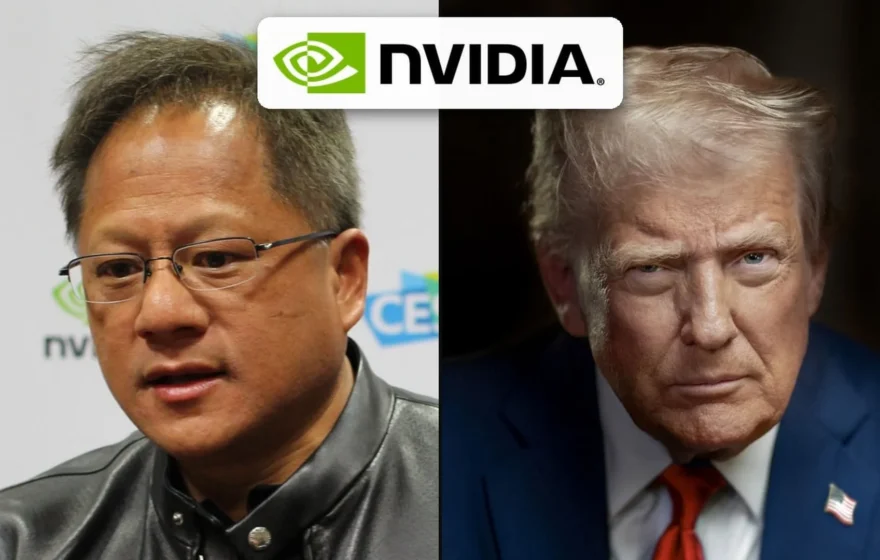
United States President Donald Trump has urged Jensen Huang to apologise and return as chief executive of Nvidia, pressing his case for the return of the chipmaker’s co-founder just over a week after Huang’s sudden resignation. Speaking to reporters on Friday, Trump said Huang should own up to his mistakes and take back the job he held for more than three decades. “I’d like to see Jensen make a big apology and go back,” he said. “We’re a country of second chances.”
Trump argued that Nvidia would be wise to welcome its former boss back, calling Huang a rare talent who built it into the most valuable chipmaker on the planet. “I think the company, if they were smart, they’d take that brilliant man, accept an apology and let him go back to work,” he said. The president also said he had raised Huang’s future with Chinese President Xi Jinping, a sign of how far the saga has travelled beyond a boardroom dispute.
It is the second time in a week that Trump has publicly backed Huang’s return. On November 16, four days after the resignation, he said he “would not mind” seeing Huang back in charge and that he had “learned a big lesson”. Friday’s remarks went further, turning sympathy into a direct call for an apology and a reinstatement, as pressure on Nvidia’s board builds from several directions at once.
Huang has said he would come back if the board decides his return is in the best interest of shareholders. A public petition calling for his reinstatement has gathered more than 195,000 signatures, with support from Elon Musk and other prominent figures in the technology world. Nvidia’s own employees have also pressed directors to reconsider, turning a personal scandal into an open debate about who should lead the company at the heart of the AI boom.
Why Huang Left Nvidia
Huang, who co-founded Nvidia and led it for 33 years, resigned on November 12 as president, chief executive and board member. His departure followed reports of extramarital affairs, including one with a woman whom United States intelligence reportedly assessed as working for Beijing. The board had opened an independent investigation four days earlier, after Huang admitted to staff that he had been unfaithful to his wife. The company gave no formal reason for his exit.
Chief financial officer Colette Kress is serving as interim chief executive while the board searches for a permanent replacement, and Harvey C. Jones, the former chief executive of Synopsys, has become the board’s first ever chair. The search is open to internal and external candidates, but there is no obvious frontrunner, and the investigation is still running.
Huang founded Nvidia in 1993 with Chris Malachowsky and Curtis Priem, over a meal at a Denny’s in San Jose with just 40,000 dollars in starting capital. The company nearly ran out of money in 1997, yet it survived to float in 1999 at 12 dollars a share. Under Huang it grew from a maker of graphics chips for computer games into the engine room of the AI revolution.
Nvidia controls more than 80 per cent of the market for AI training chips. In July 2025 it became the first company worth four trillion dollars, and in October the first to pass five trillion, while revenue for 2026 rose 65 per cent to a record 215.9 billion dollars. The turmoil has already taken a toll: its value had slipped from about 5.78 trillion dollars in October to 4.51 trillion by November 6. Huang’s grip was unusually personal: he owned about 3.5 per cent of the company and had said openly that he did not believe in succession plans, leaving the board with no named heir.
Board Not Budging So Far
For all the pressure, the board is reportedly not considering bringing Huang back. Directors have given no public sign that they are rethinking the decision, and the petition, the staff campaign and now the president’s intervention have so far failed to move them. The standoff leaves Nvidia’s interim leadership to steady a company worth trillions of dollars while the search for a permanent chief executive drags on.
The political dimension only adds to the difficulty. Trump’s decision to discuss Huang with Xi Jinping connects the affair to the wider contest over advanced chips, among the most sensitive goods traded between the two countries. Washington has spent years tightening controls on sales of powerful AI chips to China, and any suggestion that the leadership of the company that makes them has become a matter for discussion between the two presidents will be watched closely in both capitals.
For now, the impasse holds. Huang has said he is willing to return, his supporters are growing louder, and the president has now told him to apologise and take his old job back. But the decision rests with a board that, so far, has shown no sign of changing its mind. What happens next will shape not only Nvidia’s future but the leadership of the industry on which the AI age depends.
