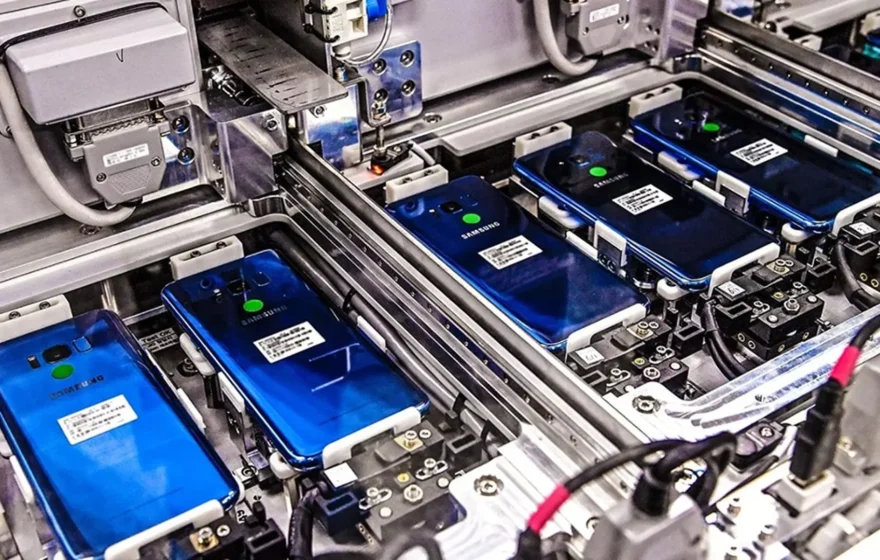
VGO TEL has emerged as Pakistan’s biggest phone maker in 2026, assembling 3.50 million mobile phones locally between January and October, according to fresh data from the Pakistan Telecommunication Authority. The brand finished well ahead of Infinix, which assembled 2.27 million handsets in the same period, and itel, which produced 2.03 million. The figures offer the clearest picture yet of a local industry that now builds the overwhelming majority of the phones Pakistanis buy, even as output has slipped below last year’s pace.
Across the industry, local plants manufactured or assembled 23.03 million phones in the first ten months of the year, roughly 2.3 million handsets a month, below the 2025 average of about 2.5 million. If the current pace holds, full-year output would land near 27.6 million units, short of the 30.21 million phones produced in 2025. Local output also took a sharp hit in April this year, a dip that has weighed on the annual total even though production recovered afterwards.
Local Output Over the Years
The longer view shows how uneven the journey has been. Local production stood at 24.66 million units in 2021, fell to 21.94 million in 2022 and 21.28 million in 2023, then jumped to 31.38 million in 2024 before easing to 30.21 million in 2025. The 23.03 million units recorded in the first ten months of 2026 keep the industry on course for its third-strongest year on record, though the final tally will depend on the last two months.
The transformation began with two policy moves. The first was the Device Identification, Registration and Blocking System, known as DIRBS, which the PTA rolled out to stop smuggled and non-tax-paid phones from working on local networks. The second was the Mobile Device Manufacturing Policy of 2020, which gave companies importing knocked-down kits for local assembly a clear tax advantage over firms bringing in fully built phones. By February 2023, 31 companies had received manufacturing authorisations, bringing in roughly 300 million dollars in investment, and more than 35 manufacturers now run plants in the country, supporting around 40,000 jobs.
VGO TEL Leads Local Brands
VGO TEL’s rise to the top is the standout story of the year. The brand assembled 3.50 million phones from January to October, comfortably ahead of Infinix on 2.27 million and itel on 2.03 million. TECNO followed with 1.38 million units, then Nokia with 1.28 million, Samsung with 1.20 million and vivo with 1.17 million. Club Mobile produced 0.93 million handsets, Q Mobile 0.77 million and E-Tachi 0.76 million, rounding out the top ten.
Together, those ten brands made 15.29 million phones, about 66 percent of everything assembled locally this year. The list also shows where the market sits today. The brands at the top compete hardest on price, serving buyers who want a capable phone without paying flagship money. Samsung, the only global premium brand in the top ten, sits sixth, a reminder that the volume in Pakistan’s market is overwhelmingly in the budget and mid-range segments.
Imports Climb Again
While local assembly still dominates, imports are climbing again. Commercial imports reached 3.95 million phones in the first ten months of 2026, already 67 percent more than the 2.37 million imported in all of 2025, and the highest yearly figure since 2021. Local phones still outnumber imports by almost six to one, but their share of the 26.98 million phones supplied this year has slipped to about 85 percent, down from about 93 percent in 2025.
The rebound points to a deeper question about what local manufacturing means in Pakistan. The plants here overwhelmingly assemble phones from imported kits rather than making the parts themselves. Imports of those kits rose from 521.9 million dollars in the 2023 fiscal year to 1,375.5 million dollars in the 2025 fiscal year, and local value addition has reached only about 10 percent against a 49 percent target. The government is now drafting a successor policy aiming to lift local value addition to as much as 50 percent, pushing companies to start making components such as chargers, batteries and circuit boards at home.
Smartphones Make Up 71% of Devices
The mix of phones actually in use is changing more slowly. As of October 2026, smartphones made up 71 percent of all mobile devices on Pakistan’s networks, while 2G phones accounted for the remaining 29 percent. The split is unchanged from 2025, but it marks a long climb from 2020, when smartphones were just 48 percent of devices and basic 2G handsets still held a 52 percent majority.
The year ahead will test whether the industry can move beyond assembly. Output is down on last year, imports are rising again, and the next policy will judge manufacturers not on how many phones they put together but on how much of each phone is actually made in Pakistan. VGO TEL’s lead shows how quickly a brand can rise here. The harder prize is turning a successful assembly business into a genuine manufacturing one.
