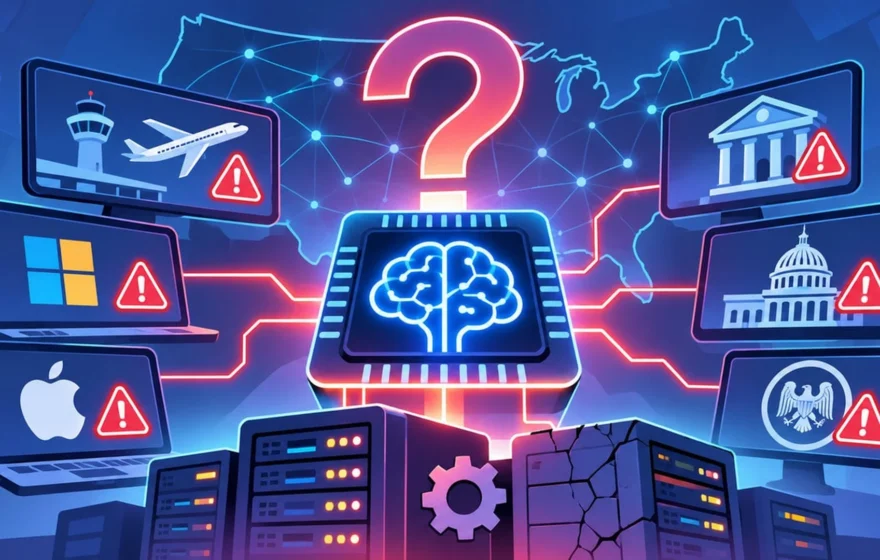
In the space of a fortnight, some of America’s most important digital systems have stumbled, one after another. Airlines could not fly, office workers could not open their email, banks struggled to serve customers, and even the National Security Agency’s internal network went down. With failures arriving so close together, a natural question began to circulate: is artificial intelligence somehow behind them?
Apple services faltered, Microsoft’s Outlook, Teams and Copilot went dark for millions of users, and on 13 November the Federal Aviation Administration grounded every departing flight in the country for nearly five hours. Yet officials in Washington and the companies involved insist there is no sign of a coordinated cyberattack. The real story may be less dramatic but more worrying: systems are being changed faster than they can safely absorb, and technology built in another era is being asked to carry the modern world.
Is AI Behind the Outages?
TechCrunch quoted Dave DeWalt, who once ran the security firm McAfee and now sits on the advisory council of the US cyber defence agency, CISA. He believes artificial intelligence could be contributing indirectly, in a subtler way than AI systems going rogue.
DeWalt explained that AI security tools can spot software weaknesses far faster than human analysts. But that creates pressure to fix each weakness immediately, before criminals find the same flaw, so patches arrive in a constant rush and every change risks breaking something else. DeWalt suggested some of the disruption may simply reflect the growing pains of making systems safer at unprecedented speed. Investigators, however, have not established that AI-driven security updates caused any of the outages. A plausible theory is not a proven cause.
Old Technology Could Be the Bigger Problem
Anusha Iyer, an engineer who founded the security startup Corsha, offered a different explanation: much of the infrastructure behind America’s essential services was built decades ago, long before anyone imagined today’s connected world, and was never designed to work alongside modern software and AI tools.
The aviation shutdown may be the clearest example. Preliminary findings blame a telecommunications modernisation project, in which contractor L3Harris was replacing ageing equipment and installing new routers, for disrupting the older network it was meant to improve. Transport Secretary Sean Duffy said overloaded switches and routers began sending inconsistent information, forcing the FAA to halt departures. The ground stop began at 3:54 in the afternoon and lasted four hours 21 minutes. More than 4,700 flights were cancelled and around 10,000 delayed. It was the longest nationwide airspace shutdown since September 2001. Iyer’s argument is that the core problem is not AI itself but the speed at which new technology is being bolted onto old systems without enough testing. A single change reached all 22 of the FAA’s air traffic control centres at once, so the backup plan failed at the national level.
US Officials Rule Out Coordinated Cyberattack
Given the timing, many first suspected a deliberate attack. The outages followed incidents in France, where supermarket refrigeration systems and blood banks were targeted, and October attacks on software projects including PHP, Node.js and LiteLLM.
American intelligence officials, however, say the November outages do not appear connected to state-sponsored terrorism. President Donald Trump described them as separate incidents, and the affected companies have blamed technical faults rather than malicious activity. Microsoft said its outage was caused by a server problem, not by any hostile act, and later blamed three factors: a previously undetected software defect, a surge in network load, and nearly 14 per cent of gateway server capacity being out of service. Investigations are continuing.
Experts Call for Better Testing and Security
Specialists agree on what should change: DeWalt wants more testing before updates reach live systems, and better prioritisation of security patches. Iyer wants older industrial systems kept better separated from modern networks, with stricter access controls, and new technology introduced gradually.
The Microsoft outage shows why that matters. It began on 12 November as a problem with Exchange Online mailboxes in the Americas and spread across Microsoft 365, affecting Teams, SharePoint and Copilot. More than 7.4 million reports flooded into Downdetector from over 70 countries, and full service returned only on 14 November, 36 hours later. The toll was still far below the CrowdStrike failure of 2024, when a faulty update crashed more than eight million Windows computers.
A New Opportunity for Cybersecurity Companies
Yet DeWalt sees a genuine opportunity. He believes AI-powered security tools could help organisations find weaknesses before attackers exploit them, and expects growing demand for technology that finds flaws, tests patches and repairs vulnerabilities automatically. The tools can find problems faster than ever before, but the systems they protect need to be strong enough to survive the cure.
The deeper lesson is not that artificial intelligence is sabotaging American infrastructure. It is that the country is modernising the systems daily life depends on while they are still running, at a pace that leaves little room for error. Until the old and the new are properly separated, tested and protected, experts warn, more failures are a matter of when, not if.
