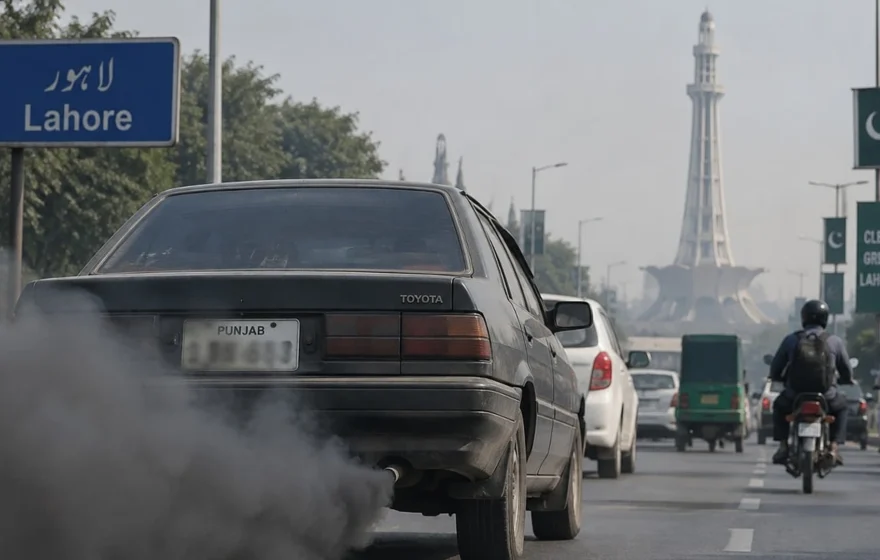
Lahore’s traffic police have widened their campaign against the vehicles fouling the city’s air, setting up special checkpoints that operate through the night and taking action against hundreds of thousands of offenders as the winter smog season tightens its grip on Punjab’s capital.
Chief Traffic Officer Syed Abdul Raheem Shirazi said officers have issued 14,653 challans to vehicles pumping out visible smoke. The drive has also taken action against 10,306 vehicles carrying soil and sand without protective covers, loads that scatter dust across busy roads and thicken the haze over the city. A further 31,618 vehicles were found running without fitness certificates or in such poor condition that they should not have been on the road, while 272,760 were penalised for overloading, which strains engines and pushes exhaust emissions far above normal levels.
The penalties go beyond a fine on the spot. Shirazi said the department is suspending the driving licences of motorists whose vehicles emit dangerously high levels of smoke, keeping the worst offenders off the road instead of charging them and letting them drive on. Commercial vehicles risk losing their route permits as well. Uncovered carriers of soil and sand have been barred from entering Lahore, cutting off a visible source of road dust at the city boundary.
Technology is doing part of the work checkpoints cannot. The traffic police are using artificial intelligence to spot smoke-emitting vehicles and issue challans through modern monitoring systems, so enforcement continues even where no officer is standing by the road. Night checkpoints have been set up across the city, with senior officers running targeted operations at entry and exit points, since heavy vehicles often move after dark. Officials said the operations would continue.
The figures show the drive growing rather than slowing down. Only ten days earlier, on 11 November, the same campaign had recorded 11,871 smoke challans, along with action against 7,919 uncovered carriers, 25,833 unfit vehicles and 253,286 overloaded ones. Every total has risen since, which suggests police are catching more offenders but also that the pool of polluting vehicles is far from exhausted. October set the pattern, with a record 67,914 challans in a month, up 39 per cent on the August-September average.
The traffic police are not working alone. The Punjab Environment Protection and Climate Change Department has been running its own crackdown on brick kilns, a major source of winter pollution. Between 1 January and 18 November, its teams made 84,370 inspections, demolishing 1,429 kilns, sealing 968 and registering 1,248 cases, with fines totalling Rs178 million. During the smog season, from 1 September to 18 November, teams made 29,999 visits, demolished 519 kilns, sealed 494 and registered 408 cases, imposing fines of Rs101.45 million.
The district administration has added its weight. Lahore Deputy Commissioner retired Captain Muhammad Ali Ijaz ordered operations against vehicles causing smoke and pollution across the district; his teams impounded 21 smoke-emitting vehicles, issued challans to 54 others and collected fines of Rs216,000. He told transporters to repair their vehicles fully and obtain valid fitness certificates before returning them to the road. Separately, the Punjab Transport Department inspected 5,000 vehicles from 1 to 7 November, challaning 659, impounding 409 and fining 442 overloaded goods vehicles Rs2.6 million. Transport Minister Bilal Akbar Khan said there would be no concession for smoke-emitting vehicles or those without fitness certificates, and that non-compliant vehicles would be seized.
All this enforcement is playing out against air that remains dangerous to breathe. Heavy smog pushed several Punjab cities into the hazardous category on Friday, with Lahore recording an hourly air quality reading of 465 between 7am and 8am, while Gujranwala reached 661 and Multan 641. On Saturday, Lahore’s air quality index stood at 293, enough for the city to be ranked the world’s most polluted once again. Residents have been advised to limit time outdoors, keep windows closed, wear masks outside and use air purifiers indoors, advice that matters most for children, older people and anyone with breathing or heart problems. Pollution can be reported through the Green Punjab app or on 1373, and smoke-emitting vehicles on 1071. Lahore Police have separately arrested 67 suspects and registered 40 cases this year for breaking environmental laws.
The scale of the crackdown raises the question of whether fines alone can clear Lahore’s skies. Vehicle exhaust is only one part of a problem that also includes industrial emissions, brick kilns, crop residue burning and the cold, still winter air that traps pollution close to the ground. Enforcement can take the worst vehicles off the road and push owners towards repairs and fitness certificates, but lasting improvement will need a cleaner, newer fleet, a fitness regime that works all year, covered transport for construction material as routine, and action beyond the city boundary in the districts whose smoke drifts into Lahore. For now the traffic police say operations will continue, and with the smog season still ahead, the coming weeks will show whether this year’s crackdown can do more than count challans and actually bring the air quality index down.
