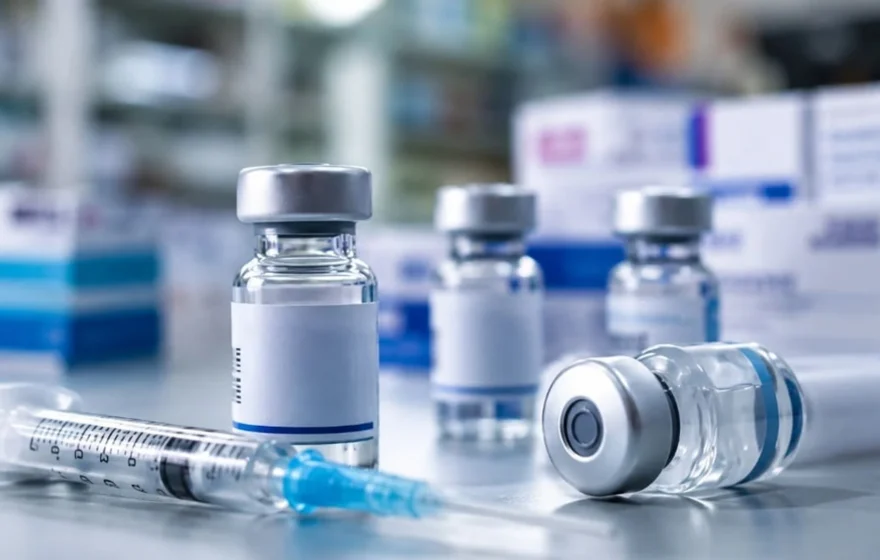
Health authorities in Islamabad have arrested three people, including the chief executive of a private laboratory, after a raid found patients allegedly being given suspected counterfeit flu vaccines.
Drug Control ICT, the drug control arm of the Ministry of National Health Services, acted after a member of the public complained that the laboratory was administering the vaccine. A team led by Chief Drug Inspector Sardar Shabbir raided Excel Diagnostic Lab and seized 27 suspected counterfeit injections of Influvac Tetra, along with the laboratory's vaccination records.
Officials said the vaccine at the centre of the case should never have been in the laboratory at all. According to the health ministry, Influvac Tetra had not been imported into Pakistan during the current year, which immediately raised questions about where the stock had come from. The batch in question, numbered 913, had already been declared counterfeit by the Drug Testing Laboratory, and the Drug Regulatory Authority of Pakistan, known as DRAP, had also issued a rapid alert about the vaccine.
The three people taken into custody were identified as the laboratory's chief executive, Dr Naseer Ahmed, its manager, Bilal Abbasi, and an employee named Sher Dil. The raid did not go smoothly. The ministry said the laboratory's management resisted the inspection, and the Federal Investigation Agency had to step in to help the drug control team complete the operation. Investigators are now working to establish whether other people were involved in supplying or distributing the suspected counterfeit stock.
The case matters because of what the vaccine is supposed to do. Influvac Tetra is a quadrivalent influenza vaccine made by Abbott Biologicals in the Netherlands and prequalified by the World Health Organization. Each 0.5 millilitre dose, supplied in a pre-filled syringe, protects against four strains of the virus, two from the A family and two from the B family, and is given once a year before the flu season. A fake version offers none of that protection. Worse, nobody can say what is actually inside a counterfeit injection, so a patient who believes they have been vaccinated may have no defence against the flu at all, while also being exposed to unknown risks from whatever the syringe contained.
This was not an isolated warning. Only days earlier, DRAP had issued a separate rapid alert, dated 12 November, about a falsified presentation of Hexaxim, a childhood vaccine made by Sanofi that protects against six diseases including diphtheria, tetanus, hepatitis B and polio. The regulator said vials carrying batch number X3H421VA were neither registered nor authorised for import, because Hexaxim is registered here only as a pre-filled syringe. Parents were urged to check batch numbers before any vaccination, and anyone who had received the suspect product was told to see a doctor and report it to DRAP. Late in October, health authorities in Punjab had also found counterfeit flu vaccines being sold under a multinational company's name, and two suspects were arrested.
The Excel case has also raised questions that officials have not yet answered. Excel Labs operates more than 100 locations across Pakistan, but the health ministry identified only one facility in connection with the raid. It did not say how many patients had received the suspect doses, whether any of them had reported adverse reactions, or whether the stock had reached any other site. Those are the questions patients who visited the laboratory will most want answered.
The wider problem of fake medicines has meanwhile reached parliament. A Senate panel, the Functional Committee on Problems of Less Developed Areas, has voiced serious concern about counterfeit medicines and vaccines spreading in rural areas and has summoned DRAP and health authorities within ten days. Ministry officials told the committee that a new two-dimensional barcode tracking system has been introduced on all pharmaceutical products and has been effective since 10 October, allowing citizens to scan a code with a mobile phone and check a medicine against DRAP's database, including its manufacturing, import and expiry details. Officials also confirmed that a National Vaccine Policy is awaiting approval from the cabinet.
Federal Health Minister Mustafa Kamal praised the drug control team for the raid and directed the authorities to take strict action against those involved. He warned that no leniency would be shown to anyone putting public health at risk and reaffirmed the ministry's commitment to eliminating counterfeit medicines from the country.
For patients, the episode is a reminder of how much trust a vaccination involves. Most people cannot tell a genuine vaccine from a fake one by looking at it, which is why the system depends on licensed suppliers, registered importers and the regulator's alerts. The advice from DRAP is straightforward: obtain medicines and vaccines only from licensed pharmacies and authorised outlets, check the batch number and the packaging, and report anything suspicious to the regulator. With the winter flu season under way and demand for the annual flu jab at its peak, that advice carries more weight than usual. Whether the Excel investigation leads to prosecutions, and whether it uncovers a wider supply chain, will now determine how much reassurance the public can take from the raid.
