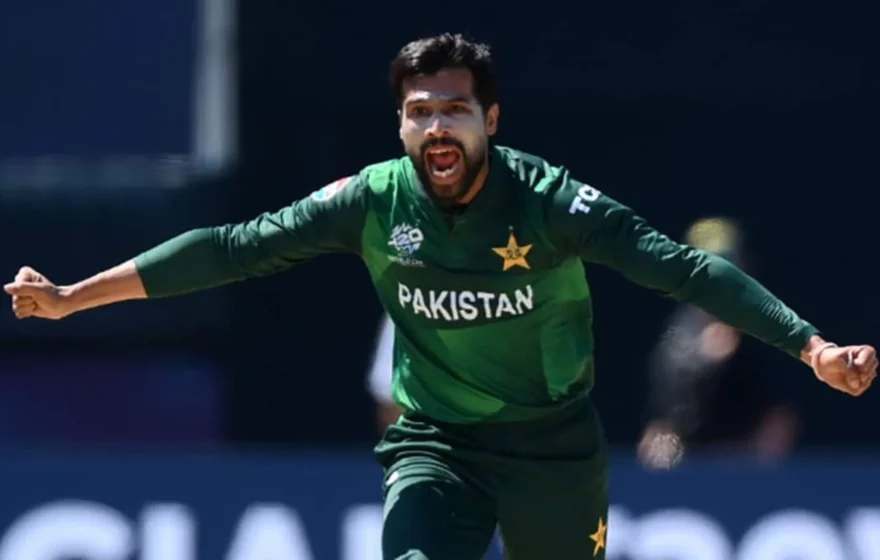
Mohammad Amir has ruled out playing international cricket for England, putting an end to the speculation that followed his decision to obtain a British passport and register as a local player in English county cricket. The former Pakistan fast bowler made his position clear in an interview with The National, insisting that his registration was only ever meant for domestic cricket and that he has no plans to wear an England shirt.
The 34-year-old explained that the eligibility rules for county cricket and international cricket are entirely different, and that he is not currently eligible to represent England at the international level. He had declared himself as a local county player, he said, not as someone preparing for an England career. The distinction matters. Registering as a local player frees a cricketer from the overseas quota in county cricket and in The Hundred, but it does not, on its own, open the door to international selection.
The clarification also closes the door on the idea that the 2028 T20 World Cup, or even the Los Angeles Olympics that same year, might tempt him into an England jersey. Amir has been consistent on this point. He has said repeatedly that his Pakistan chapter is closed, and now he has said just as plainly that an England chapter will not be opening either.
His comments also shed light on why he walked away from international cricket in the first place. Amir retired after the 2024 T20 World Cup, and he says he has no regrets about the decision. He was Pakistan's best bowler at that tournament, taking seven wickets in four matches at an economy rate of just 4.5. Yet when the tournament ended, he says, nobody from the team management contacted him to discuss his future. For a player who had fought his way back into the side and then delivered on the biggest stage, the silence was decisive. Self-respect comes first, he said, and rather than wait for clarity that never arrived, he decided to focus on his career and his family instead.
It was a sad end to a Pakistan career that had already survived more twists than most. Amir made his international debut as a 17-year-old in 2009, and within months he was part of the side that won the T20 World Cup in England, the first of his three great moments in the country. The second came a year later, and it was the darkest of his life. His involvement in the spot-fixing scandal during the Lord's Test against England in 2010 led to a prison sentence and a five-year ban from cricket, and at one stage it seemed his career was finished before it had properly begun.
The comeback, when it arrived, was remarkable. Amir returned to international cricket in 2016 and rebuilt his reputation ball by ball, and the following year he produced one of the great spells in Pakistan's history, taking three wickets for 16 runs in the Champions Trophy final against India at The Oval, dismissing Rohit Sharma, Virat Kohli and Shikhar Dhawan as Pakistan won by 180 runs. He went on to play 36 Tests, 61 one-day internationals and 62 T20 internationals, taking 119, 81 and 71 wickets respectively, and he was Pakistan's leading wicket-taker at the 2019 World Cup with 17 wickets. He first retired in December 2020, returned ahead of the 2024 T20 World Cup, and retired for a second and final time that December.
England, he says, holds a special place in his life because it contains both the best and the worst of his story. His three best moments are all there, he told The National: his selection for Pakistan and the World Cup win in 2009, his marriage in 2016, and the Champions Trophy triumph in 2017. The toughest time of his life was there too, in 2010. His wife, Narjis Khan, is a British citizen, and it was through her that he obtained his British passport this year.
That new status has already paid off on the field. Amir enjoyed a memorable 2026 in England, helping Nottinghamshire reach the semi-finals of the T20 Blast and then starring for Trent Rockets in The Hundred, where he took three wickets for 29 runs in the final even though his team lost to Manchester Super Giants. He has carried that form into the Abu Dhabi T10, where he is among the leading wicket-takers for the defending champions, UAE Bulls. Playing as a local player rather than an overseas signing makes him far more valuable to English clubs, and it has opened doors that would otherwise have stayed shut.
There will be fans in Pakistan who wish he had been given a better ending with the national team, and fans in England who wonder what he might have offered. Amir himself sounds at peace with both. He has had a career of extraordinary highs and lows, and he is now playing the game on his own terms, as a British local and a county professional. The passport has changed his paperwork, not his path to international cricket, and he has now said so in the clearest possible terms.
