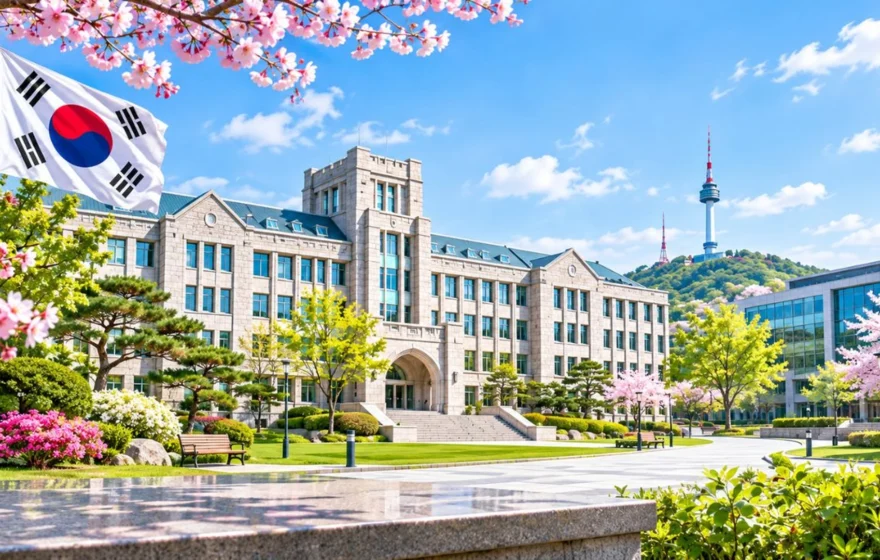
Pakistani students hoping to study in South Korea next year can now explore their options without spending a rupee or leaving home. An online education fair organised by South Korea’s National Institute for International Education (NIIED) is offering free access to admission information from 36 Korean universities, with live webinars, one-to-one guidance and advice on scholarships and visas. The 2026 Study in Korea Online Education Fair with Admission Webinars runs until November 29, 2026, and is aimed at students planning to begin their studies in 2027.
The event was announced through the Korean diplomatic office in Karachi, and it is designed to do online what an in-person fair does in a hall. Students can speak directly with university representatives, sit in on admission webinars and get personalised guidance on degree programmes, scholarships and visa requirements, all without travelling to South Korea. For many families, that matters, because flights, hotels and agents often put foreign study out of reach before an application is even filed.
Admission Webinars and Schedule
The fair’s webinar programme is spread across the coming week. On November 23, the focus is on career-linked degree programmes, with a special visa information session at 2:00 PM Korea Standard Time to explain the requirements and procedures for studying in South Korea. From November 24 to 27, the sessions turn to general degree programmes and Korean language courses, where students can ask about admission requirements and weigh up their options. The fair itself stays open until November 29, so students can keep browsing the universities and reading admission information on the Study in Korea platform after the live sessions end.
How Pakistani Students Can Join the Online Education Fair
Joining is straightforward. Students can visit the official Study in Korea website at studyinkorea.go.kr and open the ongoing online education fair. From there they can browse the participating universities, check admission details and pick webinars matching the subjects they want to study. Live webinars can be joined through the event schedule, where students can question university representatives directly, and virtual booths offer individual consultations and more detail on admission requirements.
An optional pre-registration facility lets students receive email notifications about upcoming webinars and fair activities. Students do not need to pay a participation fee or create an account simply to attend the fair, although individual university applications may carry separate registration requirements or application fees of their own. The fair is free, but applying to a university is a separate step with its own rules.
Why South Korea Is Reaching Out to Pakistani Students
The fair is part of a much bigger push by Seoul to bring in overseas students. Under its Study Korea 300K Project, launched in August 2023, Seoul set out to attract 300,000 international students by 2027, nearly doubling the roughly 167,000 foreign students there at the end of 2022. The target was met a year early: the Ministry of Education counted 307,464 international students on April 1, 2026, and announced in September that the goal had been reached ahead of schedule. The focus has now shifted from numbers to quality, with a new strategy for nurturing international talent and supporting students once they arrive.
Scholarships sit at the centre of that effort. The Global Korea Scholarship, run by NIIED, is South Korea’s flagship award for international students, and its quota is set to rise from 4,543 places in 2022 to 6,000 in 2027. Graduate places for science, technology, engineering and mathematics students are also growing, and the government has said the country quotas for India and Pakistan, where many science and engineering applicants come from, will rise as well.
Scholarships and the Road to 2027
For Pakistani applicants, the picture is already taking shape. In the 2027 undergraduate round of the Global Korea Scholarship, Pakistan was given three embassy-track places, two general and one under the regional R-GKS strand, and that window closed on September 30, 2026. The university track, through which students apply directly to one Korean university, ran from September to November 2026. At graduate level, Pakistan had eight embassy-track places and 17 university-track places in the 2026 round, and the next graduate round is expected in February 2027. Students who win a place still need a D-2 student visa, issued by the Korean Embassy in Islamabad, or by its Karachi office for students living in Sindh.
For students weighing their options, the fair’s real value is timing. The webinars run over the next few days, the fair closes on November 29, and the scholarship and admission windows for 2027 entry are already moving, so what students learn this week can shape applications filed in the months ahead. It costs nothing to attend and asks for no account, removing two barriers that usually keep students from finding out what is on offer. The harder work comes after the fair: choosing the right universities, meeting grade and language requirements, and getting the documents and the visa in order. But for a student in Lahore, Karachi or Islamabad wondering whether a Korean degree is realistic, a free week of direct answers is a sensible place to start.
