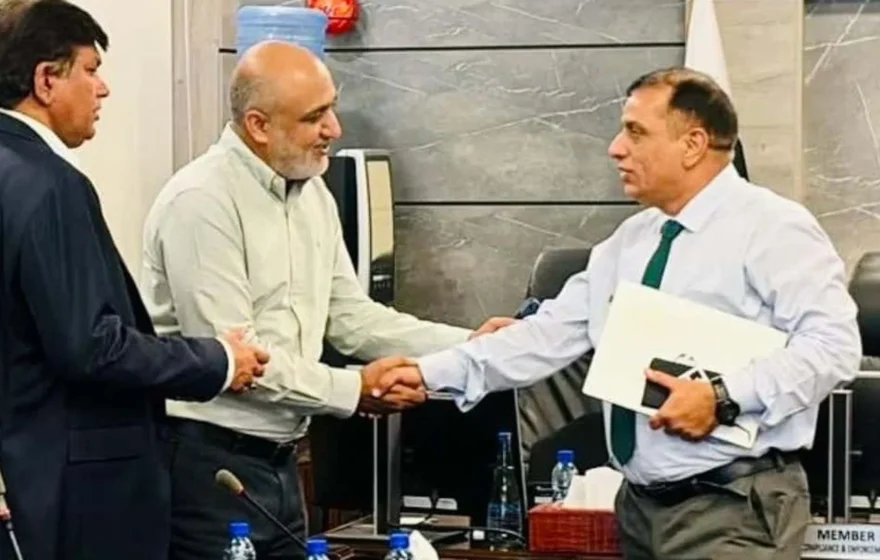
The Pakistan Telecommunication Authority has joined hands with licensed telecom operators to take on illegal internet provision across the country, warning unlicensed operators to come into the legal fold or face a nationwide enforcement operation backed by law enforcement agencies.
The message was delivered at a meeting at the regulator’s headquarters in Islamabad with licensed Long Distance International (LDI), Fixed Local Loop (FLL) and Class Value Added Services (CVAS) operators. The session was chaired by Dr Khawar Saddique Khokhar, the PTA’s Member for Compliance and Enforcement, and attended by Director General Enforcement Amer Shahzad, with industry representatives led by Wavecomm.
The core rule, the regulator said, has been ignored for too long: licensed operators may sell bandwidth only to other licensed operators. LDI and FLL licensees can supply bandwidth, including internet packages, to companies that hold a PTA licence, and to no one else. They may not hand over IP bandwidth, panel services, E1 connections, domestic private leased circuits or similar facilities to unlicensed businesses or distributors.
Bills and receipts must be issued by the relevant FLL or Class licensee, so every paying customer is on a licensed operator’s books. Internet Services Class licensees serve end users directly and cannot sell wholesale bandwidth onward for resale, a practice that has let small unlicensed networks buy capacity in bulk and sell it street by street. For cable operators and small last-mile providers, the regulator pointed to a legal route that already exists: the District Class Licence allows cable operators licensed by the Pakistan Electronic Media Regulatory Authority (PEMRA), and other last-mile providers, to buy bandwidth directly from FLL licensees.
The operators agreed to take the message to the streets. Wavecomm, HG Telecommunication, Dynasty Telecom, Connect Communication, IN Cable Internet, One Click, Logon Broadband, Galaxy Technology, INSTACOM, Prime Networks and Broadband, Telecommunication and Technology Masters, Wancom and Skynet Multi Services will run a nationwide awareness campaign giving illegal operators two choices: obtain a district-wise CVAS licence and operate legally, or sign a long-term partnership agreement with a local loop operator. There is no third option.
Once the campaign has run, any operator that has taken neither route and is still selling internet illegally will be reported to the PTA, triggering a countrywide enforcement operation with law enforcement agencies. To make the legal path easier, the PTA has promised to make getting a district-wise CVAS licence simpler and faster. The operators pledged their cooperation and welcomed the regulator’s efforts to protect businesses that play by the rules.
This is the latest step in a campaign the regulator has run for years. The PTA was set up under the Pakistan Telecommunication (Re-organisation) Act of 1996 to regulate telecom systems and services, with the power to grant licences and act against those who operate without one. Earlier guidance from the authority pointed to hundreds of thousands of illegal internet users in the big cities and told FLL and CVAS licensees to rewrite their agreements so every customer was recorded under a licensee’s name.
In July this year, the PTA and the Federal Investigation Agency raided two unlicensed internet networks in Gujrat district, in Karianwala and Sarai Alamgir, arresting two people and seizing routers, optical line terminals and other equipment. One network had 112 active users out of 186 registered, the other 271 active out of 315, and investigators found bandwidth had been passed to the illegal setup by a licensed CVAS operator through an upstream link from PTCL. Officials suspected the networks were also reaching into Azad Jammu and Kashmir, including Mirpur and Bhimber.
The same drive has targeted the grey traffic and illegal SIM trade that runs alongside unlicensed networks. In November last year, the PTA and the National Cyber Crime Investigation Agency raided a grey setup in Lahore, recovering 660 active Jazz SIMs, 22 Ufone SIMs and gateways with 256 and 128 ports, while a separate operation in Mansehra seized phones and pre-activated international SIMs. Between July 2024 and June 2025 the regulator blocked more than 3.2 million SIMs issued in the names of people who had died, carried out 44 raids in 24 cities against local SIM fraud, making 71 arrests, and blocked 83 websites selling SIMs without authorisation.
For ordinary users, the campaign could mean fewer grey-market connections that vanish overnight when a raid shuts a network down. A connection from a licensed operator comes with a proper bill, a named company and a regulator to turn to when things go wrong, none of which an unlicensed seller can offer. For licensed operators, the prize is a market where they are no longer undercut by rivals who pay no licence fees and carry none of the costs of compliance.
The test now is whether the promised simpler licensing brings small operators in, and whether enforcement follows once the awareness campaign ends. If it does, every connection sold in Pakistan could finally be sold by a business the regulator can hold to account. If it does not, the cycle of warnings and raids will continue, and the unlicensed networks will keep finding new ways to buy the bandwidth they need.
