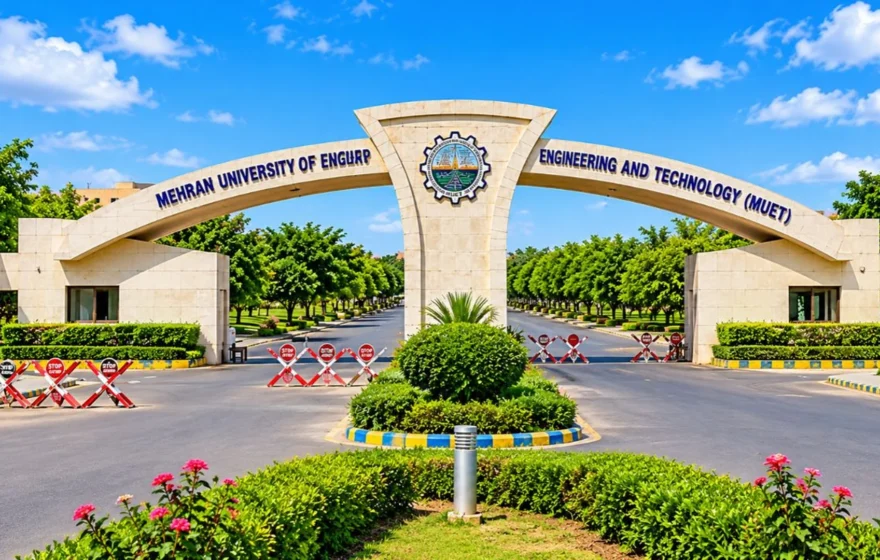
Mehran University of Engineering and Technology in Jamshoro has opened admissions for its Master’s and PhD programmes for Batch 27. Applications opened on November 20, 2026 and close on December 10, 2026. The batch covers Software Engineering, Data Science, Cyber Security, Civil, Electrical and Environmental Engineering, Applied Mathematics and management studies.
The university began in 1963 as the Sind University Engineering College, with only two departments, and this year’s offering shows how far it has travelled. It became a University of Sindh campus in July 1976 and was chartered as an independent university on March 1, 1977. Postgraduate teaching began in 1978, and the university has since grown into one of Sindh’s leading public engineering institutions, with more than 35,000 alumni and around 8,000 students today. Its Khairpur Mir’s campus, founded as a constituent college in 2009 and upgraded in 2013, extends that reach into upper Sindh.
The timing of this admissions round matters for the province. Sindh’s economy runs on engineering, from the irrigation networks that feed its farms to the power plants, highways and industries around Karachi and Hyderabad, and each sector needs engineers who can do more than follow a design. They need researchers who can solve local problems, from managing scarce water to designing for extreme heat. A postgraduate degree from MUET is one of the few routes into that work without leaving the province, and for many graduates it is also a stepping stone to teaching, research or a doctorate abroad.
The Master’s and PhD Programmes Available
Doctoral admissions are open in 27 disciplines. It includes Applied Mathematics, Biomedical Engineering, Chemical Engineering, Civil Engineering, Computer Systems Engineering, Electrical Engineering, Energy Systems Engineering and Environmental Engineering, alongside Management Sciences, Mechanical Engineering, Mining Engineering, Petroleum Engineering, Software Engineering, Structural Engineering, Telecommunication Engineering and Textile Engineering. That range reflects the university’s history: it grew out of the civil, mechanical and electrical disciplines that built Sindh’s infrastructure, and has added new fields as technology has changed.
At Master’s level, the university is offering programmes in Biomedical Engineering, Chemical Engineering, Civil Engineering, Computer and Information Engineering, Construction Management, Electrical Power Engineering and Information Technology, plus MS Data Science, MS Cyber Security, MS English Linguistics, MS Climate Change and Environmental Informatics, MPhil Applied Mathematics, Architecture, City and Regional Planning, and the Master of Business Administration. Climate Change and Environmental Informatics is notable, because Sindh has borne the brunt of floods and heatwaves, and the province needs specialists who understand both the science and the data. The SZAB Campus at Khairpur Mir’s is offering Master’s programmes in Civil Engineering, Electrical Power Engineering, Energy Systems Engineering and Petroleum Engineering, bringing advanced study closer to students in upper Sindh.
The Eligibility Rules for Applicants
The university has set separate requirements for Master’s and PhD candidates, and applicants should check them before paying the processing fee. A PhD needs a relevant Master’s, MS, MBA or MPhil degree equivalent to 18 years of education, with at least 3.0 CGPA out of 4.0 under the semester system or 60 percent under the annual system. A Master’s needs a relevant bachelor’s degree equivalent to 16 years of education, with at least 2.0 CGPA out of 4.0 under the semester system or 60 percent under the annual system. Applicants must also meet the subject-specific requirements of their chosen programme, so a degree in an unrelated field will not be enough.
The Admission Test
Every applicant must qualify in a pre-admission test. PhD candidates need at least 60 percent in the test, while Master’s applicants need at least 50 percent. The university accepts its own pre-admission test, or an eligible GRE or HAT General-equivalent test from a testing body accredited by the Higher Education Commission. Candidates who have already taken such a test should check it is still valid and matches their programme. The university has been clear that passing the admission test does not guarantee admission. Final selection depends on the full merit calculation, including academic record and the seats available in each programme.
How to Apply Online
Applications go through the admission portal at ugadmissions.muet.edu.pk/login, where candidates register, select their programme and complete the form. The processing fee is Rs. 4,950, payable through the challan generated by the portal, and applicants must also upload their academic certificates, CNIC and any other documents the university asks for. Gather those documents before starting the form, because a half-finished application saved near the deadline is a common way to miss out. Scanned certificates should be clear, the CNIC current, and the challan paid with its proof kept safe.
With the December 10, 2026 deadline less than three weeks away, candidates should move promptly. Those who prepare for the test while their application is in progress will be stronger than those who wait for a call letter before opening a book. For graduates across Sindh, Batch 27 is a genuine opportunity to deepen their expertise, and for the province another cohort of specialists for its infrastructure, industry and response to a changing climate.
