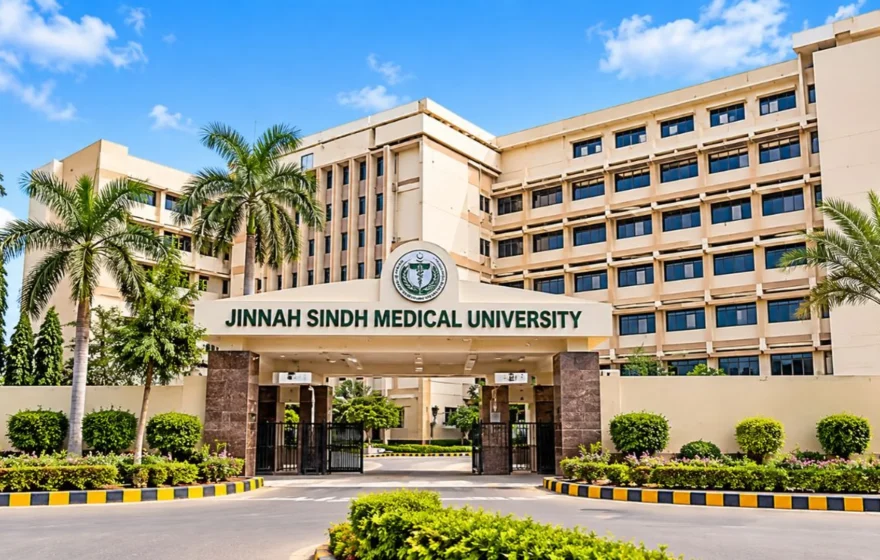
Jinnah Sindh Medical University in Karachi has opened admissions for its Pharm-D, Nursing and Allied Health Sciences programmes for the 2026-27 session, giving students across Sindh a new route into some of the most in-demand health professions. Applications are open for Doctor of Pharmacy, Doctor of Physical Therapy, BS Nursing, BS Public Health, BS Occupational Therapy and BS Medical Technology. The online application process began on November 23, 2026 and will close on December 7, 2026, so candidates have just two weeks to get their forms in. Only students holding a Sindh domicile are eligible to apply, a condition that applicants should confirm before paying the fee.
The university carries more than fifty years of medical teaching history. It began on April 7, 1973 as Sindh Medical College, when around 200 students joined its first MBBS class under founding principal Khawaja Moin Ahmed, based in the paediatrics ward of the Jinnah Postgraduate Medical Centre. It joined Dow University of Health Sciences in 2003, and on June 2, 2012 gained university status as Jinnah Sindh Medical University, becoming Karachi’s third medical university. That history matters, because half a century of training health professionals brings teaching experience, hospital links and a graduate network a new institution cannot match.
The timing is significant for another reason. Pakistan’s health system is short of almost every kind of trained professional. World Health Organization data put the density of nurses and midwives at only about 5.2 per 10,000 people, far below the WHO’s critical threshold of 30 per 10,000, and the Pakistan Economic Survey 2025-26 counted around 138,391 registered nurses. Pharmacists, physiotherapists, medical technologists and public health graduates are in short supply too. A degree in one of these fields is therefore a near-certain route into work, in a public hospital, a private clinic, a laboratory or a community health programme.
The Degree Programmes on Offer
Six programmes are open, each leading to a distinct career. The five-year Doctor of Pharmacy trains pharmacists who dispense medicines, advise doctors and patients on their safe use, and work in hospital wards and the pharmaceutical industry. The five-year Doctor of Physical Therapy prepares physiotherapists who help patients recover movement after injury, surgery or illness, a field that has grown as awareness of rehabilitation has spread.
The four-year BS Nursing (Generic) degree is the direct route into registered nursing, a profession Pakistan needs urgently that also opens doors to work abroad. BS Public Health, also four years, trains graduates to prevent disease, run immunisation and awareness campaigns, and manage health services, skills the floods and disease outbreaks of recent years have shown Sindh needs badly. BS Occupational Therapy prepares graduates to help people with physical or mental health difficulties regain independence in daily life, while BS Medical Technology trains the laboratory professionals on whose results almost every diagnosis depends. Together the six programmes cover the full arc of modern healthcare, from the pharmacy counter and the laboratory bench to the ward and the community.
Who Is Eligible to Apply
The academic bar differs from programme to programme. For Pharm-D and DPT, candidates need at least 60 percent marks in Intermediate Science (Pre-Medical) or an equivalent examination. BS Nursing (Generic) needs at least 50 percent marks in Intermediate Science (Pre-Medical) or an equivalent examination, with an age limit of 18 to 35. BS Public Health asks for at least 50 percent marks in Intermediate Science, Arts or an equivalent examination, one of the few health degrees open to arts students. BS Occupational Therapy and BS Medical Technology both need at least 50 percent marks in Intermediate Science (Pre-Medical) or an equivalent examination.
The university has also encouraged persons with disabilities to apply, provided they meet the eligibility requirements. The Sindh domicile condition applies across all six programmes, so candidates should have their domicile certificate ready before they begin the form. Those with an equivalent examination should check it is recognised, because an unrecognised certificate discovered late can cost a candidate their place.
How to Submit an Application
Applications go through the university website at jsmu.edu.pk, where candidates complete the form and upload the required documents with the fee voucher. The processing fee is Rs. 3,000, non-refundable, payable at any branch of Meezan Bank. Candidates applying for more than one programme must submit a separate fee voucher for each one, and keep every receipt. The admission prospectus, with details of seats and fees, can be downloaded from the university’s website, and applicants should read it before choosing, because seats and competition vary sharply between courses.
With the December 7, 2026 deadline only days away, there is little time to waste. Candidates should download the prospectus now, confirm their eligibility and domicile status, arrange their documents and deposit the fee at a Meezan Bank branch in good time. For students in Sindh who want a career in healthcare, this round offers six doors into the profession, from pharmacy and physiotherapy to nursing, public health and laboratory science. The choice is which door fits best, and the time to make it is now.
