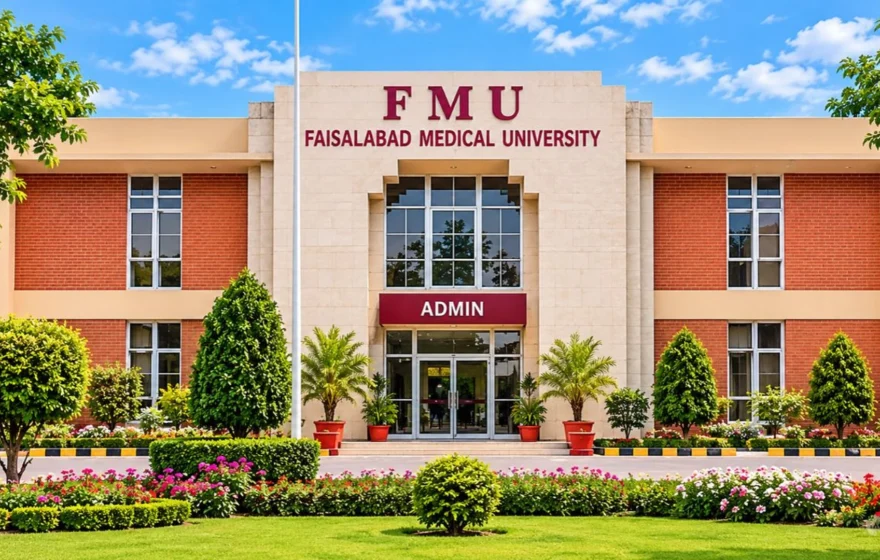
Faisalabad Medical University has opened admissions for the academic session 2026-27, offering 160 seats across eight undergraduate degree programmes in allied health sciences. Students who secured at least 40 percent marks in the latest Medical and Dental College Admission Test, known as MDCAT, can apply for the seats, which cover physiotherapy, vision sciences, laboratory technology, imaging, clinical psychology and other health disciplines that hospitals across Punjab need.
The university has announced 20 seats in each of the eight programmes, making for an even spread that gives applicants a real choice of field rather than forcing them all towards a single popular course. The programmes on offer are the Doctor of Physical Therapy, BS Vision Sciences, BS Medical Laboratory Technology, BS Radiography and Imaging Technology, BS Clinical Psychology, BS Theatre Technology, BS Renal Dialysis and BS Respiratory Therapy. The Doctor of Physical Therapy runs for five years, while the remaining seven programmes each run for four years. Applications must reach the university by December 20, 2026.
Available Degree Programs and Seats at Faisalabad Medical University
The eight programmes reflect the way modern hospitals actually work. A patient who arrives at a hospital will be seen by a doctor, but the diagnosis and the treatment will depend on a chain of other professionals: the laboratory technologist who runs the blood tests, the radiographer who takes the scan, the physiotherapist who guides recovery, the respiratory therapist who manages breathing support, and the dialysis technologist who keeps a kidney patient’s treatment on schedule. Each of these roles needs its own training, and each of the university’s programmes is built around one of them.
The inclusion of vision sciences and clinical psychology shows how the range of allied health work has widened. Eye care now involves trained vision scientists working alongside ophthalmologists, and hospitals increasingly need clinical psychologists as part of patient care. Theatre technology, which covers the skilled support work inside operating theatres, is another field where trained staff are in short supply. By offering all eight programmes together, the university is giving school leavers a route into health care that does not depend on winning one of the far fewer MBBS seats.
Eligibility Criteria for FMU Admissions 2026-27
The academic bar for admission is clear and applies equally to all eight programmes. Applicants must have passed FSc Pre-Medical, HSSC Pre-Medical or A-Level with at least 60 percent marks, and they must also have obtained a minimum of 40 percent marks in the latest MDCAT. Both male and female candidates can apply, and the university says selection will be strictly on merit, based on the admission requirements and the availability of seats. The 40 percent MDCAT threshold is the same standard used across medical and allied health admissions in Punjab, so students who have already sat the test will know where they stand.
That combination of requirements matters for applicants planning their next step. A student with strong intermediate marks but a weaker MDCAT score, or the reverse, needs to check both figures before applying, because meeting only one of the two conditions is not enough. The merit-based selection also means there is no shortcut: with 20 seats per programme, the competition will be decided by marks, not by influence.
Fee Structure for DPT and BS Programs
The university has published its fees in full, which lets families plan before they apply. Students selected for the Doctor of Physical Therapy programme will pay Rs. 125,000 per semester, while students admitted to any of the BS programmes will pay Rs. 40,000 per semester. There is also a university registration fee of Rs. 10,000 and an application fee of Rs. 2,000. The difference between the DPT and BS semester fees is substantial, and families weighing the five-year physiotherapy degree against a four-year BS programme will need to factor in both the higher per-semester cost and the extra year of study.
How to Apply for Faisalabad Medical University Admissions
The application process is paper-based and runs through the university itself. Interested candidates can obtain the prescribed application form from the university’s official website, and they must complete it with the required academic and personal information. Fee vouchers can be generated through the Fee Section of the university, and the application fee of Rs. 2,000 must be paid before the form is submitted. The completed form, together with the fee receipt and supporting documents, must be submitted to the Registrar Branch at Faisalabad Medical University. The university allows a candidate to apply under a maximum of three admission categories, but a separate application form must be submitted for each category.
The December 20 deadline leaves applicants about four weeks from the announcement to gather their documents, pay the fee and submit the form. That is enough time if they start promptly, but the paper submission means there is no last-minute online option, and forms sent late or incomplete are unlikely to be considered. Students should also keep a copy of everything they submit, including the fee receipt, because the Registrar Branch will need the original receipt with the application.
