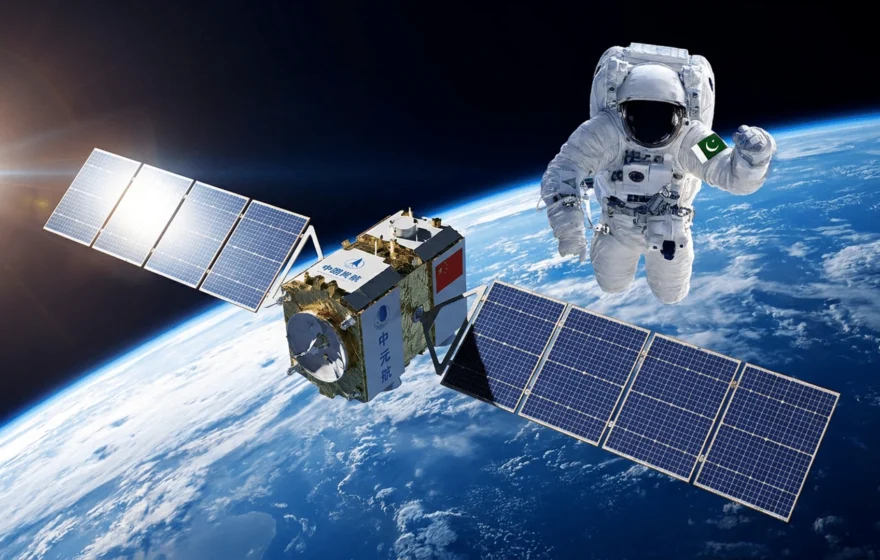
Pakistan is about to reach space in a way it never has before. A Pakistani astronaut will fly to China’s Tiangong space station aboard the Shenzhou-24 mission, becoming the first foreign national ever to visit the orbiting outpost. The China Manned Space Agency announced the plan on Saturday, November 7, confirming a moment that will put Pakistan on the map of human spaceflight.
The astronaut will travel as a payload specialist, the crew member responsible for the scientific experiments and equipment carried into orbit. The stay will be short, lasting only a few days, before the visitor returns to Earth aboard the Shenzhou-23 spacecraft, which docked at Tiangong in May. The Pakistani will go up in one spacecraft and come home in another. But the symbolism is straightforward. For the first time in the history of China’s crewed space programme, a mission will carry a foreign astronaut alongside its Chinese crew.
China has not yet said when the flight will lift off, nor has it named the astronaut who will fly. What it has said is that the mission is expected to take place before the end of the year. Pakistan’s planning minister, Ahsan Iqbal, told a ceremony in October that the flight would take place on November 25. The Chinese announcement did not confirm that date.
Two men are in line for the seat. Pilots Muhammad Zeeshan Ali and Khurram Daud were chosen as Pakistan’s first astronaut candidates in April, after a selection process that ran through three stages of screening and assessment. Both have spent months training at China’s astronaut training centre in Beijing, learning the systems of the Shenzhou spacecraft and the Tiangong station. One of them will fly. The other will stay on the ground as the backup, ready to step in if needed.
The seat comes from an agreement signed in Islamabad in February 2025, when Pakistan’s Space and Upper Atmosphere Research Commission, known as SUPARCO, and the China Manned Space Agency agreed to cooperate on selecting and training Pakistani astronauts. Under the deal, two Pakistanis would train in China and one would fly to Tiangong. Space is simply the newest frontier of a partnership built over decades, from the Karakoram Highway to the China-Pakistan Economic Corridor.
For Pakistan, the flight is the culmination of a space story that began more than sixty years ago. SUPARCO was set up in 1961. A year later, Pakistan launched its first sounding rocket, Rehbar-1, from Sonmiani. Progress after that was slow. Pakistan’s first satellite, Badr-1, did not fly until 1990, and for decades the country’s space programme worked quietly, building communications and Earth observation satellites while other nations grabbed the headlines.
The pace has quickened in the last few years. In May 2024, Pakistan’s first lunar satellite, ICUBE-Q, rode to the Moon aboard China’s Chang’e-6 mission, entering lunar orbit on May 8 and sending back images of the lunar surface. A year earlier, Namira Salim became the first Pakistani to reach space on a brief Virgin Galactic flight in October 2023. The Shenzhou-24 mission will be something else entirely: days in orbit, work to do, and a space station to live in.
That station is itself a remarkable achievement. Tiangong, whose name means Heavenly Palace, began operating in 2021 and was fully assembled in 2022, with three modules circling the Earth some 400 kilometres up. It is the only station built and run by a single country, and it exists partly because China was shut out of the International Space Station: since 2011, American law has barred NASA from working with Chinese space agencies, and China answered by building its own. Now, by inviting a Pakistani astronaut aboard, Beijing is showing that Tiangong is a platform it is willing to share with its partners.
Even the mission’s emblem carries a Pakistani touch. The newly unveiled Shenzhou-24 patch includes the jasmine, Pakistan’s national flower, woven into its design. It is a small detail, but it says this is being presented as a joint endeavour rather than a favour, a reminder that the person in the fourth seat is there as a representative of his country, not as a passenger.
There are still questions to answer. The experiments the Pakistani astronaut will carry out have not been published in full, and neither China nor Pakistan has said which of the two candidates will finally get the seat. The launch date, too, remains unconfirmed by Beijing, even if November 25 is the date circulating in Islamabad.
What is already clear is what the flight means. For Pakistan, it is a moment of national pride and a powerful message to a generation of young Pakistanis that the country’s scientists and pilots can work at the very edge of what human beings can do. For China, it is proof that Tiangong can be the centre of a different kind of space cooperation. And for the two countries together, it is the latest and most visible sign of a partnership that keeps finding new ground, this time four hundred kilometres above it.
