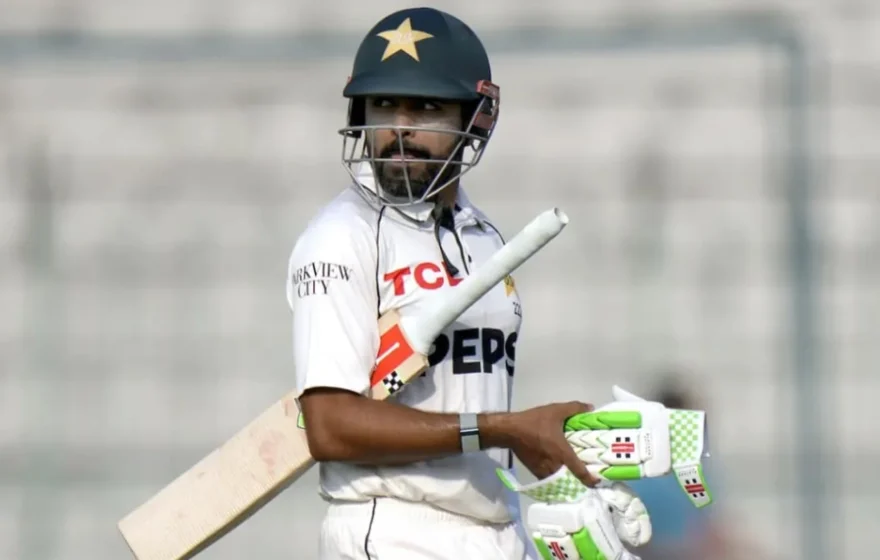
Pakistan wicketkeeper-batter Azam Khan has strongly criticised the behaviour of Babar Azam’s fans, describing some of them as toxic and uneducated after recalling the abusive messages he has received on social media. Speaking on the Backward Point Cricket Podcast, Azam said the hostility he faced had nothing to do with Babar’s batting and everything to do with a fan culture in which disagreement is answered with personal abuse.
Azam recalled an incident during Pakistan’s tour of Ireland, when he was batting alongside Babar, who was on around 75 runs, with Pakistan needing another 40 runs to win. While the match was still going on, a supporter commented on Azam’s Instagram picture, saying that his mother would die and his father would develop cancer if he prevented Babar from completing his century. Azam said he could not understand why any supporter would make such a remark over a cricket match, and he asked what kind of person wishes death on a player’s family for the sake of a hundred.
His criticism was aimed squarely at the supporters, not at Babar. There is nothing wrong with Babar and his game, Azam said, but his fan base is very toxic. He described Pakistani cricketers as having an uneducated fan base, and said that seeing the things people write leaves you wondering why anyone would say them. He repeated the distinction several times: his problem is with the behaviour of a section of the fans, not with the former captain.
Azam knows what he is talking about, because he has lived on the receiving end of it for years. The 28-year-old, son of former Pakistan wicketkeeper-batter Moin Khan, came into prominence in the Pakistan Super League as a power-hitter and wicketkeeper, and he was selected for the senior national side in 2021. He has played 14 Twenty20 internationals for Pakistan, scoring 88 runs, but his international career has been defined as much by the criticism he has attracted as by his cricket, particularly over his performances and his physical appearance.
The worst of it came during the 2024 T20 World Cup in the United States and the Caribbean, when Pakistan’s campaign fell apart and Azam became a target for the anger of fans. He played only one game in the tournament, the opening match against the United States, which Pakistan lost in a Super Over, and he faced just one ball. Yet he says everything was blamed on him, and he has spoken before about the fitness criticism that followed Pakistan’s defeat to India in the same tournament. It is the kind of scapegoating that social media makes easy, where one player becomes the symbol of a whole team’s failure.
The problem Azam described goes beyond his own experience. Analysts and commentators who offer measured criticism of a player’s form or technique receive abusive messages simply for doing their jobs, and discussions about players often turn into personal attacks instead of constructive debate. In Pakistan cricket, where loyalties to individual stars run deep, questioning a favourite player can feel like an insult to his supporters, and the response is frequently not an argument but an insult in return.
The controversy has arrived at a time when Babar himself is under pressure over his batting. During the one-day international tri-series involving Pakistan, England and Sri Lanka, the former captain scored 118 runs in five matches at an average of 23.60 and a strike rate of 74.21, without registering a half-century. The numbers have given his critics fresh material, and the debate around him has grown sharper, which is exactly the environment in which Azam says the abuse flourishes.
Azam, for his part, has never hidden his respect for Babar as a batter. He has previously acknowledged the former captain’s consistent performances between 2019 and 2021, when Babar was among the most reliable run-scorers in world cricket. Both players represented Pakistan at the 2024 T20 World Cup, and Azam’s complaint is not that Babar is beyond criticism, but that criticism of a cricketer should stay about cricket.
There is a wider question here about what fandom has become in the age of social media. Supporting a player once meant cheering from the stands and arguing with friends about team selection. Now it can mean following a player’s teammates to their personal accounts and sending abuse to their families, all from behind a screen. The players see these messages, and so do their parents, their wives and their children, and the damage is done long before anyone thinks to apologise.
Whether Azam’s words change anything remains to be seen. Cricketers have spoken out about online abuse before, and the abuse has continued, because the platforms reward outrage and the accounts sending it face few consequences. But a player who has endured it himself, and who is willing to name it plainly, has at least put the issue back on the table. The test now is whether fans, and the platforms they use, are willing to draw a line between loyalty to a player and cruelty to everyone around him.
