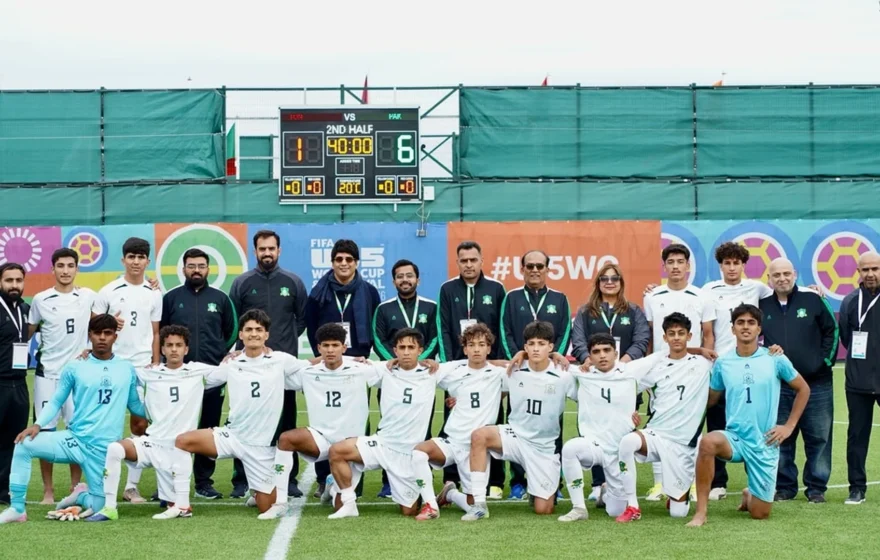
Pakistan’s under-15 football team has recorded a landmark victory at the FIFA U-15 World Cup and Festival 2026 in Azerbaijan, beating Tonga 6-1 in Baku thanks to a remarkable four-goal display from Kaleem Ullah. The result gave the young Shaheens their first win of the tournament and, in the words of the Pakistan Football Federation, made them the first Pakistani side ever to win a match on a FIFA World Cup stage.
The match did not start in Pakistan’s favour. Tonga went ahead in the sixth minute from the penalty spot, against the run of play. The lead lasted barely a minute. Kaleem Ullah converted a penalty of his own in the seventh minute, and Pakistan took control from there. He headed Pakistan in front in the 13th minute after a cross from the right, then completed his hat-trick with another penalty in first-half stoppage time. After the break he rose at the far post to head home a kick-in from the left for his fourth goal. Maqbool Ahmed added a fifth with a powerful strike from distance, and Muhammad Mustafa finished the scoring after an attacking move down the left.
Pakistan Football Federation president Syed Mohsen Gilani watched the match in Baku and congratulated the players afterwards. He praised the coaching staff and team management for preparing the squad for an occasion of this size, and spoke about the value of international exposure for young Pakistani footballers. Players of this age improve fastest when tested against opponents from different footballing cultures, and a first win on this stage gives that argument something concrete to stand on.
The victory was also a reward for patience, because Pakistan’s start had been difficult. The team opened with a 4-2 defeat to Gambia on October 24, then lost 1-0 to South Sudan and 4-0 to Cyprus. The mood changed on Monday, when Pakistan held both Jordan and Nigeria to 1-1 draws. Kaleem Ullah scored in both games, in the 27th minute against Jordan and in the 22nd minute against Nigeria, and those draws brought Pakistan its first two points. After three defeats and two draws, the win over Tonga ended a five-match wait for a victory and gave the campaign real momentum.
Part of what makes this tournament different is its design. The FIFA U-15 World Cup and Festival is a new event, and Azerbaijan is hosting its first edition, with matches mainly at the Hovsan Competition Complex in Baku and the finals at Baku Crystal Hall. Games are played eight-a-side over two 20-minute halves on a smaller pitch, with kick-ins instead of throw-ins and rolling substitutions. There is no traditional knockout draw in which one defeat ends a team’s tournament. Instead, opening-phase results place teams into six performance tiers, and every side keeps playing to the final day, with the top-tier winner crowned overall champion. Close to 1,000 matches were scheduled, making it one of the largest youth gatherings FIFA has ever staged.
Pakistan arrived in Baku as newcomers. Head coach Ihsanullah Khan selected a 14-member squad, and the team was among dozens of associations appearing at a FIFA global competition for the first time. That inexperience showed early, when the side conceded goals in bursts against sharper opponents. The draws against Jordan and Nigeria suggested the players were learning quickly, and by the time they faced Tonga they looked like a team that understood what the tournament demanded.
The wider meaning of the win should not be overstated, nor dismissed. One victory at under-15 level does not repair the deeper problems of Pakistani football, which has long struggled with organisation, funding and a shortage of regular competitive matches for young players. What it does provide is public evidence, on a global stage, that Pakistani teenagers can compete, score freely and handle pressure when given proper preparation and a run of games. For coaches and administrators back home, it is a reminder that youth investment produces visible returns, even if those returns arrive one age group at a time.
Events since the Tonga match have kept the story moving. Pakistan’s next outing ended goalless against Nepal before Nepal won the penalty shoot-out 4-3, a reminder that progress at this level rarely follows a straight line. The team responded by beating the Bahamas 5-0, with Kaleem Ullah and Maqbool Ahmed scoring twice each, and then thrashed the Cook Islands 7-1 to reach the Tier F final against Djibouti. That sequence captures this squad’s character: they can recover from disappointment, and finish chances when on top.
Whatever happens in the final, the Tonga game will define this campaign. It was the afternoon when Pakistan stopped chasing its first win and started playing like a team that expected to win. But the wider picture matters just as much: a first appearance at a FIFA World Cup event, a first victory on that stage, and school-age players returning home with experience no training session could give them. If Pakistani football builds on that experience rather than treating it as a one-off celebration, this week in Baku may be remembered as a starting point rather than a curiosity.
