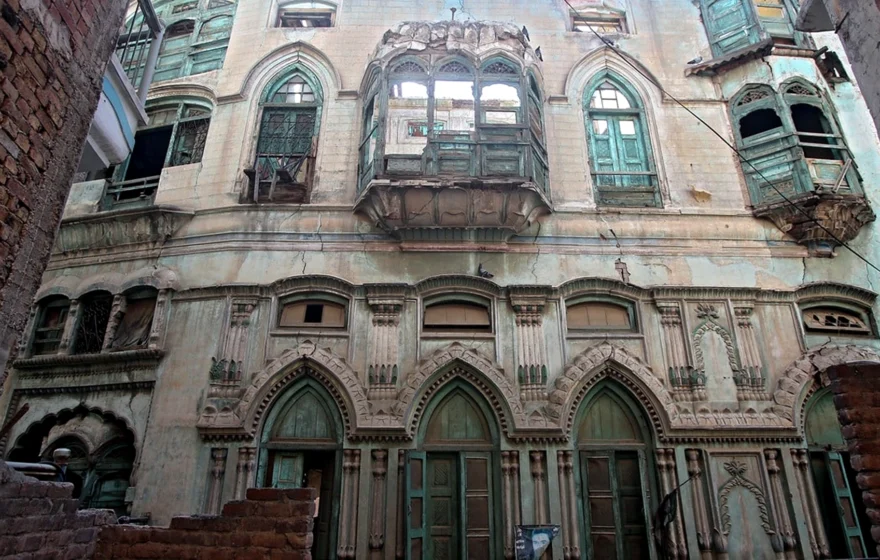
Khyber Pakhtunkhwa Governor Faisal Karim Kundi has ordered officials to begin restoring the ancestral homes of two of cinema’s greatest names, Dilip Kumar and Raj Kapoor, in Peshawar as soon as possible. The instruction, given during a meeting on the city’s historical landmarks and tourist attractions, puts fresh momentum behind a preservation effort that has been discussed for years but has repeatedly stalled before work on the ground could make a lasting difference.
The meeting reviewed the state of Peshawar’s heritage sites and the facilities available to visitors, and the governor pressed for faster progress on both fronts. He called for heritage preservation to move at a quicker pace and for better arrangements for the people who come to see the city’s old neighbourhoods, monuments and museums. The message from the governor’s office was straightforward: these buildings are part of Peshawar’s identity, and they should be treated as assets to be protected rather than as problems to be managed from one meeting to the next.
Adviser for Development and Planning Usman Saifullah, Tourism Secretary Saadat Hassan and other relevant officials attended the meeting.
Governor Kundi said Peshawar represented centuries of history, civilisation and culture, and he emphasised the need to highlight the city’s historical identity in order to attract domestic and international tourists.
To improve access to historical landmarks, the governor called for the introduction of special tourist buses. He also directed officials to display the vintage ambulance and old fire engines preserved at Gor Khatri at a suitable location where visitors could see them.
In addition, Governor Kundi ordered the installation of large information boards near the Peshawar Motorway Toll Plaza to introduce visitors to the city’s historical sites and cultural attractions. The idea is that travellers arriving by road should learn, before they even reach the old city, what Peshawar has to offer and where to go first.
He also stressed the importance of cultural activities in preserving Peshawar’s traditions, arts and literary heritage. Welcoming the preservation efforts already under way, the governor said restoring historical landmarks and improving tourist facilities would help strengthen Peshawar’s cultural identity, a point that goes to the heart of why this project matters to residents as much as to tourists.
The two houses at the centre of the announcement stand in the historic Qissa Khwani Bazaar, the old Storytellers’ Bazaar, where merchants and travellers once gathered and where the families of both actors lived before Partition. The Kapoor Haveli, in the Dhaki Nalbandi area of the bazaar, was built by Dewan Basheswarnath Kapoor between 1918 and 1922, and Raj Kapoor was born there. Dilip Kumar, born Yusuf Khan in Peshawar in 1922, grew up in a house in the Mohallah Khudadad area of the same old city, and he went on to become one of the most respected actors of his generation.
Both families left Peshawar around the time of Partition in 1947, and the houses they left behind became symbols of a shared cultural history that crosses the border between Pakistan and India.
The houses were declared national heritage sites years ago, and the Khyber Pakhtunkhwa government has at various times announced plans to buy them, restore them and turn them into museums dedicated to the lives and work of the two actors. In July 2025, officials confirmed a restoration project with a budget of around seventy million rupees, expected to take about two years, under the province’s Directorate of Archaeology and Museums, with the aim of returning the buildings to their original architecture.
That history of delay is what makes the governor’s latest directive worth watching closely. A direction to begin work as soon as possible is welcome, but its value will be judged by what happens next on the ground: whether conservation teams are appointed, whether funds are released on time, and whether the restoration follows proper heritage practice instead of a hurried facelift.
For now, the announcement signals that the provincial leadership wants heritage to be part of Peshawar’s future, not only its past. Special tourist buses, information boards at the motorway toll plaza, better displays at Gor Khatri and a renewed push on cultural activities all point in the same direction: a city that presents its history with confidence and care. The practical test will come in the weeks ahead, when residents and heritage lovers look for conservation teams on site, scaffolding around the old houses and a clear timetable for the work. Peshawar’s old city has survived centuries of change, and its bazaars still draw traders, visitors and storytellers every day. Giving two of its most famous houses a proper future would honour that living tradition as well as the two actors who began their journeys there, and it would give the city a heritage trail worth walking, from Qissa Khwani Bazaar to Gor Khatri and beyond.
