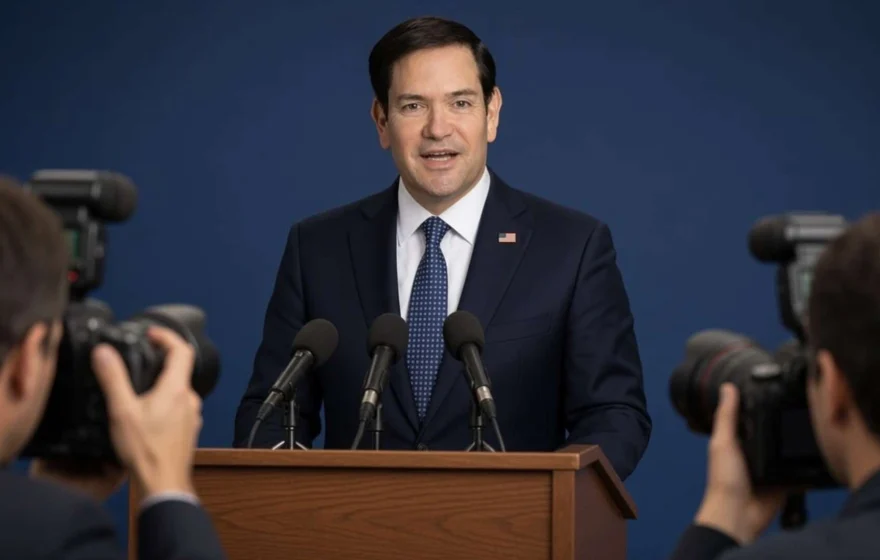
The United States has backed Pakistan’s position on cross-border terrorism. Secretary of State Marco Rubio said Washington does not want Pakistan to suffer attacks launched from Afghan soil. His remarks give Islamabad’s complaint a clear endorsement, though they stop short of promising any new American action.
Rubio spoke on October 31 at a press briefing after the G20 Foreign Ministers’ Meeting in Atlanta, Georgia. He was answering a question about the worsening friction between Pakistan and the Taliban government in Afghanistan. His answer was measured, but its direction was clear: Pakistan’s concern was heard and shared.
What Rubio Said About Pakistan and the Taliban
The question noted that Russia had stepped in to try to mediate between Islamabad and Kabul, and asked how Washington viewed the tensions. Rubio set out Pakistan’s case in plain terms. He said Pakistan believed terrorist attacks against it were being sponsored from Afghan territory, and that the Taliban had not done enough to restrain them. Pakistan, he noted, had itself taken action in response.
He then made the American position explicit. Washington had heard Pakistan’s concerns, he said, and did not want Pakistan to be targeted by terrorism. If there was a useful part for the United States to play, it would play it. At the same time, he was candid about the limits of American influence, noting that Washington did not have the closest of relationships with the Taliban government.
Rubio closed with a broader principle, saying the United States had seen some of the attacks Pakistan pointed to and opposed terrorism wherever it came from. Taken together, his words amount to political backing for Islamabad, delivered by America’s most senior diplomat on a global stage. They do not, however, amount to a pledge of military help, mediation, or any other specific step.
Why This Matters for Pakistan
The significance of the remarks lies less in what they promise than in what they confirm. For over a year, Pakistan has argued that the banned Tehreek-e-Taliban Pakistan, along with other armed groups, uses Afghan territory as a base for attacks inside Pakistan. That argument is central to Islamabad’s security policy and to its dealings with Kabul.
Hearing the same argument echoed by the United States Secretary of State therefore matters. It puts Pakistan’s case on the record from a voice that carries weight far beyond South Asia. It also places the Taliban government under international scrutiny, since the complaint is now being acknowledged by a major power that says it has seen evidence of the attacks.
Yet the limits of the statement are just as important as its support. Rubio offered help only if Washington could play a productive part, and he admitted American ties with the Taliban are thin. There was no new initiative, no timetable, and no indication of what form any involvement might take. For Pakistan, this is diplomatic encouragement rather than a turning point.
The timing also deserves attention. The remarks came less than a week after Rubio had said the United States wanted greater influence over Pakistan, suggesting Islamabad had climbed higher on Washington’s agenda. Read together, the two statements point to an America paying closer attention to Pakistan, and seeing it as a partner worth engaging.
Where Pakistan-Afghanistan Talks Stand
The backdrop is a long and frustrating round of diplomacy that has so far failed to settle the core dispute. Several countries have tried to calm tensions between Islamabad and Kabul, and each effort has run into the same obstacle: armed groups operating from Afghan territory.
Qatar and Turkiye brokered a ceasefire in Doha last October, raising hopes of a lasting understanding. Those hopes faded when follow-up talks in Istanbul collapsed the following month. Saudi Arabia also hosted discussions, and China held talks in Urumqi in April this year. None of these efforts resolved the central disagreement.
On the ground, the situation has remained tense. Earlier this year, Pakistan paused its Operation Ghazab lil-Haq against Afghanistan, suggesting some willingness to give diplomacy room. Cross-border strikes have continued since then, however. After an attack in Kohat on September 18, Pakistan struck Afghan territory on September 24 and again on October 1.
Russia, the only country to have formally recognised the Taliban government, has offered to help mediate if both sides ask. That offer has not yet produced a breakthrough. The Moscow Format meeting on Afghanistan on October 5 ended without a joint statement, because the two delegations could not agree on wording about terrorist networks.
Pakistan, for its part, has said it is not shying away from dialogue, but that talks will not be unconditional. It wants a negotiated way out, but not talks for their own sake while attacks continue. Rubio’s offer adds another possible channel. Whether Washington takes it up, and whether Kabul responds, will shape what happens next.
For now, the picture is one of cautious movement rather than resolution. Pakistan has gained a public endorsement from the United States, the Taliban government faces a reminder that its handling of militant groups is being watched beyond the region, and the diplomatic track remains open but unproven.
