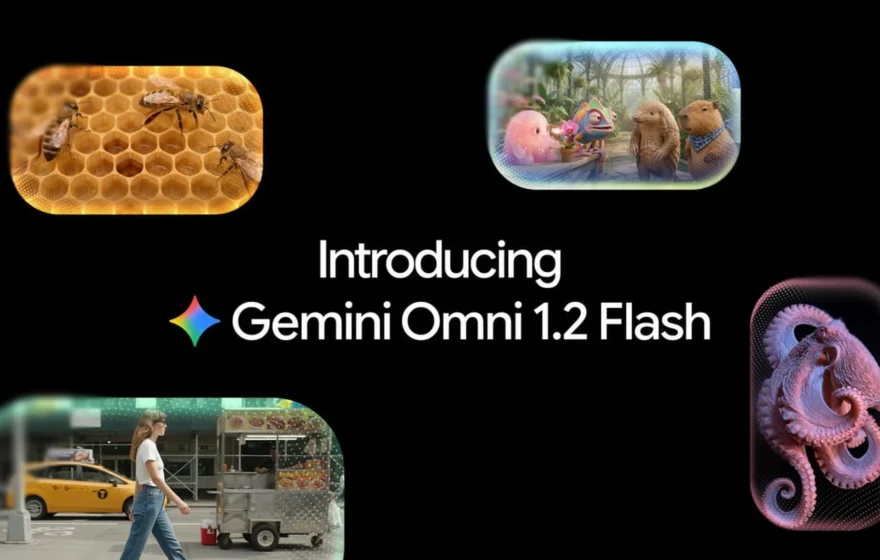
Google has launched Gemini Omni 1.2 Flash, a new AI video model that makes clips of up to fifteen seconds, edits existing footage through plain conversation and keeps characters and scenes far more consistent from one shot to the next. It is now generally available through the Gemini API and Gemini for business, and video generation costs thirty percent less than with the previous version.
The launch matters because short clips and high prices have held AI video back. A ten-second ceiling forced anyone making an advert, a product demonstration or a short explainer to stitch fragments together, while per-second pricing made longer experiments expensive. Longer clips at a lower price turn the tool from a novelty into something small businesses and independent creators can afford to use.
Gemini Omni 1.2 Flash Specifications
At its core, the model turns text prompts and reference images into moving video. Clips run from three to fifteen seconds, adjusted in one-second steps, so a creator can ask for exactly the length a scene needs. Drafts are produced at 360p or 720p, and the finished result can be upscaled to 1080p or 4K.
The model also accepts several kinds of reference material at once: photographs of people, pictures of products, style examples and motion clips of up to three seconds, so movement can be borrowed from one subject and applied to another. Sound is built in as well, with dialogue, several voices and lip movements matched to the words. Camera work can be directed with flythroughs, zoom-outs and orbits, and every clip carries an invisible SynthID watermark.
What Has Improved Over Gemini Omni 1.1 Flash
The most obvious change is length. The earlier Gemini Omni 1.1 Flash stopped at ten seconds; the new model runs to fifteen, which gives a scene room to breathe. Google says faces, clothing, product packaging, printed text and colours now hold together far better while people move and the camera changes position.
Editing is the other big step forward. Instead of starting again whenever something is wrong, a user can change the background, swap a product, alter the lighting or the weather, or switch the shape of the frame simply by describing the change in a follow-up message, and the model reworks the existing clip rather than generating a fresh one. Google showed the idea with a virtual try-on, where a photograph of a model combined with several clothing images produced a video of the same person in different outfits.
Gemini Omni 1.2 Flash Pricing
The price cut is straightforward. Generating video at 720p now costs seven cents per second through the API, down from ten cents. That puts a three-second clip at twenty-one cents and a ten-second clip at seventy cents, while the new twelve- and fifteen-second lengths cost eighty-four cents and one dollar and five cents.
Those figures cover generation at 720p only, and any separate upscaling charges sit outside them, but the direction is clear. Users can also start with a low-resolution draft before deciding whether a clip is worth finishing at full quality, and because follow-up edits rework a clip instead of rebuilding it, fewer wasted generations mean lower bills.
Better Speech, Motion and Video Consistency
Sound and movement have received as much attention as price. The model can generate conversations between several characters, match a different voice to each one and keep the timing natural, with lip movements that follow the words. Complex camera moves are handled more smoothly too, with fewer unwanted cuts and less visual drift.
Google demonstrated the range with a fifteen-second animated conversation built from four references, a science explainer with moving text labels, and a sequence that transferred the movement of an animated octopus to a dancer. Google is candid, though, that the model still struggles with fast sports action, rapid changes of scene and complicated physics.
Where Gemini Omni 1.2 Flash Is Available
The model is generally available now through the Gemini API and Gemini for business, with developer access through Google AI Studio and enterprise support through Google Cloud. It is also spreading into Google’s own products: Google Vids gives users up to three free fifteen-second videos a month, Flow gains video generation and conversational editing, and the Gemini app is rolling the model out to Google AI Ultra subscribers.
Google Ads will use it to help advertisers build video campaigns, and the model is also reaching creative software, with an integration into Adobe Firefly announced, a demonstration inside Figma Weave and support for creative workflows in Magnific. Early users include Adobe, Monks, Whering, Figma, Magnific, Resemble AI and STAN, which suggests Google is aiming as much at professional studios and marketing teams as at individual creators.
Taken together, the release points in a clear direction. Longer clips, lower prices and the ability to fix a video by talking to the model attack the practical reasons people have held back from AI video. The remaining weaknesses are real, but for adverts, explainers and social clips, fifteen seconds at seven cents a second is now cheap enough to try, and consistent enough to use.
