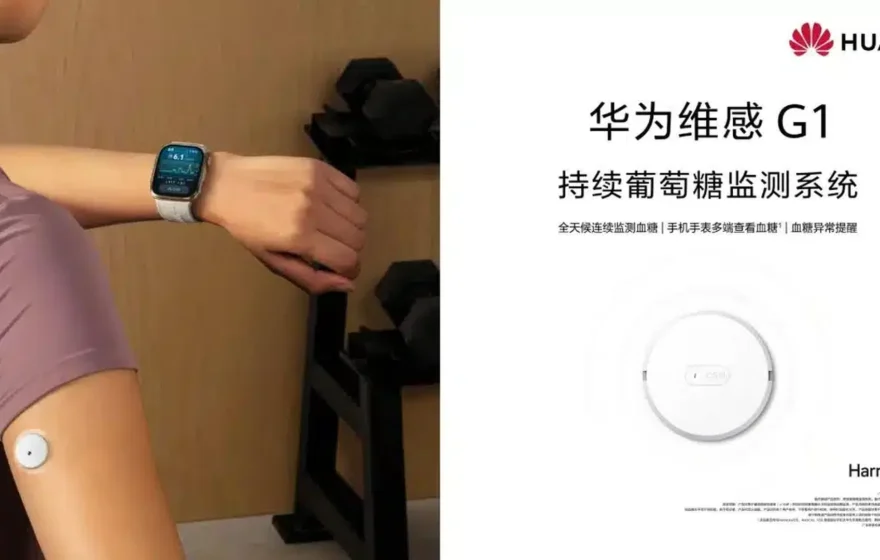
Huawei has unveiled the Sense G1, its first continuous glucose monitor, in China. The small round sensor sticks to the upper arm and tracks glucose day and night for up to 16 days, sending an alert when a reading moves outside a set range, with results shown on a compatible phone or smartwatch.
The launch takes Huawei beyond the wrist. For years the company has built its health story around smartwatches that track heart rate, sleep, stress and blood oxygen. A dedicated glucose sensor is a different kind of commitment, moving Huawei from estimating health risk to measuring a live medical signal and challenging the specialist firms that have dominated glucose monitoring for a decade.
How It Works
The Sense G1 looks unremarkable, a small white disc about the size of an Apple AirTag. Beneath the skin, a thin flexible probe sits in the fluid around the body’s cells, where it uses an enzyme called glucose oxidase and a pair of electrodes to measure glucose continuously. There is no finger prick for each reading, because the sensor talks straight to the phone or watch. Huawei says each sensor is meant for one person only and needs no manual calibration.
The sensor keeps recording through the night as well as the day, building a full picture of how glucose rises and falls after meals, during exercise and while sleeping. That overnight record often shows patterns that daytime finger-prick tests miss.
How Accurate Is It?
Accuracy is where any glucose sensor is judged, and here the picture is still incomplete. Early reports cite a tipster putting the Sense G1’s mean absolute relative difference, known as MARD, below 10 percent. MARD measures how closely sensor readings match laboratory reference values; lower means closer agreement. The same tipster said readings could lag behind real changes in blood glucose by about five to 15 minutes. Huawei has confirmed neither figure, so both remain unconfirmed.
The lag would not be unusual. Every continuous monitor reads glucose in the fluid between cells rather than in the blood, and that fluid takes a few minutes to catch up when blood sugar moves quickly. What matters is how large the gap is in practice, and whether the sensor stays reliable during rapid swings.
For comparison, the two best-known sensors today sit in a similar band. The Dexcom G7 records an overall MARD of around 8.2 percent in its own studies and is worn for 10 days, with a newer 15-day version also available. Abbott’s FreeStyle Libre 3 lasts 14 days and reports a MARD of about 7.9 percent. If Huawei’s claim holds up in independent testing, the Sense G1 would sit close to those rivals, and its 16-day wear time would edge past both by a day.
China Clears the Sensor
The Sense G1 has already passed an important test at home. China’s National Medical Products Administration has registered it as a Class III medical device, the country’s highest risk category. It is the first Class III registration for Huawei’s consumer hardware business.
The approval follows a long development run. Huawei consumer business CTO Li Xiaolong said the Sense G1 had the longest development cycle of any product his team had worked on, and he first wore a test unit in December 2023, about 35 months before the unveiling. Huawei introduced its TruSense monitoring system in 2024, and some of its recent smartwatches can already assess diabetes risk. Those watches do not measure blood sugar directly. Its Watch GT 6 Pro offers a diabetes risk assessment from wrist sensors over three to 14 days, a screening aid rather than a diagnosis, while the Sense G1 measures glucose itself through a probe beneath the skin.
Price and Release Date
Huawei has not yet announced a price or a sale date. As consumables replaced every week or two, the cost of each sensor matters most. A 16-day wear time helps, because fewer sensors are needed across a year, but only if the price per sensor stays within reach of the established brands. The company could share more at an event expected late in November, where it may also introduce the Mate X8 foldable phone and the MateBook Fold S.
The timing is striking. The announcement comes on World Diabetes Day, 14 November, and Pakistan carries one of the heaviest diabetes burdens in the world. The International Diabetes Federation estimates 34.5 million adults in Pakistan were living with diabetes in 2024, a prevalence of 31.4 percent, the highest of any country, with about 9.3 million undiagnosed. It projects about 70 million by 2050 without stronger prevention. In a country where a third of adults are affected, a longer-wearing, simpler sensor could matter, but only if it arrives at a price people can afford and with the accuracy its early claims suggest.
For now, the Sense G1 is a promising first step rather than a finished story. Huawei has shown it can build the hardware, win the toughest level of Chinese medical registration and keep a sensor running for more than two weeks. The next test is harder: independent accuracy data, an everyday price, and a launch beyond China.
