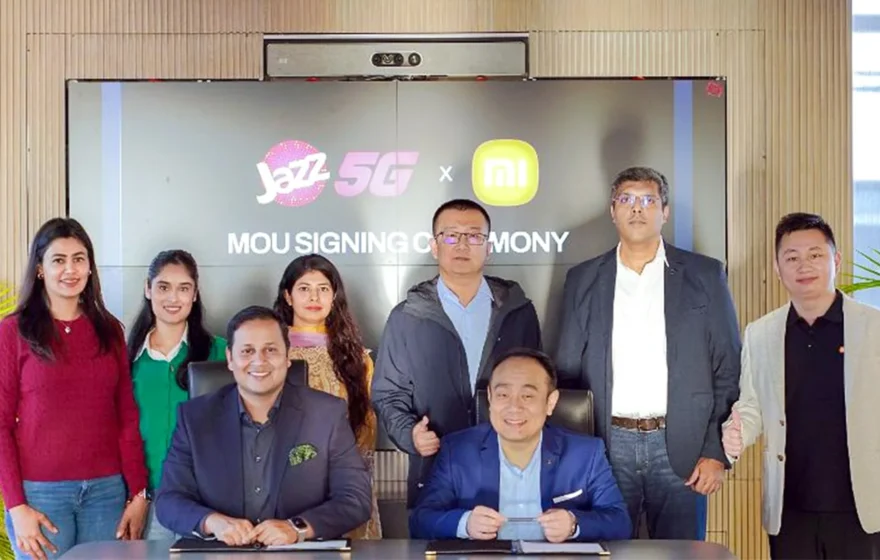
Jazz has teamed up with Xiaomi Pakistan to bring an affordable 5G smartphone to the country, pairing the launch of the new REDMI 17 5G with payment plans that spread the upfront cost. The agreement, signed as a memorandum of understanding, targets the one obstacle that has held back Pakistan’s 5G story: many people now live within reach of a 5G signal, but far fewer own a phone that can use it.
The REDMI 17 5G is built for everyday use rather than flagship glamour. It runs on Qualcomm’s Snapdragon 4 Gen 5 processor, with a large 6.9-inch display, a 50-megapixel AI camera and a 7,500mAh battery with 45W fast charging. Priced at Rs 72,999 in Pakistan, it sits in the mid-range bracket where most buyers actually shop, rather than the premium tier where 5G phones first appeared.
What sets this launch apart is how Jazz is selling the phone. Buyers can pay in full, or spread the cost through a Buy Now, Pay Later plan, subject to eligibility checks and the usual charges and conditions. Jazz Postpay customers can take it in twelve monthly instalments, and credit card holders can order through Jazz E-stores and experience centres. For a household weighing a new phone against school fees or rent, paying in parts rather than all at once can decide whether to upgrade now or wait another year.
Asad Maqbool, who heads consumer growth at Jazz GSM, said expanding 5G coverage is only half the job, and that affordable handsets matter just as much if more Pakistanis are to benefit from the new network. He said the partnership adds another option to Jazz’s device range, with payment plans meant to ease the cost of switching to 5G. Brain Shawn, Xiaomi Pakistan’s country manager, said the deal pairs Xiaomi’s focus on feature-rich phones at accessible prices with Jazz’s growing network, and that the two companies want the REDMI 17 5G to give Pakistani buyers a powerful, reliable phone.
The timing is no accident. Pakistan’s 5G era began this year, when the Pakistan Telecommunication Authority auctioned 480 megahertz of spectrum on 10 March 2026 for around 507 million dollars. Jazz won the largest share, 190 megahertz, and switched on 5G on 19 and 20 March with about 180 live sites in Islamabad, the four provincial capitals and other large cities. By late October the IT minister told parliament the country had 1,782 live 5G sites across 24 cities and about 1.8 million users, with Jazz accounting for 1,015 sites, ahead of Zong on 640 and Ufone on 127. Jazz now says it has passed 1,200 sites.
That growth has exposed a gap no tower building can close. A 5G network is little use to someone whose phone only supports 4G, and the first 5G handsets in Pakistan were priced beyond most buyers. Operators have answered by competing on devices as well as coverage, and Xiaomi is now central to that contest. Hours before the Jazz announcement, Zong unveiled its own deal with Xiaomi around the same REDMI 17 5G, so the two largest networks are pushing the same affordable handset through their own stores. For buyers that rivalry should mean better deals; for the operators it is a race to turn costly spectrum into paying customers.
Jazz enters that race from strength. It is Pakistan’s largest operator, with about 76 million subscribers as of September 2026, including 59 million on 4G, and a market share near 36 percent. The VEON-owned company has remade itself from a traditional network into a digital services business built on the JazzWorld app and JazzCash, its mobile money service with more than 58 million registered customers. A customer who already pays bills and sends money through Jazz’s apps is a natural candidate for a phone instalment plan. Xiaomi has built its name in Pakistan on capable phones priced below the big global brands, and the Redmi line has long been the default for buyers who want a big screen, a big battery and a decent camera without flagship money.
Questions remain. The companies have not said how many phones they expect to sell, what the instalments will be, or who will qualify for Buy Now, Pay Later. Those details will decide whether the scheme reaches the people it targets or stays limited to salaried postpay customers with strong credit records. The eligibility rules, charges and conditions will matter as much as the headline price, and buyers should read them before signing up.
Even so, the direction is clear. The rollout has moved faster than many expected in its first eight months, but the next phase will be decided in shops and living rooms, not auction halls. If operators can put a capable 5G phone in buyers’ hands at a manageable price, the network they spent hundreds of millions of dollars building will start to pay for itself, and faster connectivity will reach beyond the early adopters in the big cities. The Jazz and Xiaomi deal is a step that way, and if the payment plans work as promised, it will not be the last of its kind.
