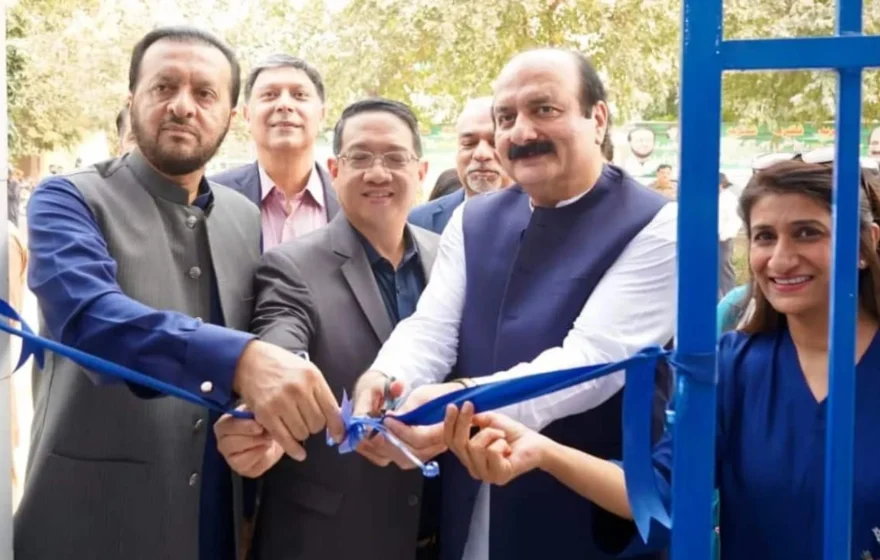
Residents of Gulshan-e-Ravi in Lahore have a new source of clean drinking water after Nestlé Pakistan opened its eleventh Clean and Safe Drinking Water Facility in the neighbourhood, a project the company says will serve around ten thousand people every day. The facility was formally inaugurated by Rana Mashhood Ahmad Khan, Chairman of the Prime Minister’s Youth Programme, alongside Jason Avanceña, the Chief Executive Officer and Managing Director of Nestlé Pakistan, at a ceremony held in the area on Monday.
The new plant joins a network the company has built over the years around its factories, milk collection centres and raw material sourcing areas. Nestlé Pakistan already runs ten such facilities, each supplying clean water to more than ten thousand people a day, so the network now reaches well over one hundred thousand people daily. For families nearby, the difference is immediate: water they can drink without fear of falling ill, close to home rather than fetched from distant or unreliable sources.
Speaking at the inauguration, Rana Mashhood said access to clean and safe drinking water was fundamental to the wellbeing of communities. He praised Nestlé Pakistan for supporting neighbourhoods through projects that improve access to safe water, calling the new facility a remarkable contribution and expressing hope that people would truly benefit from it. His presence also underlined the government’s interest in seeing private companies help solve a public problem the state alone has struggled to fix.
Jason Avanceña said water was a shared resource at the heart of thriving communities and a sustainable future, and called the opening another step in the company’s efforts to make a positive difference to families, communities and the planet through what Nestlé calls Creating Shared Value, the idea that a business should create value for society as well as for itself. Sheikh Waqar Ahmad, Head of Corporate Affairs and Sustainability for Nestlé in Pakistan and Afghanistan, added that the company’s work went beyond its own operations and that it remained committed to addressing local water needs.
The plant uses advanced ultrafiltration and a multistage process of sedimentation, filtration and disinfection, removing contaminants and pathogens before the water reaches the tap. That matters in Lahore, where groundwater is often polluted by sewage, industrial waste and agricultural chemicals, and where many households cannot tell whether the water they drink is safe.
The Gulshan-e-Ravi facility is part of Nestlé’s flagship Caring for Water-Pakistan initiative, launched in 2017 and built around three areas: its factories, the communities around them, and agriculture. In 2017, Nestlé Pakistan’s Sheikhupura factory became the first site in Pakistan, and the first Nestlé site anywhere in the world, to earn certification under the Alliance for Water Stewardship standard. The company also reports saving more than fifty thousand cubic metres of water across its factories in 2025 through recycling and reuse, and its water education programme reached forty thousand children and four hundred and fifty teachers in schools during the year. The ninth facility opened in Karachi’s Port Qasim area in December 2024, and a tenth followed in 2025, before the Lahore opening took the total to eleven.
The need for such projects is hard to overstate. According to the Pakistan Council of Research in Water Resources, only forty-seven per cent of Pakistanis currently have access to safe drinking water, up from thirty-nine per cent in 2022 but still far short of the United Nations goal of universal access by 2030. Figures cited from UNICEF suggest that nearly seventy per cent of households consume contaminated water, and that between thirty and forty per cent of diseases in the country, including diarrhoea, hepatitis and typhoid, are linked to unsafe water. The same research warns that unsafe water causes around fifty-three thousand child deaths every year. Per capita freshwater availability has fallen from more than five thousand cubic metres in 1951 to below one thousand cubic metres in 2024, placing the country firmly in the water-scarce category.
Against that background, a single facility serving ten thousand people a day cannot transform the national picture on its own, and nobody at the inauguration claimed that it would. What it can do is change daily life for one neighbourhood, and it shows a model that could be repeated. The partnership on display in Gulshan-e-Ravi points to the kind of cooperation Pakistan will need if the larger crisis is to be addressed: the state sets standards and reaches places companies cannot, while businesses bring funding, technology and the discipline of maintaining a plant day after day. Nestlé says it maintains its facilities under strict quality checks, and that long-term commitment matters as much as the opening ceremony, because a water plant that breaks down within a year helps nobody.
For now, the people of Gulshan-e-Ravi have clean water flowing from a new plant in their own neighbourhood, opened with the backing of a government youth programme and one of the country’s largest food companies. It is a small step in a very large crisis, but it is a real one, and for the families who will fill their containers there each morning, it is the kind that matters most.
