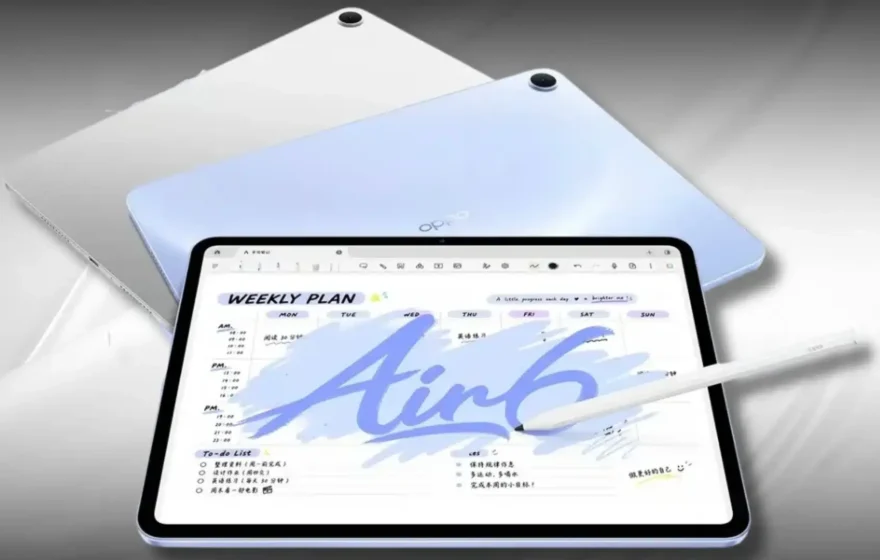
Oppo has taken the covers off its next mid-range tablet, the Pad Air6, just days before its formal launch in China on November 16. The company has revealed the full specification sheet while holding back its price, leaving the most important detail for launch day itself. The tablet will arrive alongside the Reno17 smartphone series. The Pad Air6 succeeds the Pad Air5, which reached China on December 25 last year and later went on sale around the world as the Oppo Pad 5. That earlier model started at roughly 270 dollars for its base Wi-Fi version, and Oppo appears to be following the same playbook this time.
Display and Design
The tablet carries a 12.1-inch LCD panel with a resolution of 2,800 by 1,980 pixels, a 14:10 aspect ratio and a refresh rate of 120Hz. The screen reaches 600 nits of brightness in normal use and peaks at 900 nits, while colour coverage stands at 100 per cent of the sRGB gamut in Natural mode and 98 per cent of DCI-P3 in Vivid mode. On paper, that is a strong screen for watching films, reading and sketching, and it matches the panel on the Pad Air5 almost exactly.
Oppo is offering the display in two forms. The standard version sits alongside a Matte Display option with an anti-reflective coating that cuts down glare, a useful touch for students and office workers who spend long hours under bright lights. The tablet also supports an optional stylus, which makes it a plausible note-taking and drawing device rather than a pure media machine.
The body itself has grown a fraction. At 6.89 millimetres thick and 603 grams, the Pad Air6 is marginally thicker and heavier than the Pad Air5, which measured 6.83 millimetres and 597 grams. The difference is small enough that most people would never notice it in the hand. Buyers will be able to choose between Starlight Silver and Encounter Blue.
Performance and Storage
Under the screen sits the biggest change: MediaTek’s Dimensity 7360 Super processor, a newer variant of the Dimensity 7300 Ultra that powered the Pad Air5. The same chip family already appears in Oppo phones such as the F35, the F35 Pro and the K14 Plus, which suggests it is a proven mid-range performer rather than an untested part.
Memory options are generous for the price bracket. The tablet ships with 8GB or 12GB of LPDDR5X RAM running at 4,266MHz, paired with 128GB or 256GB of UFS 3.1 storage. That is enough for heavy multitasking, large games and offline video libraries, although there is no mention of a microSD slot for expansion. As before, Oppo will sell both Wi-Fi and 5G versions, with the cellular model aimed at buyers who want to stay connected away from home.
Cameras and Connectivity
Tablets are rarely bought for their cameras, and Oppo has not tried to change that. The Pad Air6 carries two 8-megapixel cameras, one on the front and one on the back, and both record video at 1080p and 30 frames per second. That is adequate for video calls and the occasional document scan, but nobody should expect it to replace a phone camera.
Connectivity is solid for a mid-range device. Wi-Fi 6 handles wireless networking, Bluetooth 5.0 covers accessories and supports both aptX HD and LDAC for higher-quality wireless audio, and a USB-C 2.0 port takes care of charging and data. Four speakers and two microphones round out the package, which should make the tablet a capable device for films, online classes and video meetings.
Battery and Charging
Battery life remains one of the tablet’s strongest selling points. The 10,050mAh cell is identical in capacity to the one in the Pad Air5, and with the same screen and a similar chip, real-world endurance should be much the same. A battery of this size in a tablet of this class typically stretches across several days of light use or a full day of heavy streaming and work. Charging is handled at 33W through SuperVOOC, with support for the UFCS and PPS standards as well.
Price and Availability
Oppo has not announced pricing for the Pad Air6, and that silence is deliberate. The Pad Air5 started at about 285 dollars for the 8GB and 128GB Wi-Fi model.
If Oppo follows that pattern, the Pad Air6 should land in a similar band, which would put it in direct competition with mid-range tablets from Xiaomi, Lenovo and Samsung. Its advantages are clear: a large high-refresh display, a huge battery and a capable chip.
The tablet launches in China on November 16 alongside the Reno17 series, and the price announced that day will decide whether it is a quiet refresh or a genuine bargain. Until Oppo confirms a global release, buyers outside China can only watch and wait, but the Pad Air6 already looks like a sensible, safe upgrade for anyone whose old tablet is starting to feel its age.
