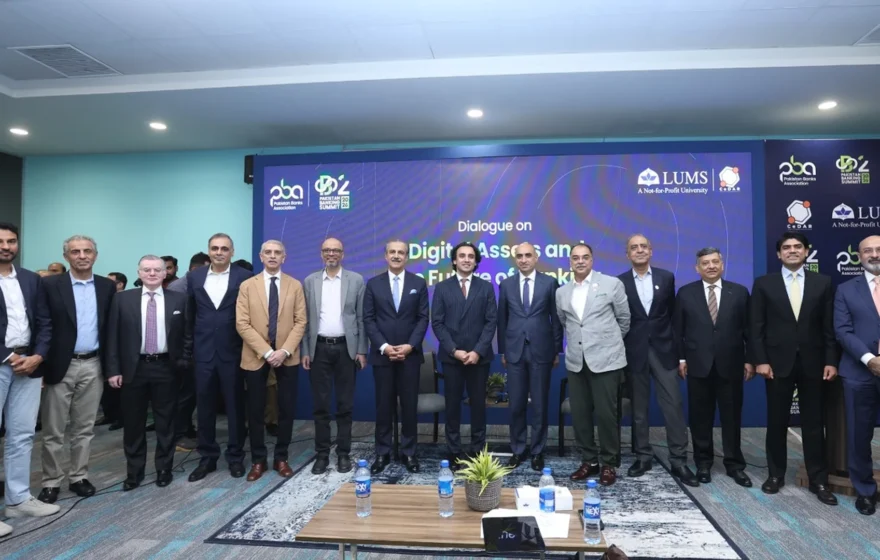
Pakistan’s banks and its financial regulators have come together to work out how digital assets should fit into the country’s banking system. The meeting, the Dialogue on Digital Assets and the Future of Banking, was organised by the Pakistan Banks Association with the Centre for Digital Asset Research at the Lahore University of Management Sciences, following on from the Pakistan Banking Summit 2026. Its purpose was practical: to agree a shared way forward.
The discussion covered cross-border payments, the tokenisation of assets, programmable payments and the everyday use of new financial technology in Pakistan’s banking system. The organisers framed the session around responsible innovation, closer coordination between regulators, and the readiness of banks to handle new products safely. That matters because digital finance now touches remittances sent home by workers abroad, accounts used by overseas Pakistanis, and the way businesses pay and get paid.
Finance Minister Muhammad Aurangzeb, who attended as chief guest, said the government is exploring the tokenisation of Pakistan’s existing Eurobond debt, subject to the approvals such a step would require. Tokenisation means creating a digital representation of an asset on a blockchain system, so ownership and transfers can be recorded and settled electronically. He argued that banks, regulators and technology specialists must work together on solutions serving national economic priorities, with strong risk management and cybersecurity safeguards underneath.
Bilal Bin Saqib, the Minister of State who chairs the Pakistan Virtual Assets Regulatory Authority, urged Pakistan to help shape the new financial system rather than simply adopt platforms designed elsewhere. He contrasted this with an earlier era, when Pakistan largely used correspondent banking arrangements and payment networks built by others, and asked whether the country wanted to keep renting its financial future or to help build and own it. He called on banks to act as launchpads for innovators and to invest in artificial intelligence.
The State Bank’s view, presented by Deputy Governor Saleem Ullah, was deliberately grounded. He argued that practical uses should come before enthusiasm for any particular technology, naming blockchain-enabled remittances and Roshan Digital Accounts as areas worth testing in a regulatory sandbox, where ideas can be tried under supervision before reaching the wider public. He listed the risks to manage: monetary and financial stability, cybersecurity, anti-money laundering and know-your-customer compliance, and consumer trust.
Imtiaz Haider, a Commissioner at the Securities and Exchange Commission of Pakistan, urged a clear, value-driven approach to tokenisation. He asked who stands to benefit from tokenising a particular asset, what regulatory gaps must be closed first, and how ready Pakistan really is to adopt the technology. The central question, in his telling, is not whether assets can be turned into digital tokens, since in technical terms many can be, but which assets should be tokenised to deliver genuine economic value.
Zafar Masud, chairman of the Pakistan Banks Association, said Pakistan’s banks are not asking to be protected from change, but for clear regulatory standards they can build towards. Banks, he argued, are the delivery channel for financial services, with the networks, compliance systems and public trust needed to turn innovation into products people can actually use. They must therefore be formally involved from the outset, especially while the regulatory framework is still being developed.
Dr Ali Cheema, Vice Chancellor of LUMS, underlined the role of research in connecting policy with industry practice, so opportunities can be assessed honestly and the skills needed for digital finance can be built. A workshop led by Umar Farooq, Global Co-Head of Payments at J.P. Morgan, brought banking technology leaders, regulators and academics together to identify priority uses and possible pilot projects. The discussions should feed into a coordinated industry roadmap.
That ambition follows a fast regulatory shift. For years the legal position was uncertain, with no comprehensive statute governing the sector. In July 2025 a presidential ordinance created the Pakistan Virtual Assets Regulatory Authority to license, regulate and supervise virtual asset service providers, and Parliament later gave the framework permanent footing through the Virtual Assets Act 2026. The State Bank has set out a conditional route for banking services to licensed firms, while banks remain barred from holding or trading virtual assets with their own funds or customer deposits.
Remittances give the debate its most immediate human stakes. Pakistan received 41.6 billion dollars in overseas remittances last fiscal year, and early figures suggest this year’s total could rise beyond 44 billion dollars. For millions of families, the cost and speed of receiving money from abroad is a monthly reality, and Gulf corridors carry a large share of those flows. If supervised, bank-led digital payments genuinely lower costs and speed up settlement, households will feel the benefit directly.
The real test will be what happens next, rather than what was said in the room. A coordinated roadmap, pilot projects tested in sandboxes, and clear standards from the State Bank, the securities regulator and the virtual assets authority would turn conversation into practice. Cabinet approval is still needed before any Eurobond tokenisation proposal moves to a formal request for proposals. Done carefully, Pakistan could lower costs and widen access; done hastily, it could expose savers to risks the regulators themselves have named.
