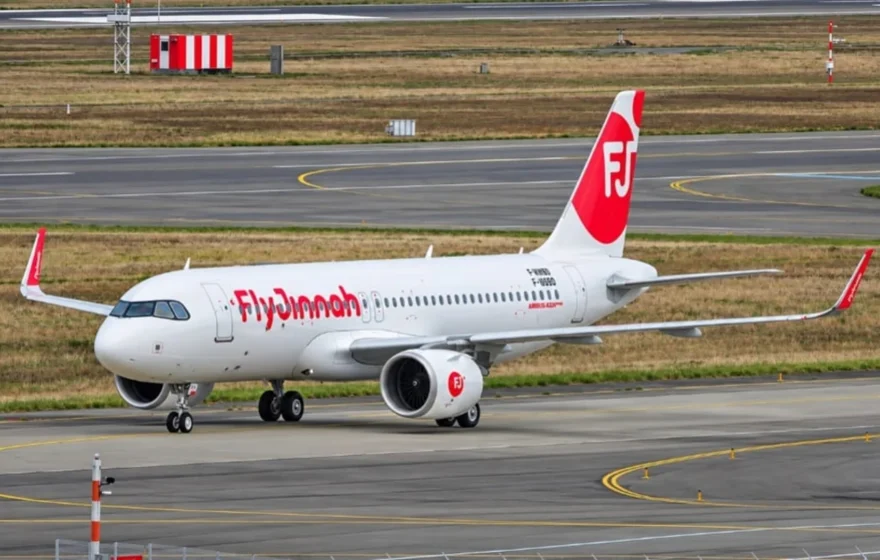
Fly Jinnah’s incoming Airbus A320neo has completed its first test flight in France, moving the aircraft one step closer to joining the Pakistani low-cost carrier’s fleet. The flight, carried out from Toulouse on Monday, 2 November, marks an important milestone in the journey of a new aircraft from the factory floor to commercial service, and it signals that Fly Jinnah’s fleet expansion is now in its final stages before delivery.
The aircraft is currently flying under the French registration F-WWBD. It operated test flight AIB01BD on Monday, departing Toulouse at 12:08 p.m. and returning to the same airport at 2:10 p.m. The flight lasted two hours and two minutes, and during that time the aircraft climbed to a maximum altitude of 39,000 feet. A first test flight of this kind is not a routine hop around the airport. It is a carefully planned sortie in which the aircraft’s systems, handling and performance are checked in the air, after ground tests have been completed, before the manufacturer hands the jet over to its customer.
Once testing and acceptance are complete, the aircraft is expected to receive the Pakistani registration AP-BQA before it enters service with Fly Jinnah. The change of registration is more than a paperwork formality. It marks the point at which the aircraft passes from the manufacturer’s test register to the register of its home country, and it is one of the visible signs that delivery is near.
Toulouse, in southern France, is the natural setting for this story. It is home to Airbus’s final assembly and delivery operations for the A320 family, and aircraft built there routinely carry out their early flights from the city’s airport before delivery. For a Pakistani airline, a test flight in Toulouse is therefore not an exotic detour, but the standard last chapter of the manufacturing process, when an aircraft that has existed until then mainly as metal, wiring and paperwork finally proves itself in the air.
The aircraft itself is also significant. The A320neo, where neo stands for new engine option, is the modernised version of Airbus’s best-selling single-aisle family. It is fitted with new-generation engines and sharklet wingtip devices, and Airbus describes the family as around 15 to 20 percent more fuel efficient than the previous generation of A320 aircraft, with a substantially smaller noise footprint. For a low-cost airline, those figures matter in a very practical way. Fuel is one of the largest costs in running an airline, and an aircraft that burns less fuel on the same route can help keep fares lower, or fly longer sectors more economically.
For Fly Jinnah, the arrival of an A320neo would build on a fleet so far built around the earlier A320. The airline is Pakistan’s first low-cost carrier in its current form, a joint venture between Pakistan’s Lakson Group and the United Arab Emirates-based Air Arabia Group, based in Karachi. It began commercial operations in November 2022 with domestic services, and has since grown steadily. Its domestic network covers Karachi, Islamabad, Lahore, Peshawar and Quetta, with newer routes to Multan, Faisalabad and Sialkot, while internationally it serves Sharjah and Dubai, Bahrain, and Jeddah, Riyadh and Dammam in Saudi Arabia.
The timing fits a wider pattern in Pakistani aviation. Demand for air travel within Pakistan, and between Pakistan and the Gulf states where large numbers of Pakistanis live and work, has remained strong. Low-cost carriers have played a central role in meeting that demand, by making flying accessible to travellers who might previously have relied on long road or rail journeys. A new, more efficient aircraft does not by itself create that demand, but it gives an airline the capacity and the cost base to serve it, and the flexibility to operate a short domestic hop in the morning and a longer Gulf sector in the evening.
What happens next will be watched closely by aviation enthusiasts and regular passengers alike. After further checks and the formal handover, the aircraft would be flown from France to Pakistan on a delivery flight, re-registered as AP-BQA, and prepared for service, including the airline’s own acceptance checks and crew familiarisation. The source report does not announce a date for the aircraft’s first commercial flight. Delivery is a process, not a single moment, and airlines prefer to announce a new aircraft’s entry into service only when they are confident it will operate as planned.
Even so, the significance of Monday’s flight should not be understated. A test flight is the point at which an order stops being an announcement and becomes a real aircraft, flying under its own power, at altitude, over France. For Fly Jinnah, it is evidence that its fleet expansion plans are moving from paper to tarmac. For passengers, it is a promise of newer, quieter and more fuel-efficient aircraft on the routes they fly. The next time this aircraft is seen in Pakistan, it will not be wearing a French test registration. It will be AP-BQA, in Fly Jinnah colours, and the test flight over Toulouse will be remembered as the day its working life began.
