Lahore’s traffic police have begun taking motorists who have not paid their digital traffic fines to court, marking a sharper turn in the city’s long struggle to collect unpaid e-challans. Officials say court summons will now be issued to people who ignore payment notices for ten days, a step that moves the dispute from a notice on a phone screen into a courtroom. Traffic wardens have been posted at courts across the city to help judicial authorities with the recovery process, a sign of how seriously the department now views a backlog that has grown far beyond a routine administrative problem.
The procedure behind the new drive is straightforward, and it is the reason the fines have become so difficult for many motorists to clear. Under the system described by officials, a traffic fine doubles if it is not paid within ten days. Once that period passes without payment, the unpaid challan is forwarded to the courts for further proceedings. What began as a single fine can therefore become a considerably larger sum by the time a motorist is called to answer for it, and the seized documents that go with the case remain held until the matter is settled through the prescribed legal route.
The scale of the problem explains why the police have decided to act in this way. Officials put the number of pending digital challans and seized documents in Lahore at nearly 800,000, a figure that captures both the fines that have gone unpaid and the licences and identity cards held back while cases remain unresolved. That is not a handful of persistent offenders. It is a city-wide accumulation, built up case by case as cameras recorded violations, notices were issued, deadlines passed and fines doubled, until a very large number of motorists found themselves facing amounts they were reluctant to pay and documents they could not easily recover.
That reluctance has itself created a second problem. Officials say the increased penalties have discouraged several motorists from going to court to retrieve their seized documents at all. Some have instead obtained duplicate identity cards and driving licences, choosing to replace the document rather than pay the doubled fine and collect the original. The result is a tangle in which the fine remains unpaid, the original document remains held, and the motorist continues to drive with a replacement, while the case stays open in the background. The court summons now being issued are intended to break that pattern by bringing each case directly to the person concerned, rather than waiting for the motorist to come forward.
Lahore’s traffic police have urged motorists to clear their outstanding e-challans and collect their seized documents by following the prescribed legal procedure. The message is deliberately practical: pay the fine, settle the case, and recover the document through the court, before the matter escalates further. Officials have warned that those who do not respond even after receiving a summons will face stricter legal action, although the immediate aim is recovery and compliance rather than punishment for its own sake. The department wants the money owed to be paid and the digital enforcement system to be taken seriously, and it believes that a formal summons carries a weight that a text message or a notice no longer does.
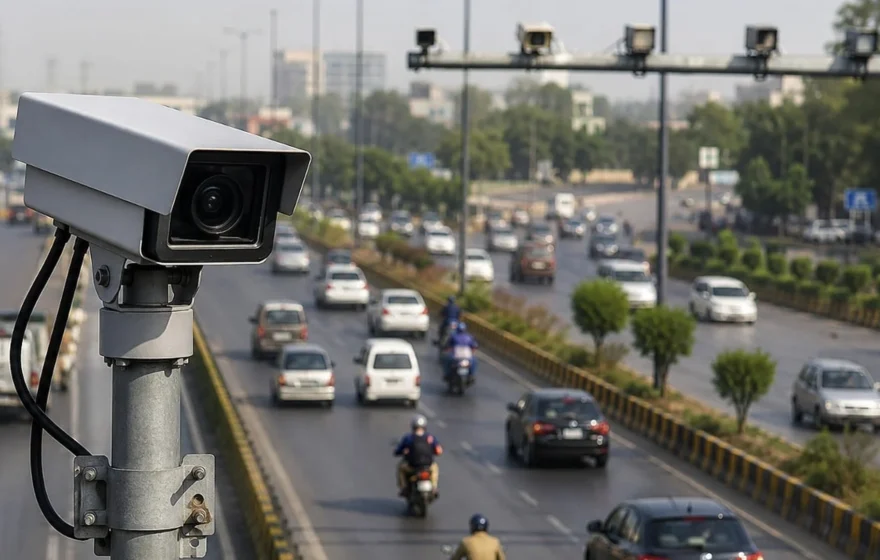
To understand why so many cases have piled up, it helps to understand how Lahore’s e-challan system works. The Punjab Safe Cities Authority operates a network of cameras across the city’s intersections and main roads, and those cameras record violations automatically, day and night. Using automatic number-plate recognition, the system matches a vehicle to its registration record, generates an electronic challan and sends a notice to the registered owner. The violations caught in this way range from jumping a red signal and speeding to driving on the wrong side of the road, using a mobile phone while driving, riding without a helmet and driving without a seatbelt. Because no warden needs to stop the vehicle, a motorist may first learn of a violation days after it happened, when the notice arrives.
Whether the drive succeeds will depend on more than the summons themselves. Courts will have to absorb a large number of cases, and motorists will need a clear, workable way to check what they owe, to challenge a challan they believe is wrong, and to pay without confusion about which messages and portals are genuine. If those pieces work, the backlog should begin to fall, the seized documents should return to their owners, and the deterrent effect of the camera system should grow, because drivers will know that an unpaid fine does not simply fade away. For any motorist who has already received a notice, the practical lesson is to check the official record and settle the fine within the ten-day window, before it doubles and the case moves to court.
