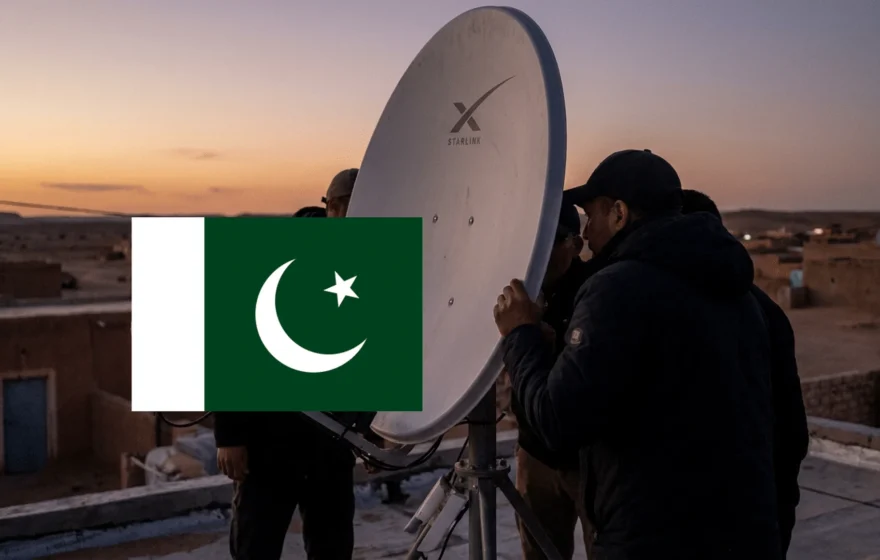
A fresh storm over spying claims has given Pakistan another reason to keep Elon Musk’s Starlink satellite internet service on hold, with a technology analyst saying the affair is one of the biggest reasons the service has still not switched on in the country.
The claims centre on Discover-Tech, an Israeli digital advertising company that researchers say spent months heavily targeting people using Starlink connections in more than 100 countries. According to a Reuters report, researchers at TrendAI, part of the Tokyo-based cybersecurity firm Trend Micro, found the company was one of the largest buyers of advertising shown to Starlink users, and the leading bidder for Starlink traffic in over a hundred countries.
The concern is not the adverts themselves but what the bidding process behind them can reveal. Every time an advert appears online, a split-second auction takes place that can leak technical details about the person seeing it. Investigations by TrendAI, the Canadian research group Citizen Lab and the advertising security firm Confiant found that information exposed in those auctions can be gathered and pieced together to follow people across websites and applications, identifying them and working out where they are.
The researchers believe the targeting was no accident. TrendAI published a report on 15 October about the Starlink targeting but stopped short of naming the company behind it, referring to it only by the codename “Shadow-Earth-79”. Six people familiar with the matter told Reuters the codename stood for Discover-Tech. On the same day, Citizen Lab and Confiant named the company publicly, saying it had abused the advertising auction process in a way that could pass information about internet users back to the bidder.
A separate line of investigation went further, linking Discover-Tech’s advertising setup to surveillance work and to the possible delivery of spyware, software that can watch a device unseen, without the user ever needing to click on a dodgy advert. The researchers also found the company’s adverts appearing inside dozens of sensitive networks, including those belonging to media organisations, governments and technology companies.
The fallout was swift. After the findings were published, Google, Comcast and other companies removed Discover-Tech from their advertising platforms, cutting off one of its main routes to internet users. The company has not publicly answered the claims in detail, but the episode has sharpened the debate about how much can be learned about a person from the adverts their connection serves up.
For Pakistan, the timing could hardly be worse. The researchers said the activity was especially worrying in countries where Starlink is banned or restricted, and in war-hit places such as Syria, Libya, Yemen and Sudan. Pakistan’s own security establishment has long treated satellite internet with caution, and the idea that Starlink connections could be singled out for tracking will only harden that view, though the analyst’s comment is opinion, not an official explanation for the delay.
The plain fact is that Starlink is still not available in Pakistan, and the road to a launch remains blocked at several points. The service is registered with the Securities and Exchange Commission of Pakistan as Starlink Internet Services Pakistan (Private) Limited, and it received provisional registration from the Pakistan Space Activities Regulatory Board in March 2025. But its full registration with the board is still incomplete, and until that step is cleared it cannot even apply for the Fixed Satellite Service licence it needs from the Pakistan Telecommunication Authority. Starlink’s own availability map lists Pakistan as “pending regulatory approval”, and there is no confirmed launch date.
Nor is Starlink alone in the queue. Six satellite internet companies have now registered with the SECP, but none of them has been cleared to operate, and details given to a Senate committee showed that Starlink, Galaxy Space and SpaceCell Pakistan are still waiting for security clearance from the Ministry of Interior for their foreign directors and shareholders. The PTA has set out four requirements for any operator: registration with the SECP, registration with the space board, meeting national security requirements, and finally a PTA licence. As of September, the regulator told a Senate committee that no Starlink licence application was even pending.
The legal framework, at least, is moving. The federal cabinet approved the Fixed Satellite Services licensing framework in April 2026, and licences once issued will run for 15 years, with operators given 18 months to start services. The IT minister has said the rules for low-earth orbit satellites are in their final stages. Other operators, including OneWeb, Amazon’s Project Kuiper, Telesat and China’s Shanghai Spacecom, are also waiting in line, so Pakistan’s satellite market will not be a one-company story.
For now, though, the wait goes on, and the Discover-Tech affair gives the sceptics a fresh argument. Regulators and security officials will want to know that a satellite connection cannot be turned into a tracking beacon before they let it into the country, and that question now sits alongside the unfinished paperwork. Until both are settled, people in remote and poorly served areas hoping for fast internet from the sky will have to keep waiting, with no date in sight.
