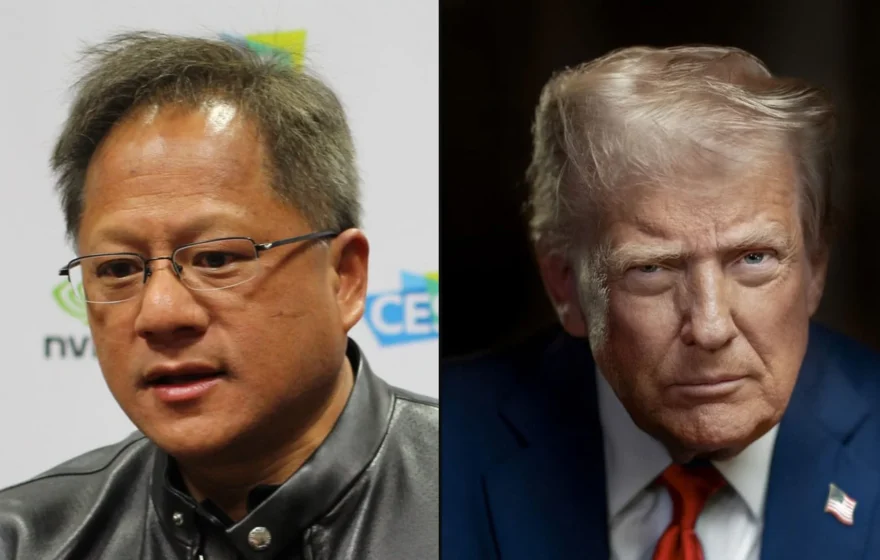
United States President Donald Trump has backed calls for Jensen Huang to return as chief executive of Nvidia, saying he would have no objection to the ousted chip boss taking back the top job at the company that sits at the centre of the global artificial intelligence boom. Speaking to reporters at the White House on Monday before leaving for a trip to Asia, Trump said a growing number of people wanted Huang back, described the idea as far from a bad one, and played down the national security concerns that surrounded the executive’s sudden departure last week.
“I would not mind that,” Trump said. “A lot of people are asking Jensen, they think Jensen should go back. That certainly isn’t a bad idea.” He added that Huang had “learned a big lesson.”
Huang’s exit stunned the technology world. He co-founded Nvidia in 1993 with Chris Malachowsky and Curtis Priem, and he led the company for 33 years, turning a maker of graphics chips for video games into the world’s leading supplier of the processors that power advanced artificial intelligence. The company controls an estimated 80 to 90 percent of the market for the chips used to run advanced AI systems, and it ranks as the world’s second-most valuable listed company after Apple, worth roughly 4.5 trillion dollars.
The trouble began when reports emerged that Huang had affairs with two women, including a businesswoman accused of spying for China. Nvidia’s board opened an independent investigation into reports that Huang was the target of a foreign intelligence effort, and on November 8 Huang admitted to company employees that he had been unfaithful to his wife after more than 41 years of marriage. Four days later, on November 12, he resigned as president, chief executive and board member with immediate effect. The company gave no formal reason for the exit, and chief financial officer Colette Kress stepped in as interim chief executive while the board searches for a permanent successor.
The market reaction was brutal. Nvidia lost more than 600 billion dollars in market value in the week the reports surfaced, and its shares fell more than 8 percent in after-hours trading after the Wall Street Journal reported that the board was preparing to remove Huang.
Trump Doubts Spy Claims
At the heart of the affair are reports of Huang’s relationships with a subordinate and with Alice Huang, a former executive at Megaspeed, a Singapore-based company that bought about 4.8 billion dollars worth of equipment from the chipmaker. Alice Huang is suspected of working for Chinese intelligence, a claim Trump said he did not accept.
“I don’t know that she was a spy at all,” Trump said, adding that national security “was not put at risk.” He said he might raise the matter with Chinese President Xi Jinping when the two leaders meet in Shenzhen on the sidelines of the APEC summit.
Trump also repeated that he would support former Apple chief executive Tim Cook as a possible replacement if Huang does not return, keeping open a second path for the board.
Mixed Signals From Washington
Trump’s remarks gave fresh energy to the campaign to bring Huang back, which is backed by Elon Musk and by an online petition that has gathered about 180,000 signatures. Supporters argue that no one else understands Nvidia’s technology, its customers and its place in the AI supply chain as Huang does, and that the company cannot afford a long period of uncertainty at the top.
But the message from Washington is far from united. Treasury Secretary Scott Bessent said on Sunday that Nvidia needed a “dramatic shake-up” of its leadership and urged the board to look outside the company for its next chief executive, a direct contrast with the president’s own position.
Many analysts also doubt that a return is likely. The prediction market Kalshi gives Huang only a 14 percent chance of becoming Nvidia’s next permanent chief executive, behind Arm chief executive Rene Haas. Nvidia shares were down roughly 2 percent in New York trading on Monday, a sign that investors remain unsure how the saga will end.
What happens next now rests with Nvidia’s board, which can remove or appoint a chief executive by a majority vote of its directors. Huang owns about 3.6 percent of the company and holds no majority voting control, so the decision is the board’s to make, not his. The choice matters far beyond one company. Nvidia’s chips power the data centres of Microsoft, Google, Amazon and Meta, and its revenue rose 65 percent to a record 215.9 billion dollars in its last financial year, so a long leadership vacuum could slow the wider build-out of AI infrastructure. The affair has also pulled Nvidia deeper into the contest between Washington and Beijing over advanced chips, with Congress already questioning exports of AI chips to China after a smuggling case in Taiwan. Whoever takes the job permanently will have to steady investors, satisfy regulators and keep Nvidia ahead in a race it has dominated for years, and whether Trump’s backing can tip the balance remains to be seen.
