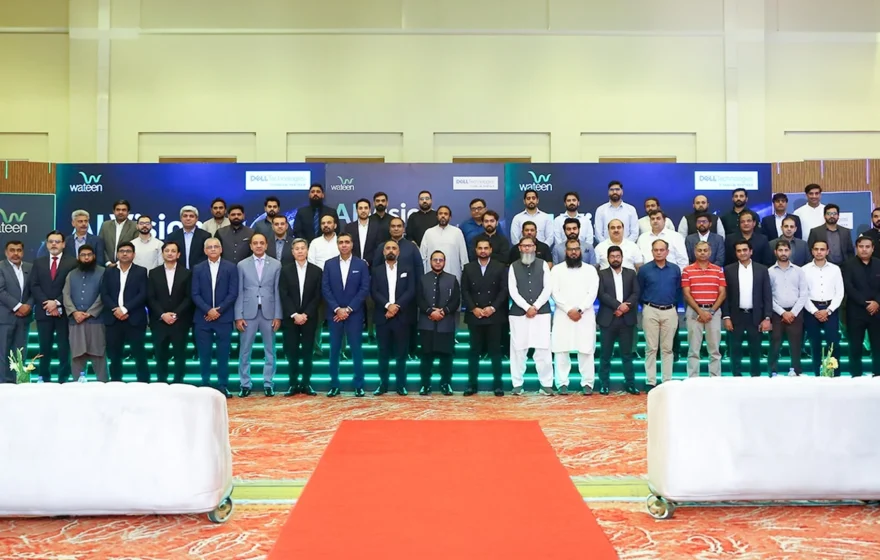
Artificial intelligence dominates every boardroom conversation in Pakistan today, yet for most companies the distance between talking about AI and gaining from it remains wide. Wateen and Dell Technologies set out to close that gap this week, bringing business leaders, technology professionals and customers together for an evening built around one question: what does it take to turn AI from an idea into something that delivers real value?
The event, titled “AI Vision: From Possibility to Impact”, was hosted by Wateen in collaboration with Dell Technologies. It was not a product launch. Instead, it was a working conversation, where the people who decide how companies spend on technology could sit with the people who build and run that technology, and talk honestly about where the promise of AI meets the reality of running a business.
That honesty matters, because the gap between interest and implementation is where most AI projects stall. Companies can buy the tools and run the pilot projects, but unless the technology is tied to a clear business problem and supported by the right infrastructure, the results stay on a slide deck.
Opening the evening, Naeem Majeed, Vice President Enterprise at Wateen, and Muhammad Awais Asif, Director Sales, welcomed the Dell Technologies representatives and customers on behalf of Wateen, setting the tone for a discussion about doing the work rather than admiring the idea.
The first detailed look at the technology came from Chin Wah Mak, Managing Director for Emerging Markets at Dell Technologies, and Gulshan Herath, an AI Solutions Architect at Dell. They examined how the AI landscape is changing and what Dell’s AI Factory offers to companies trying to keep up. The AI Factory is Dell’s full-stack approach to enterprise AI, built with NVIDIA, bringing together computing power, storage, networking and software into one validated system. The point they made was practical: AI needs a foundation, and the foundation has to be able to grow. A system that works for a small experiment will often collapse under a real production workload, with data scattered across departments and costs that nobody can predict. An integrated platform, they argued, gives companies a steadier path from a first pilot to something the whole business can rely on.
That emphasis on foundations is especially relevant in Pakistan, where many organisations are still building the basics of their digital infrastructure. Wateen is no stranger to that groundwork. The Lahore-based company, part of the Abu Dhabi Group, began operations in 2007 with what was then the largest fibre optic network in the country, and it became the first company in the world to roll out a WiMAX broadband network nationwide. It has since moved from connectivity into enterprise solutions, serving businesses with data services, cloud and IT infrastructure, and its standing as a Dell Technologies Titanium Partner reflects the depth of that relationship.
Broadening the discussion beyond infrastructure, Nasir Mahmood, Vice President Business Solutions at Wateen, spoke about what AI could mean for industries and for everyday life in Pakistan. His message was that the time to prepare is now. The capabilities a business builds today, the data it organises and the skills its people learn will decide how ready it is when AI moves from an experiment to an expectation. Companies that wait for the technology to settle before they start learning it will find themselves learning it under pressure, while their competitors are already using it to serve customers faster and cheaper.
That is a warning worth hearing across Pakistan’s economy. Banks are already using AI to detect fraud and speed up customer service, manufacturers are using it to spot faults before machines break down, and retailers are using it to manage stock. The challenge is not a lack of ambition. It is the shortage of skilled people, the patchy quality of data, the cost of the hardware, and the simple difficulty of knowing where to start.
Naveed Siraj, Country Manager for Dell Technologies Pakistan, delivered the closing remarks. His point was that the conversation between business priorities and technology expertise is itself what matters. It happens when the people who understand the business and the people who understand the technology sit in the same room and agree on what success looks like.
As a Dell Technologies Titanium Partner, Wateen says it will keep strengthening its AI and professional services capabilities, supporting businesses with the infrastructure, expertise and partnerships they need to adopt AI. The event reflected that commitment: not a promise that the technology will solve every problem, but a statement that the company intends to help its customers take the next practical step.
The real test will come after the evening ends. If the companies in that room go back to their offices and start with one clear problem, one clean set of data and one measurable goal, then the evening will have done its job. If they simply add AI to their list of things to think about someday, then it will have been just another event. The difference between those two outcomes is the difference between AI as a conversation and AI as a capability.
