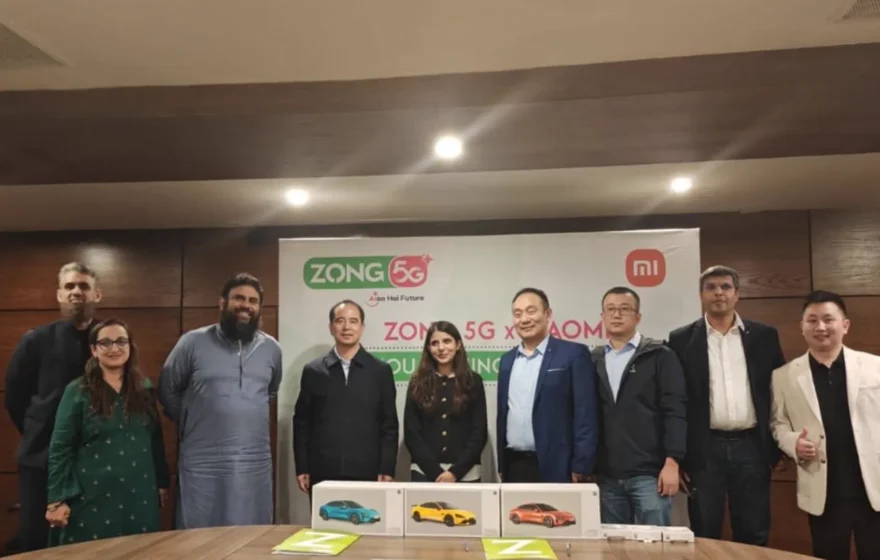
Zong has teamed up with Xiaomi Pakistan in a long-term partnership aimed at making 5G phones affordable for ordinary Pakistanis. The two companies say the deal will put low-cost 5G handsets in the hands of Zong customers across the country, starting with the Redmi 17 5G, which is now available at Zong customer service centres nationwide.
For all the excitement around 5G in Pakistan, the biggest obstacle so far has not been the network itself but the price of the phones that can use it. A fast network is of little use to someone whose handset cannot connect to it, and until now most 5G-capable phones on sale here have sat well beyond the budget of the average buyer. That is the gap Zong and Xiaomi are trying to close, by pairing an affordable device with tailored data bundles and help at the point of sale.
The first phone from the partnership is the Redmi 17 5G, an entry-level handset Xiaomi launched in Pakistan on 11 November. It costs Rs. 72,999 for the version with 4GB of memory and 128GB of storage. It runs on Qualcomm’s Snapdragon 4 Gen 5 processor, has a large 6.9-inch display with a refresh rate of up to 120Hz, and packs a 7,500mAh battery with 45W fast charging. It also has a 50-megapixel main camera and is sold as PTA-approved with a one-year brand warranty. Pre-orders run until 22 November, with deliveries beginning the following day.
What makes the Zong offer different from simply buying the phone from a shop is the package around it. Customers who pick up the Redmi 17 5G from a Zong service centre can also sign up for exclusive Zong bundle offers, and staff will walk them through the purchase and help them get started on 5G. For many first-time buyers, that assisted experience matters as much as the price.
The partnership was sealed at a signing ceremony attended by senior leaders from both companies, including Zong’s chairman and chief executive, Huo Junli, and its chief commercial officer, Omer Bin Tariq, along with Xiaomi Pakistan’s country manager, Brian Shawn. Tariq said the real promise of 5G was not just faster networks but making those benefits available to everyone, and that the deal would bring that vision closer by making 5G devices more affordable. Shawn said Xiaomi was committed to making innovation accessible to everyone, and that the Redmi 17 5G was only the first step in a longer plan to widen the range of 5G devices and help more Pakistanis take part in the country’s digital future.
The deal lands while Pakistan’s 5G story is still in its early chapters. The Pakistan Telecommunication Authority held the country’s first 5G spectrum auction on 10 March 2026, raising around 507 million dollars and selling 480 megahertz of spectrum. Jazz took the largest share with 190 megahertz, Ufone won 180 megahertz, and Zong secured 110 megahertz. Zong switched on its commercial 5G service on 19 March, the same day its licence was signed, starting in more than 16 cities, and Jazz followed within a day.
Since then the network has grown steadily, if not yet everywhere. An update from the IT minister in the National Assembly on 23 October put the national picture at 1,782 live 5G sites across 24 cities, serving around 1.8 million users. Jazz led the count with 1,015 sites, Zong had reached 640, and Ufone, which had won spectrum but had yet to launch a consumer service by late October, stood at 127. Those numbers show real progress, but also how much of the country is still waiting, since most Pakistanis live outside the big cities where 5G arrived first.
That is why the device side matters so much. A network can only grow as fast as the phones that connect to it, and in a price-sensitive market like Pakistan, a phone costing several months’ wages will never reach the mass market, however good the coverage becomes. Affordable handsets are what turn a network launch into a genuine shift in how people use the internet.
Zong has framed the Xiaomi deal as part of a wider ambition it calls Beyond Connectivity, an effort to build an integrated world of connectivity, devices and digital services rather than simply selling mobile packages. Both companies say the deal creates a platform for more joint phone launches and deeper cooperation in the years ahead.
Whether it delivers will depend on what follows the first phone. One affordable handset is a start, not a solution, and the real test will be whether more low-cost 5G models arrive, whether the bundles stay genuinely affordable, and whether the network reaches the smaller towns where most Pakistanis live. For now, though, the partnership gives ordinary buyers something they have not had before: a 5G phone at an entry-level price, sold with a data plan and a helping hand, on a network already live in two dozen cities. For a country that has waited years for 5G to become real, that is a meaningful step forward.
