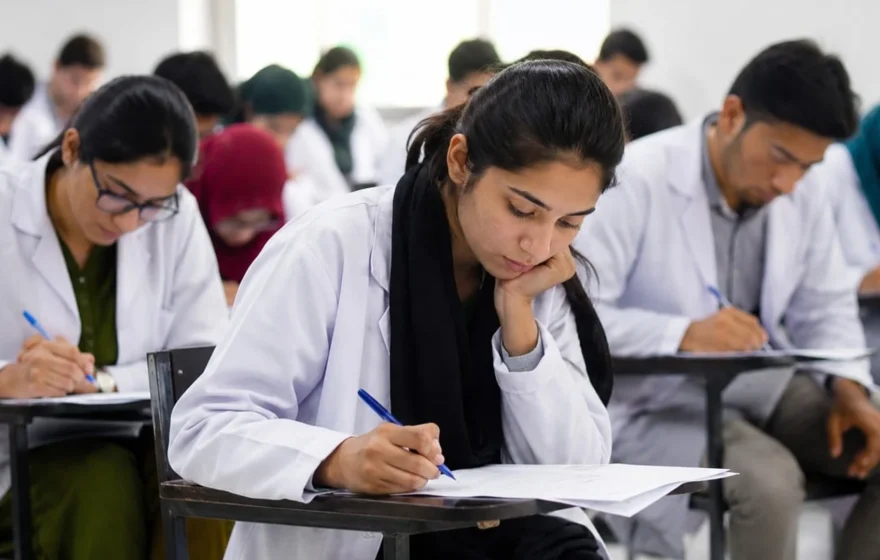
The Sindh government has firmly rejected the criticism surrounding this year’s Medical and Dental College Admission Test, insisting that the results tell a very different story from the one circulating on social media. In a formal response to the Pakistan Medical and Dental Council, the provincial health department argued that Karachi’s candidates did not lag behind the rest of the province, but recorded the strongest performance of any division in Sindh.
At the heart of the dispute is a test that shapes the future of tens of thousands of young Pakistanis annually. The Medical and Dental College Admission Test, known as MDCAT, is the mandatory entrance examination for MBBS and BDS programmes in medical and dental colleges across the country. Under the council’s framework, candidates must clear the test and meet academic thresholds before competing for a seat, with the test score carrying half the weight in the merit calculation alongside intermediate and matriculation results.
In Sindh, the 2026 test was conducted by the SIBA Testing Services of Sukkur IBA University, and the health department says 33,336 candidates appeared across the province. Its letter states that 57.96 per cent of those candidates scored 90 marks or more. Karachi, it says, came out on top among the province’s divisions with an average score of 107.67 marks. Of the 9,505 candidates who sat the test from Karachi, 66.98 per cent scored 90 or more, while 57.78 per cent managed 99 or more, figures the department presents as clear evidence against claims that the city’s students performed poorly.
The letter also breaks down the other divisions for comparison. In Sukkur, 55.04 per cent of candidates scored 90 or more, followed by 54.50 per cent in Larkana, 53.62 per cent in Shaheed Benazirabad and 52.34 per cent in Hyderabad. The department adds that all districts of Karachi were among the nine best-performing districts in the province, based on its analysis of results compiled by the testing service.
The controversy began not with the results themselves but with the reaction to them. After the results were announced, complaints circulated on social media alleging that the question paper had been leaked, and some candidates and public representatives questioned whether the process had been fair to everyone. Reports also noted that none of the top twenty candidates on the merit list was from Karachi Division, with the first Karachi candidate appearing at number twenty-one, the federal health ministry then took up the matter in early October, asking the council to examine transparency and fair play, including a centre-wise analysis of results and scrutiny of examination records and complaints.
That intervention led to the council writing to the Sindh Health Department on October 5, asking the province to investigate the allegations and submit its report within two weeks. The council, which regulates medical education and admissions, had already carried out an internal review and, according to officials quoted in press reports, found no anomalies, but the ministry’s request prompted a proposal for a joint review involving the provincial authorities, the council and the testing service.
One of the most sensitive parts of the debate is how seats in public medical colleges are allocated, and here the Sindh government has drawn a clear line. The health department maintains that seats are distributed on a district basis under the applicable admission rules, with Karachi’s seats reserved for candidates holding a Karachi domicile. The department also cautioned against viewing candidates with suspicion simply because they obtained higher marks, and urged that the results not be made controversial for political purposes.
Critics have raised further concerns beyond the headline scores, including questions about entrusting the test to Sukkur IBA, complaints about answer keys in biology, chemistry and physics, and questions about arrangements at examination centres. Others have demanded a transparent account of the registration fees collected. None of those claims has been established as fact, and the provincial government does not accept them, but their persistence explains why calls for an independent inquiry have continued even after the province published its defence.
What happens next will matter as much as what has already been said. The proposed joint review would put the province’s figures alongside the council’s own analysis and the complaints received, and test whether both sides can agree on a common set of facts. If it confirms the province’s account, it would go a long way towards settling the dispute and letting admissions proceed without a cloud over them. If it uncovers procedural lapses, even ones that did not change the overall outcome, it could still force changes to how future tests are run.
