Pakistan fast bowler Haris Rauf has been fined twenty percent of his match fee and given an official reprimand after an on-field confrontation during Pakistan’s dramatic one-day international victory over England in Lahore. The International Cricket Council has confirmed the punishment, following the tri-series match at the Gaddafi Stadium on Sunday, and added one demerit point to the fast bowler’s disciplinary record.
The governing body found Rauf guilty of a Level 1 breach of its Code of Conduct, under the article covering behaviour contrary to the spirit of the game. The charge related to an incident late in Pakistan’s innings, when the match was still finely balanced and every decision carried unusual weight. Officials treated the episode as a matter of conduct rather than cricketing skill, and the penalty reflects that distinction.
The flashpoint came at the end of the 46th over of Pakistan’s innings. Rauf, standing at the non-striker’s end, appealed for a wide delivery and then became involved in a heated exchange with England all-rounder Will Jacks. During the argument, Rauf raised his bat, and he carried on arguing even after umpire Sharfuddoula Ibne Shahid warned him to stop. As the exchange continued, Rauf brushed past the umpire while walking towards Jacks, an action match officials viewed as crossing the line from a verbal disagreement into conduct that could not be ignored.
The latest sanction is Rauf’s third offence within a twenty-four-month period, and it takes his total to five demerit points. Demerit points keep a running record of a player’s disciplinary history, rather than treating each incident in isolation. A single offence may bring only a fine or a reprimand, but a pattern of offences builds a record that follows the player for two years.
England were also punished for a separate matter from the same match. The visiting side was fined fifteen percent of its players’ match fees after being found three overs short of the required over rate, even after time allowances were taken into account. Under the Code of Conduct, a side is fined five percent per player for every over it fails to bowl in time, which explains the fifteen percent figure. Over-rate penalties are aimed at keeping the game moving for players and spectators alike.
Both cases were settled without formal hearings. Rauf admitted his offence and accepted the sanction proposed by Jeff Crowe of the Emirates ICC Elite Panel of Match Referees, while England captain Harry Brook did the same for his side’s over-rate offence. The charges had been laid by on-field umpires Rashid Riaz and Sharfuddoula, third umpire Wayne Knights and fourth umpire Nassir Hussain.
The wider context makes the incident easier to understand, even if it does not excuse it. Pakistan were chasing 242 after England had been bowled out for 241 in 46.4 overs, despite a century from Ben Duckett, while Shaheen Shah Afridi had taken four wickets for 46 runs. Pakistan’s chase soon ran into trouble, and by the 34th over the hosts had slumped to 154 for nine, with only one wicket left. It was in that pressurised atmosphere, with the match seemingly lost, that the confrontation took place.
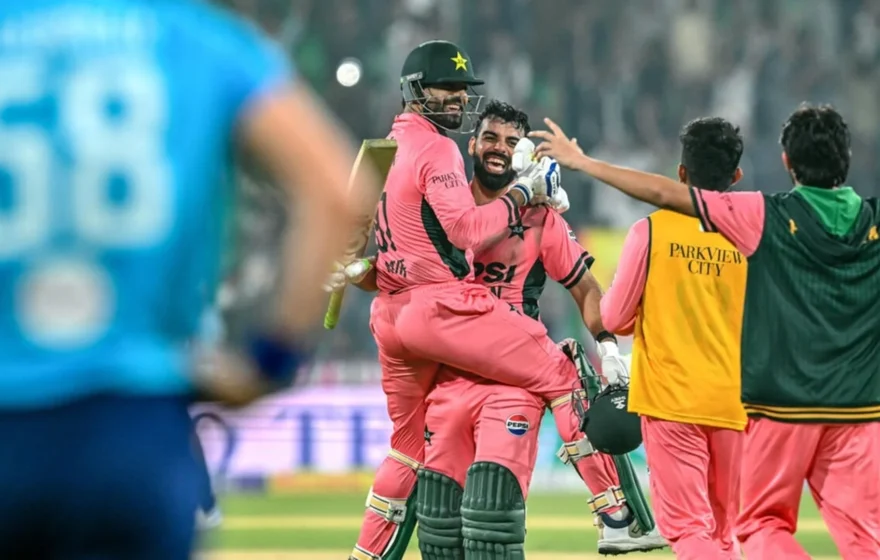
What followed was one of the most remarkable comebacks in recent one-day cricket. Shadab Khan produced an unbeaten 113 from 96 balls, with thirteen fours and five sixes, and found a determined partner in Rauf. Rauf made only seven runs from nineteen balls, but his refusal to give his wicket away allowed Shadab to play with freedom, and together they added an unbroken 89 runs for the final wicket. That stand is the highest for the last wicket in a successful one-day run chase, and it carried Pakistan to victory with seventeen balls to spare and into the tri-series final against Sri Lanka on October 31.
The disciplinary system behind the punishment is worth explaining. A Level 1 breach carries a minimum penalty of an official reprimand and a maximum fine of fifty percent of a player’s match fee, along with one or two demerit points. Under the ICC’s own notes, when a player reaches four or more demerit points within twenty-four months, those points are converted into suspension points, and two suspension points equate to a ban from one Test or two one-day or two Twenty20 internationals, whichever comes first. Demerit points remain on a record for twenty-four months, after which they are removed.
For Pakistan, the episode arrives at an awkward but instructive moment. The team will head into the final on the back of a famous victory, yet also with a reminder that discipline is part of winning cricket at the highest level. Fast bowlers thrive on aggression, but the line the ICC draws is clear: a player may appeal and show passion, but may not continue an argument after an umpire’s warning or move towards an opponent in a way that risks a confrontation. The match will rightly be remembered first for Shadab’s century and an extraordinary last-wicket stand, and second for that timely reminder.
