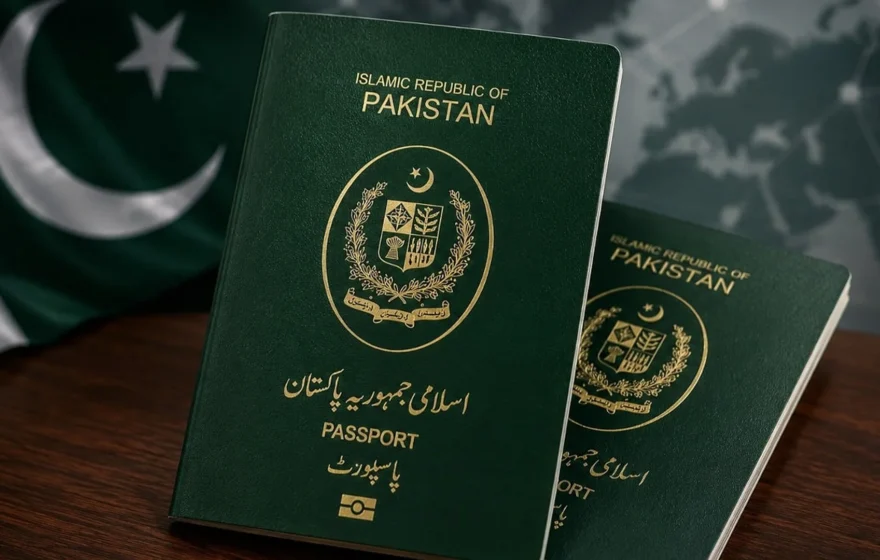
Pakistanis living in Thailand now have a clear price list for the country’s new electronic passports, after the Pakistan Embassy in Bangkok published what applicants will pay for regular and urgent processing. The revised schedule, which took effect on 23 October 2026, covers the standard passport sizes and validity periods, and it also sets out the much higher charges that apply when a passport has been lost. For families, workers and students planning a renewal or a first application, the announcement removes the guesswork from a process that has changed fundamentally in recent days, because Pakistan no longer issues the old machine-readable documents at all.
The timing is no accident. On the same day the new charges took effect, Pakistan completed a nationwide switch that had been building for more than four years, ending the issuance of machine-readable passports and moving entirely to electronic passports at offices across the country and at missions abroad. The Directorate General of Immigration and Passports has confirmed that the 22-year-old machine-readable system has now been phased out, although anyone who already holds a valid machine-readable passport can keep using it until the date printed on it. Only when that document expires will its holder have to apply for an electronic passport instead.
Under the Bangkok schedule, the cheapest option is the familiar 36-page passport valid for five years, which costs 1,500 Thai baht with normal processing and 2,400 baht if the applicant needs it urgently. The ten-year version of the same booklet costs 2,200 baht normally and 3,500 baht urgently. A 72-page passport valid for five years costs 2,600 baht normally and 4,100 baht urgently, while the ten-year, 72-page version, the most expensive standard option, costs 3,800 baht for normal processing and 6,000 baht for urgent processing. The embassy shared the schedule publicly on 25 October 2026.
The gap between normal and urgent processing is wide enough that applicants will want to plan ahead rather than leave an application to the last minute, since urgent processing adds roughly sixty per cent to the normal fee in every combination. Losing a passport is where the schedule bites hardest. Replacing a first lost passport costs between 3,000 and 12,000 baht, depending on page count, validity and processing category, while a second loss costs between 6,000 and 24,000 baht. Anyone applying after a third or fourth loss will have the fee decided under the applicable rules, with approval required from the Directorate General of Immigration and Passports headquarters in Islamabad.
The fee list makes more sense against the longer story of Pakistan’s passport modernisation. Electronic passports were first introduced in March 2022, but only for diplomats and residents of Islamabad, and it was not until August 2023 that every Pakistani citizen was given the option of choosing an electronic passport or a machine-readable one. For three years the two systems ran side by side. The final step was announced in the National Assembly, where the interior ministry said machine-readable issuance would stop within a month, and the original target of 15 October was later moved to 23 October, with machine-readable applications accepted until 22 October.
That local application matters because an embassy is, for citizens abroad, the passport office. Pakistanis in Thailand who need a new or renewed passport cannot walk into an office in Islamabad or Lahore, and they depend on the mission in Bangkok to issue the document and handle the paperwork in local currency. A published fee list in baht makes budgeting possible for workers sending money home, students on tight budgets and families renewing several passports at once. It also reduces confusion at the counter, where a misunderstanding about page count, validity or processing speed can mean a wasted journey or an unexpected extra charge.
The electronic passport itself is worth understanding, because the higher charges buy a different kind of document. Unlike the old booklet, an e-passport carries an electronic chip that stores the holder’s personal and biometric information, and the authorities say the technology is designed to strengthen security and make identity verification more effective in line with international standards. The Directorate General of Immigration and Passports has described the transition as part of a broader effort to modernise passport services for Pakistanis at home and overseas, pursued under the prime minister’s vision and on the instructions of Interior Minister Mohsin Naqvi, with Director General Muhammad Ali Randhawa calling it an important step towards modern travel documents.
For applicants in Thailand, the immediate task is practical. Those whose machine-readable passports are still valid do not need to rush to replace them. Those applying fresh, or renewing an expired passport, will now receive an electronic passport as a matter of course, and should expect to pay the Bangkok rates rather than the rupee rates charged inside Pakistan. Every Pakistani mission abroad is now issuing only electronic passports, so Pakistanis in Bangkok, the Gulf and Europe will hold a single format and a single set of security standards, which should make their passports easier to verify at borders and harder to misuse.
