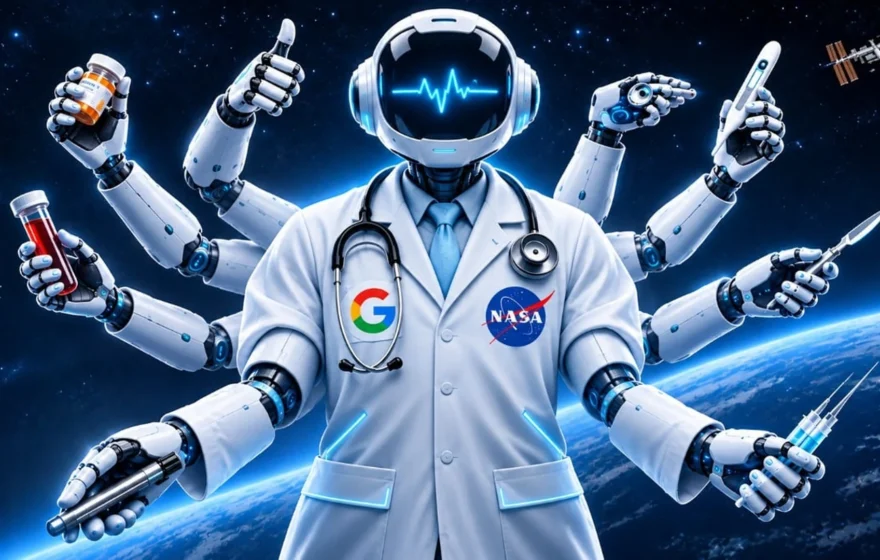
Google is working with NASA on an artificial intelligence robot that could one day help astronauts deal with medical emergencies far from Earth. The experimental machine is being designed to support crews on future journeys to the Moon and Mars, where a doctor on the ground cannot simply be called into the room. It would fetch equipment, organise supplies and help with routine jobs inside a spacecraft, giving a small crew an extra pair of hands.
The project is still at an early stage, and neither company is presenting it as a finished medical device. It cannot yet carry out medical procedures on its own, and it is not intended to replace the human crew member responsible for medical care. Its value lies in what it points towards: a crew that can look after itself for longer, with a machine handling fetching and preparation while people keep control of medical decisions.
Why Astronauts Could Need an AI Medical Robot
The problem the robot is meant to solve is distance. A crew travelling to Mars would be so far from Earth that a message sent to mission control and the reply coming back could take as long as 44 minutes for the round trip. In a sudden medical emergency, that delay could be dangerous, because a crew member in pain or facing a serious injury cannot wait for instructions to travel across millions of kilometres and back again before anyone acts.
That challenge grows sharper further from Earth. On the International Space Station, crews can speak to flight surgeons almost in real time, and a seriously ill astronaut can, in principle, be brought home comparatively quickly. A Mars crew would have neither advantage. The robot builds on a system Google and NASA began testing in 2025, the Crew Medical Officer Digital Assistant, which helped astronauts understand health problems when immediate help was unavailable. That system offered advice on a screen; the robot adds a physical helper that can move and prepare equipment.
How Google’s AI Robot Would Work
In practice, the robot would follow spoken instructions from astronauts and carry out practical tasks inside the spacecraft. Google gives the example of an astronaut suffering severe back pain that could signal kidney stones. In that situation, the robot could locate an ultrasound machine, bring it to the right place and prepare it for use. The crew medical officer would then examine the scan and decide what treatment was needed. The machine would do the fetching and preparation, while the human would do the judging.
Google says the robot could eventually help with simpler tasks, such as checking vital signs or assisting with ultrasound examinations. Even then, it would work under human supervision and would not make treatment decisions by itself. When it is not needed for medical work, the same robot could take on everyday duties, moving cargo, organising tools, securing equipment and helping with routine maintenance. On a long mission, where every crew member’s time is precious, that kind of help could improve both safety and productivity, even before it ever touches a medical task.
AI Robot Achieves 85% Success Rate in Early Tests
Google and NASA have begun testing the technology in laboratory conditions, and the early results are encouraging without being conclusive. In one experiment, the robot was asked to find a medical bag and move it elsewhere. It succeeded in about 85 per cent of its first tests. That shows real progress, but also why the system is far from ready for a real emergency: a helper succeeding roughly six times out of seven in a laboratory would not be trusted with a life-or-death task in a spacecraft.
Researchers are refining how the robot understands its surroundings and handles objects, far harder in the confined interior of a spacecraft than in an open laboratory. NASA’s Jet Propulsion Laboratory is adapting technology originally developed to track objects in space to help it navigate indoors, and the team is using Google DeepMind’s MuJoCo simulation software to test its movements virtually first. Power is another constraint, so Google says researchers have tested around 15 computing devices to find hardware that runs the system well without using too much electricity.
When Will NASA Send the Robot to Space?
Google has not announced when, or even whether, this particular robot will be sent into space. The project remains in its early testing phase, and the company has not confirmed that a fully working, space-ready version exists. The work involves Google Cloud, NASA’s Human Research Program, the Johnson Space Center and the Jet Propulsion Laboratory, and the teams still need to improve the system’s reliability, its movement and its ability to work safely around astronauts in close quarters. Those safety questions must be answered to a very high standard before any crew would rely on such a machine.
Still, the direction of travel is clear. As NASA’s Artemis programme plans increasingly ambitious Moon missions, with a sustained presence there as a stepping stone towards crewed missions to Mars, crews will spend longer further from Earth. Google’s long-term goal is a machine that understands simple voice commands and helps with medical and everyday tasks. If it succeeds, astronauts may find their most useful crewmate is a machine that never tires and is always ready to help.
