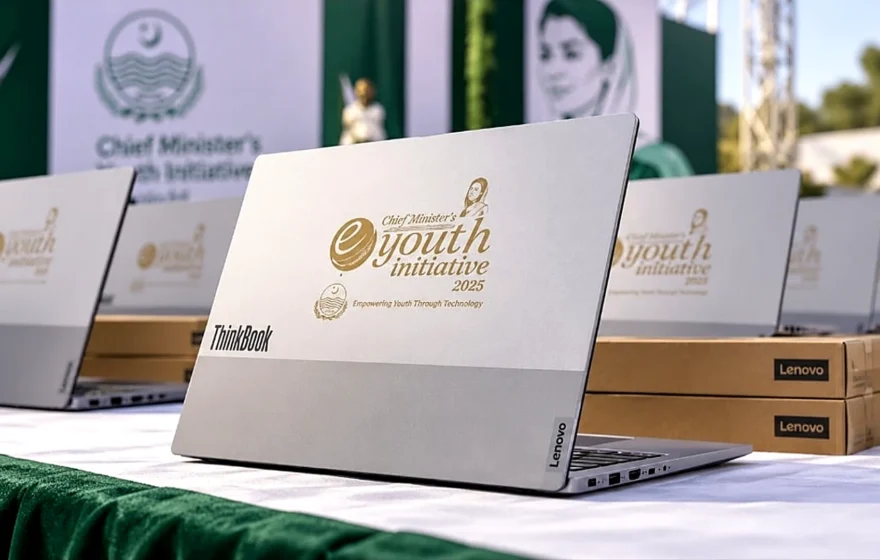
Punjab Chief Minister Maryam Nawaz Sharif has distributed laptops and scholarship cheques to students at a ceremony at COMSATS University in Attock, in the latest round of a provincial programme that aims to put higher education within reach of students who might otherwise be forced to stop studying for financial reasons. At the ceremony, 6,161 laptops were handed over to students from across Rawalpindi Division, alongside cheques under the Honhaar Scholarship Programme for deserving students.
The scale of the laptop distribution reflects how the programme is organised. Rather than a single province-wide event, devices are distributed division by division, so that students in each region receive their laptops at ceremonies in their own area. Rawalpindi Division, which includes Attock and neighbouring districts, is one of the larger divisions in the province, and a distribution of more than six thousand machines in one round gives a sense of the numbers involved. For many recipients, a laptop is not a luxury item but the basic tool on which coursework, assignments, research and online learning now depend.
Alongside the laptops, the ceremony also highlighted the Honhaar Scholarship Programme, through which the Punjab government says it has now awarded scholarships to 108,000 students across the first, second and third phases. That figure matters because it moves the programme beyond a symbolic gesture. A scholarship scheme that reaches six figures of students begins to change the calculations made by families deciding whether a child can continue to university, particularly in households where every rupee is already committed to food, rent and other essentials.
Addressing the ceremony, the chief minister spoke about the students the programme is designed to reach. She drew attention to young people from financially struggling families, including students who have lost their fathers and those whose fathers work as daily wage labourers. Those two examples describe very different kinds of hardship, but they share a common feature: in both cases, the family’s income is either absent or unpredictable, which makes the cost of education, from fees to books to transport, a recurring crisis rather than a one-off expense. A scholarship or a laptop does not remove that pressure entirely, but it removes one large and visible obstacle at a critical moment.
Her central pledge at the ceremony was that no student should have to abandon education solely because of financial difficulty, and that every capable and hardworking student deserved access to education. Pledges of that kind are easy to make and harder to deliver, and their test lies in the details that follow the ceremony: whether scholarships arrive on time, whether eligibility rules are clear and fairly applied, and whether students in remote districts hear about the programme and can apply without travelling long distances or navigating complicated paperwork. The experience of students who have already received support will therefore matter as much as the announcements themselves.
The choice of venue also carries meaning. COMSATS University is one of the country’s better-known public institutions for science and technology, and holding the ceremony there places the scheme in an academic setting. Universities are where a laptop’s value becomes visible: students use them to write papers, run software, attend online lectures and apply for internships and jobs.
Laptop schemes in Pakistan have a long and mixed history, and that history is worth remembering when assessing any new round. Earlier programmes, at both federal and provincial level, were praised for widening access to technology but also criticised at times over targeting, delays and questions about whether devices reached the students who needed them most. The lesson drawn by education specialists from those experiences is consistent: distribution is the easy part, while selection, verification and follow-up determine whether a scheme is fair. Publishing clear criteria, keeping records open to scrutiny, and tracking whether recipients remain in education are the measures that separate a durable programme from a one-day event.
The Honhaar programme’s emphasis on students from struggling backgrounds suggests that its designers are aware of that risk. Scholarships that cover fees and related costs, combined with a laptop, address two barriers at once: the cost of being a student and the cost of the tools a student needs. For a student whose father works as a daily wage labourer, the combination may be the difference between enrolling and staying home. For a student who has lost a parent, it may reduce the pressure to take on full-time work immediately after school.
For the students who collected laptops in Attock, however, those longer-term questions are for another day. Their immediate reality is a new machine, a scholarship cheque for some, and a public acknowledgement that their hard work has been noticed. If the devices are used well, if the scholarships are paid promptly, and if the programme keeps reaching students in the circumstances the chief minister described, then the ceremony will have been more than a photo opportunity. It will have been one more step towards a system in which a student’s prospects depend a little less on the size of their family’s income and a little more on their own ability and effort.
