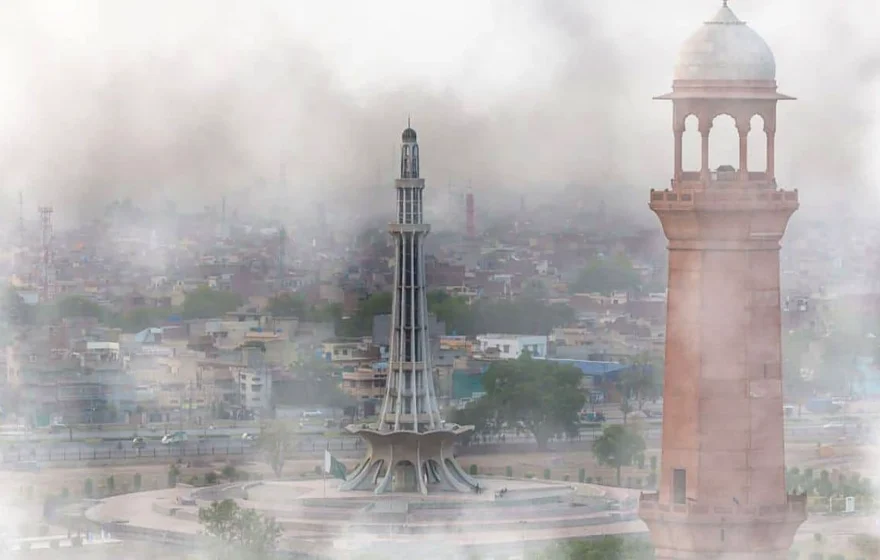
The Punjab government has launched a new cleanliness and anti-smog campaign, called Chamkta Lahore, aimed at reducing airborne dust, improving sanitation and keeping roads and public spaces clean across the provincial capital. The campaign, launched on the directives of Chief Minister Maryam Nawaz Sharif, was inaugurated by Local Government Minister Zeeshan Rafique at Liberty Chowk, one of the city’s busiest roundabouts and a fittingly visible starting point for a drive about cleaner streets.
At its core, the campaign is a practical response to a problem Lahoris know all too well. Every winter, a thick haze settles over the city, a mixture of dust, vehicle exhaust, smoke from burning and industrial emissions that turns the air grey, stings the eyes and makes breathing difficult, especially for children, older people and anyone with asthma or other lung conditions. Road dust is one of the contributors: dry, dusty surfaces are constantly churned up by traffic, and the fine particles stay in the air long after the vehicle has passed. Washing roads and suppressing dust is therefore not cosmetic; it targets one of the sources of the particles people breathe.
The scale of the operation is substantial. The government has identified 100 major roads, locations and commercial markets for targeted cleaning, and plans to wash approximately 648 kilometres of roads every week, with a daily target of 100 kilometres. To do that work, the campaign will use 16 mechanical washing machines for road cleaning and 46 rickshaw-mounted washers for footpaths, the narrower spaces that larger machines cannot reach. In addition, 10 rickshaw-mounted anti-smog mist guns will spray fine water into the air to settle dust particles, a technique used in many dusty cities to bring down airborne particulate levels, at least temporarily.
Speaking to the media at the launch, Rafique said the government’s anti-smog measures over the past two years had produced encouraging results, claiming that smog levels in November were noticeably lower than those recorded two years ago. That claim will be tested by the coming winter, because November is when Lahore’s air quality typically deteriorates as temperatures fall, winds drop and the various sources of pollution combine. If the campaign, together with other measures, can keep the worst days at bay, it will be a genuine achievement. If not, residents will judge the effort by the air they breathe rather than by the launch ceremony.
The minister expressed confidence that the new campaign would further improve air quality and cleanliness across Lahore. Confidence, however, is only part of the story. Anti-smog campaigns face a recurring challenge: washing a road helps for hours, not weeks, and dust returns as soon as traffic resumes and the surface dries. Sustained impact therefore depends on repetition, on the machines actually covering their daily target, and on the campaign continuing through the worst of the winter rather than fading after the opening weeks. The weekly and daily targets announced at the launch give the public a yardstick against which to measure that follow-through.
Rafique also used the occasion to highlight wider development work under way in Punjab, including road infrastructure, healthcare, education and urban beautification, saying these initiatives were being implemented from major cities down to union councils to improve public facilities and people’s quality of life. That broader framing presents Chamkta Lahore as part of a larger effort to make cities more liveable, rather than a standalone response to smog. Clean streets, working footpaths and maintained public spaces do contribute to health and wellbeing in their own right, quite apart from their effect on air quality, by reducing litter, standing water and the general grime that accumulates in a fast-growing city.
For residents, the campaign offers something tangible to watch. Washed roads, cleaner markets and mist guns in operation are signs that the machinery of the campaign is working. The less visible test will be whether the air itself improves on the days when smog would normally be at its worst. Lahore’s citizens have heard many anti-smog announcements over the years, and their patience depends on results they can feel in their lungs and see in the sky.
If Chamkta Lahore delivers on its daily targets through the winter, it will have made a real, if partial, contribution to a cleaner city. Clean roads will not end smog on their own, but they will reduce one of its sources, improve the look and feel of public spaces, and show that the government is willing to do the unglamorous, repetitive work that cleaner air requires. In a city where the winter haze has become an annual ordeal, that kind of sustained effort is exactly what residents have been asking for.
