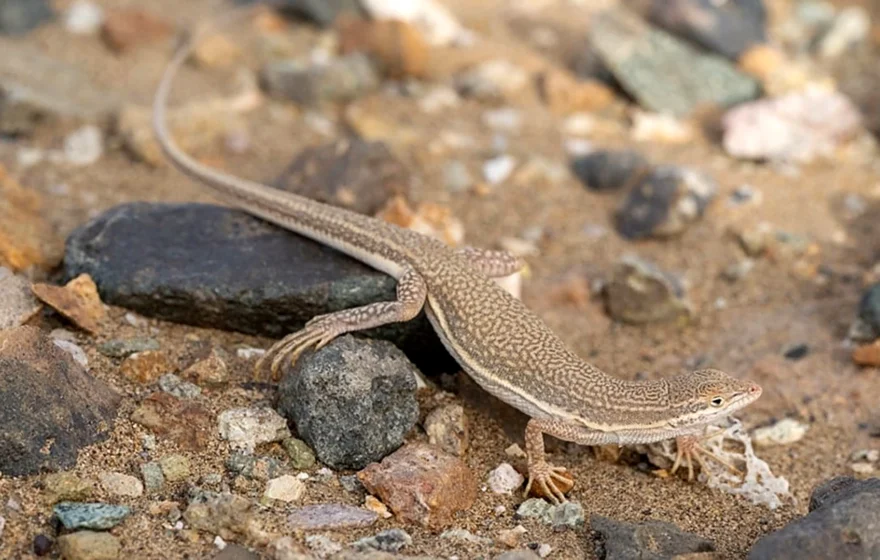
An international team of researchers has identified a lizard species never before known to science in the deserts of Balochistan, a discovery that underlines how much of Pakistan’s wildlife remains unrecorded despite decades of natural history work. The new species, found in Chagai District in the far west of the province, has been given the scientific name Eremias chagaiensis, after the district where it lives, and it belongs to a group of fast-moving desert lizards known as racerunners.
Racerunners are built for open, sandy country. They are slender, alert lizards that dart between shrubs and burrows, and they are a familiar sight to anyone who has spent time in arid landscapes across Central and South Asia. What sets the Chagai animal apart is the pattern on its back. Where most of its relatives carry lengthwise stripes running from head to tail, this species carries winding, maze-like brown markings that stay visible throughout its life, in young lizards as well as adults. That consistent difference was one of the first clues that the researchers were looking at something distinct, rather than a local variation of a known species.
The lizards were recorded at four separate locations during field surveys carried out between 2022 and 2025, a span that itself says something about the difficulty of working in this terrain. Chagai is remote, sparsely populated and climatically harsh, and reaching its dune fields repeatedly over several seasons requires planning, local knowledge and patience. The animal itself is small: its body reaches up to 5.7 centimetres, not counting the tail, which can grow to more than twice the length of the body. A creature that size, the colour of sand and shadow, is easy to miss, especially when it spends much of its time in burrows or moving quickly between patches of cover.
The research was led by Rafaqat Masroor of the Pakistan Museum of Natural History, an institution that holds the country’s most important reference collections of its fauna. Speaking about the find, he pointed to the wider significance of working in a region that science has barely touched. Balochistan’s deserts, he said, rank among the least explored places in South Asia, and finding a previously unknown vertebrate there is a reminder of how much remains undocumented. That observation carries a practical consequence: species cannot be protected, studied or even counted if nobody knows they exist, and conservation plans drawn without that knowledge may miss the very animals most in need of attention.
At first glance the new lizard closely resembled another recently described species, Eremias graphica, identified in Iran in 2023. Resemblance, however, is not identity, and the team tested the question carefully before concluding that they had a new species. They analysed two mitochondrial genes and one nuclear gene, a combination that lets researchers compare both the maternally inherited genetic signal and a separate line of evidence from the cell nucleus. They also compared body proportions and scale patterns in detail. Together, the genetic and physical evidence pointed the same way: the Chagai lizard is a separate species, not a population of its Iranian lookalike.
The same study produced a second notable result. It confirmed, through modern specimen examination and DNA analysis, that another species, Eremias fasciata, is indeed present in Pakistan, more than a century after it was first reportedly recorded in the country. Old records of that kind are often treated with caution, because early identifications were made without the tools available today and because similar species are easily confused. A confirmation grounded in both specimens and genetics puts the record on firm footing, and it also matters for understanding relationships: in the mitochondrial analysis, E. fasciata emerged as the closest relative of the new species, with roughly 10.6 percent difference in the genes examined, a substantial gap that supports treating them as distinct.
Ecology helped to complete the picture. The new species was found chiefly in loose sand, particularly on low dunes and sandy patches near desert shrubs, where the lizards dig burrows. It was absent from nearby gravel plains, and those gravel areas were instead occupied by E. fasciata. That separation of habitat is a classic pattern in desert ecology: closely related species divide the landscape between them, each adapted to a slightly different ground type, and that division reduces direct competition. It also means that the new species may be more vulnerable than its small size suggests, because its preferred habitat, loose dune sand, is a specific and patchy resource rather than the whole desert.
