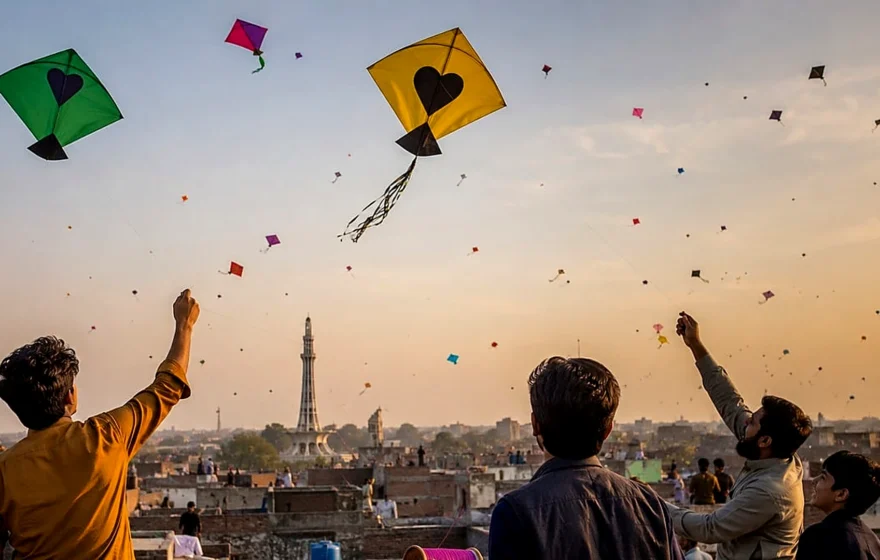
The Punjab government has announced a set of safety measures and restrictions for Basant 2027, the kite-flying festival scheduled to take place in Lahore from 12 to 14 March. The decisions, taken at a meeting of officials and kite-flying representatives, aim to let the festival go ahead with colour and enthusiasm while preventing the accidents that have overshadowed Basant in the past and led, at various times, to its suspension.
Under the new plan, kite flying will be restricted to the three designated festival days only. Flying outside those dates will not be permitted, a rule the administration says is essential if the festival is to remain manageable for police, hospitals and rescue services. Alongside that restriction, authorities have ordered an immediate crackdown on the sale of illegal kite strings and prohibited raw materials, the items most often blamed for the festival’s most serious injuries.
The danger is well known to Lahoris. Traditional kite string, when coated with glass or other abrasive material to cut rival kites, can act like a blade. Motorcyclists have been among the worst affected, with strings stretched across roads causing deep cuts, and children and bystanders have also been injured. That history explains the second major decision from the meeting: a campaign to fit safety rods on motorcycles, devices designed to deflect a string before it can reach a rider’s neck. Officials have directed the relevant departments to make sure the rods campaign is carried out properly, not merely announced.
Security arrangements for the festival were also discussed in detail. The meeting directed departments to ensure strict security before, during and after the three days, covering crowd management, traffic, emergency medical readiness and enforcement against illegal activity. Lahore DIG Operations Faisal Kamran told the meeting that strict measures would be put in place to ensure peaceful celebrations, drawing a parallel with Basant 2026, which officials present as a model for how the festival can be held safely.
Among those at the meeting were Waqar Ahmed, an aide to PML-N leader Nawaz Sharif, Deputy Commissioner Muhammad Ali Ijaz, DIG Faisal Kamran and representatives of kite-flying associations. The presence of association representatives matters, because a festival that depends on thousands of rooftop flyers cannot be policed entirely from above. If the associations accept the rules and help spread them among their members, compliance is far more likely than if the rules are simply imposed. Waqar Ahmed said licensed permit holders would be allowed to operate freely, provided they followed the prescribed rules and regulations, a message aimed at reassuring legitimate traders and flyers that the crackdown targets illegal material, not the festival itself.
Deputy Commissioner Muhammad Ali Ijaz stressed that public safety remained the administration’s top priority and warned that kite flying would not be allowed outside the official dates. That warning is significant because much of the risk in previous years came not from the festival days themselves, when police and medical teams are on alert, but from flying in the days before and after, when strings remain in the air and on roads without the same level of supervision. A clear, enforced window helps everyone, from flyers to commuters, know when the skies are busy and when they are not.
Officials also discussed regulating the prices of bamboo and other raw materials used to make kites, with the aim of keeping the festival affordable for lower-income groups. Basant has always been a people’s festival as much as a spectacle, with families on rooftops across the old city and beyond, and price spikes in raw material can push poorer enthusiasts towards cheaper, sometimes illegal, alternatives. Keeping inputs affordable is therefore not only an economic measure; it is also a safety measure, because it reduces the incentive to use prohibited string.
The broader context is that Basant occupies a complicated place in Lahore’s recent history. For years it was one of the city’s great public celebrations, drawing visitors from across Pakistan and abroad, filling the sky with colour and the rooftops with music and food. But a series of fatal accidents, particularly involving motorcyclists, led to bans and to a long period in which the festival was either not held or held only in restricted form. Its return in recent years has therefore been cautious, with authorities trying to recover the celebration without repeating the tragedies. The 2027 measures continue that careful approach: the festival is welcomed, but on terms designed to protect life.
For residents, the practical message is simple. Kite flying is for 12 to 14 March, with licensed sellers and permit holders operating within the rules, safety rods on motorcycles, and enforcement against illegal string. For traders, the message is that legitimate business will be allowed to proceed, while illegal material will be seized. And for the city as a whole, the hope is that Basant 2027 can be remembered for its colour rather than its casualties. If the restrictions are enforced consistently, and if flyers respect the three-day window, Lahore may be able to show that a beloved tradition and public safety are not opposing goals but two parts of the same celebration.
