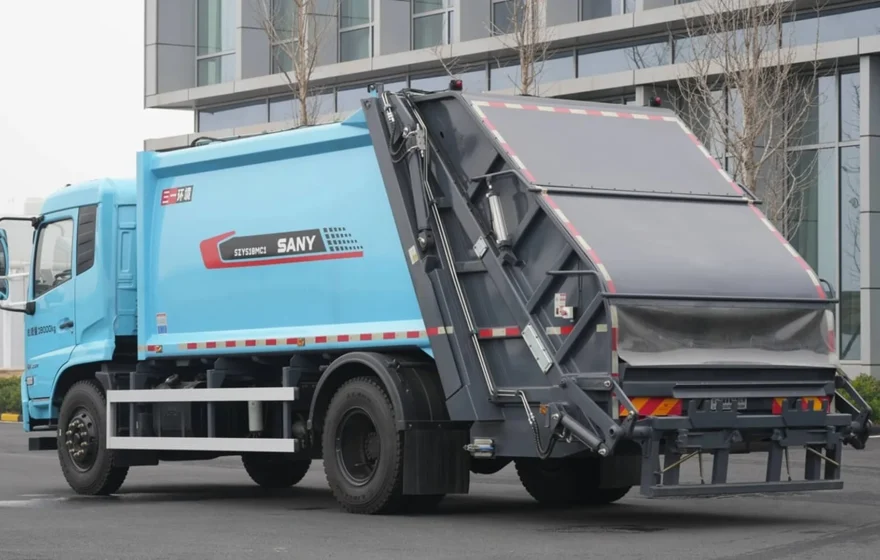
Punjab has put Pakistan’s first fully electric sweeper truck on the road, in a move the provincial government says will make street cleaning cleaner, quieter and cheaper. Chief Minister Maryam Nawaz Sharif inaugurated the vehicle in Lahore, inspected it herself, and was briefed on how it works before it was sent out for duty. The truck will begin its working life on the Lahore Ring Road, sweeping and washing the carriageway, and it carries a feature no road cleaning vehicle in the country has had before: a water suction system that can pull standing water off the surface and leave the road dry.
The machine is a sweeper and a washer in one. Its electric broom and brushes clear dust and litter from the road, while its washing system cleans the surface, and the suction unit deals with puddles and standing water after rain. That last point matters in a city where monsoon downpours regularly leave water sitting on main roads, slowing traffic and damaging the surface. Until now, clearing that water has meant waiting for it to drain or dry. The new truck can remove it as part of its normal cleaning round, which is why officials are describing the suction system as a first for Pakistan.
On a single full charge, the truck can keep sweeping and washing for up to 70 kilometres, which is enough to cover a long stretch of a major road before it needs to plug in again. Because it runs entirely on electricity, it produces no exhaust emissions at the point of use, and it runs far more quietly than the diesel trucks that have done this work until now. Both points count in Lahore, a city that struggles with dirty air and heavy traffic noise, and where every source of pollution that can be removed helps. Road dust is a particular problem, since it is kicked up again and again by passing traffic, and a sweeper that traps dust rather than scattering it can make a visible difference to the air along a busy route.
Money is the other half of the argument. An electric truck has no diesel to buy and far fewer moving parts to maintain than a conventional sweeper, so the province expects its running costs to fall sharply over time. Fuel and maintenance are the two biggest running costs of any municipal fleet, and a vehicle that cuts both is attractive to a government that has to keep hundreds of machines working every day. The chief minister’s team made that point plainly at the launch, presenting the truck not as a showpiece but as a working machine that should pay for itself through lower bills.
The launch fits into a much larger clean-up effort that Punjab has been building for the past two years. The Suthra Punjab programme, launched in December 2024, now collects more than 50,000 tons of waste every day across 36 districts and 141 tehsils, with over 140,000 workers and real-time digital monitoring of the work. In Lahore alone, the authority fields more than 4,200 vehicles, including over 3,000 rickshaw loaders, and more than 18,000 sanitation workers, alongside road washing and mechanical sweeping machinery. The province has also introduced three-colour bins to encourage people to separate waste at source, with more than 2,000 bins already placed in key areas.
The electric sweeper is the latest step in that direction. In December 2025, the chief minister approved a plan to modernise the province’s sanitation system, with electric vehicles for cleaning work at its centre, alongside a waste-to-value project that aims to turn rubbish into usable resources and digital systems to track vehicles and payments. Cleaning services are now provided seven days a week, including Sundays, and littering in commercial areas and on roads can bring legal action.
That scale is what makes a single truck worth watching. One electric sweeper will not clean a city on its own, and the real test is whether more of them follow. The Ring Road deployment is a trial in all but name: if the truck proves reliable over 70-kilometre shifts, keeps its running costs down, and handles standing water as promised, the case for buying more becomes hard to argue against. Other cities in Punjab, and other provinces, will be watching the same numbers. Municipal fleets across Pakistan still run almost entirely on diesel, and a successful electric sweeper in Lahore would be the first proof that the alternative works on Pakistani roads, in Pakistani heat, on a daily cleaning schedule.
There is a wider shift behind the launch as well. Electric vehicles are moving from private cars and bikes into the working machinery of government, from anti-littering patrol bikes to full-size cleaning trucks, and each step makes the next one easier to justify. Charging points, trained drivers and maintenance crews built up for one vehicle can serve a whole fleet. For now, the truck’s job is simple: keep one of Lahore’s busiest roads clean and dry. If it does that well, quietly and cheaply, it will have made the argument for its own successors.
