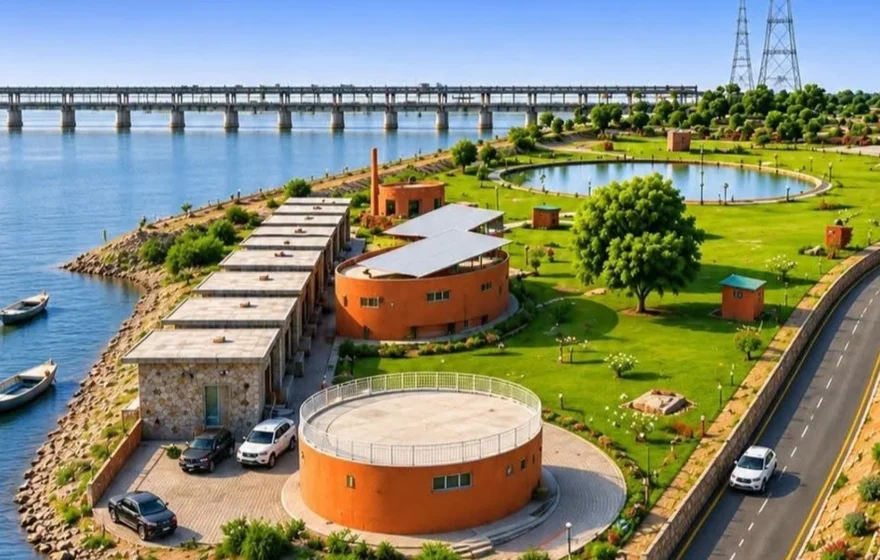
Punjab has opened a new riverside resort where visitors can watch one of Pakistan’s rarest animals. Chief Minister Maryam Nawaz Sharif has announced the launch of the Tourism Development Corporation of Punjab (TDCP) Blind Dolphin Resort at Taunsa Barrage in Kot Addu, a 120-kanal retreat along the River Indus with the endangered Indus blind dolphin as its star attraction.
The chief minister shared the news in a post on X on November 5. She invited visitors to imagine sipping their morning tea while watching the rare blind dolphins leap through the waters of the Indus, and described the resort as part of her government’s vision for a Magnificent Punjab, a push to open up the province’s natural treasures to tourists. The resort, she said, is an eco-friendly destination built to international standards, combining hospitality, wide terrace views over the river, dining, and wildlife conservation.
For the Tourism Development Corporation of Punjab, which will run the resort, the project is a chance to put a little-known corner of the province on the tourism map. Taunsa Barrage sits on the Indus near Kot Addu, around 20 kilometres north-west of the town, in a stretch of river long recognised for its wildlife. The barrage and its surrounding wetlands were declared a wildlife sanctuary in the early 1970s and listed as a Ramsar wetland of international importance in March 1996, covering some 6,756 hectares. It is an important wintering ground for water birds, and its waters are also home to hog deer, the smooth-coated otter and the Indus dolphin.
The animal at the heart of the project is unlike any other dolphin in the world. The Indus blind dolphin, known locally as the Bhulan, lives only in the Indus River system of Pakistan and a small stretch of the Beas River in India. It has adapted to the murky, sediment-laden waters of the Indus by effectively giving up its sight: its eyes have no lens, so it cannot see in any meaningful sense. Instead it navigates and hunts fish by echolocation, sending out sound pulses and listening for the echoes from the riverbed and its prey. That adaptation has made it a symbol of the Indus, but it has also left it deeply vulnerable to the changes humans have made to the river.
The species is listed as endangered on the International Union for Conservation of Nature’s Red List, and its story is one of near-loss followed by a slow recovery. By the 1970s, the population had fallen to only around 100 animals, squeezed by the barrages and dams that divided the Indus. Today, after decades of conservation work led by WWF-Pakistan, the population has climbed back to roughly 2,000; a survey in 2017 counted 1,816 dolphins. Yet the population remains fragmented into five sub-groups, and the stretch around Taunsa holds only a modest share: about 170 dolphins between Chashma and Taunsa and around 571 between Taunsa and Guddu, while the largest group, more than 1,000 animals, lives further downstream between Guddu and Sukkur, where the Indus Dolphin Reserve offers formal protection.
That fragility is why a resort built around the dolphin matters, and also why it must be handled with care. The threats that pushed the species to the edge have not gone away: dolphins still die in fishing nets, still get stranded in irrigation canals when water levels fall, and still suffer from pollution and the diversion of river water. Over the past two decades, conservation teams have rescued and returned around 300 stranded dolphins to the main river. A resort at Taunsa could help that work, by giving local people a reason to protect the dolphins and by raising awareness among the fishing communities whose nets pose the greatest danger. But it could also add pressure if boat traffic and crowds disturb animals that rely entirely on sound to navigate, feed and breed. Balancing tourism with the needs of a blind, sound-dependent animal will be the real test of the project.
For the people of Kot Addu, the resort also promises something more immediate: jobs, visitors and a reason for travellers to stop in a part of Punjab that rarely features on tourist itineraries. Southern Punjab has no shortage of history and natural beauty, yet its tourism infrastructure has lagged behind the north. A well-run resort at Taunsa could change that, drawing birdwatchers, families and school groups. If the visitors come, the small businesses around the barrage, from tea stalls to guides and guesthouses, stand to benefit too.
The launch is only the beginning. A resort is judged not by its opening announcement but by how it is run in the months that follow: whether the facilities are maintained, whether visitor numbers are managed so the dolphins are watched, not harassed, and whether the conservation message at its heart survives the day-to-day business of hospitality. For now, Punjab has given its most unusual animal a new stage, and anyone who makes the journey to Taunsa Barrage at dawn, tea in hand, may be lucky enough to see a blind dolphin leap through the waves of the Indus.
