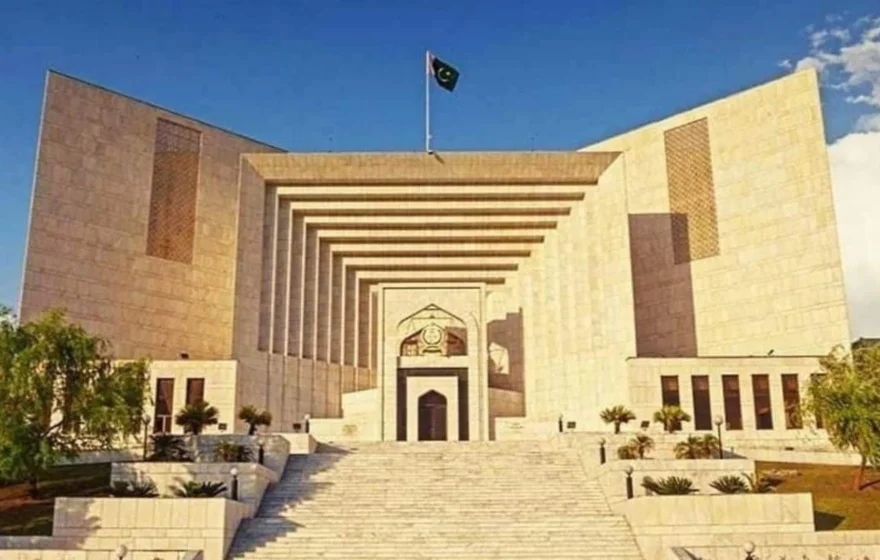
The Supreme Court has set out eight clear grounds on which bail granted to an accused person can be cancelled, ruling that the concession can be withdrawn when it is misused or when it begins to interfere with the course of justice.
In a judgment written by Justice Muhammad Ali Mazhar, the court held that bail may be cancelled if the order granting it is prima facie illegal or unjust, or if the accused tries to influence prosecution witnesses, tampers with evidence, or otherwise obstructs justice. The ruling draws a firm line between the grant of bail and its cancellation, treating the two as governed by very different principles.
The court listed the remaining grounds in the same judgment. Bail can be withdrawn where there is a risk that the accused will flee the jurisdiction of the court, where the accused interferes with the investigation, or where the accused commits a similar offence while out on bail. Fresh facts or evidence that come to light after bail has been granted, and that tend to link the accused with the alleged crime, can also justify cancellation.
The ruling came in a case from Larkana, where the court dismissed an appeal and upheld a decision of the Sindh High Court. The case concerned the death of a man in Larkana, and the accused in the matter is Ali Asghar Khokhar. The Sindh High Court had granted him pre-arrest bail on October 20, 2025, after a sessions court had turned down his application. The Supreme Court, while deciding the appeal, observed that the nine-month delay in the registration of the first information report, along with the question of the accused’s alleged involvement in the incident, were matters that still required further inquiry.
The judgment also carried a direction that reached beyond the bail question itself. The court ordered that a copy of the judgment be sent to the Water and Power Development Authority, so that the authority could examine allegations of illegal electricity supply and power theft connected with the case.
The ruling matters because bail occupies a sensitive place in Pakistan’s criminal justice system. Bail is not an acquittal, and it is not a finding that the accused is innocent. It is a concession, granted on the understanding that the accused will face trial, cooperate with the investigation, and leave witnesses and evidence alone.
Under Section 497 of the Code of Criminal Procedure, the power to cancel bail sits in subsection 5 of the provision that governs bail in non-bailable offences. The courts have repeatedly held that the principles for cancelling bail are completely different from the principles for granting it. Granting bail turns on whether there are reasonable grounds to believe the accused committed the offence and whether the case calls for further inquiry. Cancelling it turns on something else entirely: whether the order was wrong in the first place, or whether the accused has since behaved in a way that makes the concession untenable.
That distinction has been settled in earlier judgments of the Supreme Court. In the Samiullah case, the court laid down guidelines that have been followed ever since. Bail should be cancelled only where the order granting it is so patently illegal, erroneous, or factually incorrect that it results in a miscarriage of justice, where the accused has misused the concession in any manner, or where the accused has tried to hamper the prosecution evidence by persuading or pressurising witnesses. The same guidelines cover the likelihood of the accused absconding, interference with the investigation, a similar offence while on bail, and fresh facts that tend to establish guilt.
The courts have also stressed that the threshold for cancellation is high. In an earlier ruling, the Supreme Court held that very strong and exceptional grounds would be required to interfere with bail once granted, because the accused stands clothed with liberty as a consequence of the concession. The mere possibility of a different view is not enough to justify recalling bail.
That reluctance has a constitutional foundation. The right to liberty and the right to a fair trial are guaranteed under Articles 9 and 10-A of the Constitution, and an accused person is presumed innocent until proven guilty. At the same time, the system cannot work if witnesses are intimidated, evidence is destroyed, or the accused simply disappears. The eight grounds are the court’s attempt to hold that balance.
For trial courts, the judgment is a useful checklist, and for the prosecution it clarifies what must be shown: not merely that the accused might be guilty, but that the bail order was flawed or that the accused has misused the liberty it gave. For the defence, it confirms that bail, once granted, cannot be taken away lightly. The Larkana case itself is not over, and the trial will still have to answer the questions the court flagged. What the judgment ultimately does is give the law on bail cancellation a clear, workable shape.
