Twenty-three Pakistani students who carried the country’s flag into some of the toughest science competitions in the world have been honoured at home, with the Higher Education Commission recognising a year in which the national teams brought back 14 international awards. The students represented Pakistan in Biology, Chemistry, Physics, Mathematics and Artificial Intelligence at the 2026 International Science Olympiads, winning one silver medal, six bronze medals, five honourable mentions, one Certificate of Merit and one Certificate of Recognition.
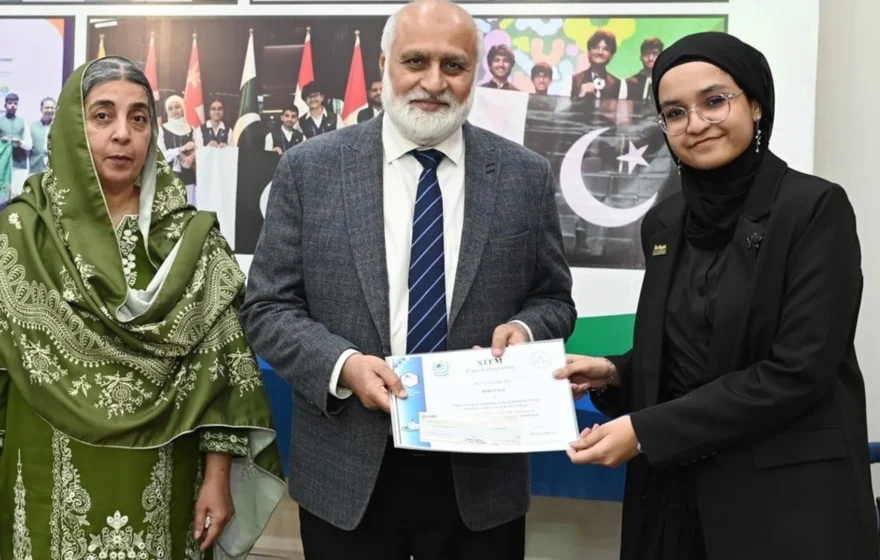
The achievements were celebrated at a ceremony organised by the STEM Careers Programme, the joint initiative of the Higher Education Commission and the Pakistan Institute of Engineering and Applied Sciences that finds talented school students, trains them and sends them to the annual international competitions. Higher Education Commission Chairman Professor Dr Niaz Ahmad Akhtar attended as chief guest, congratulated the students on their performance and distributed cash prizes and certificates in recognition of what they had achieved against the best young scientists from around the world.
The standout result of the year came in biology. Hassan Atif Cheema, a student of the International School Lahore, won the silver medal at the 37th International Biology Olympiad, held in Vilnius, Lithuania, from July 12 to 19, 2026. The competition brought together more than 350 outstanding students from over 90 countries, making it one of the most demanding contests in the world for school-level biology. Muhammad Mutahir of Karachi Grammar School also earned recognition at the same event, receiving a merit certificate for his performance.
Pakistan’s teams did not stop at biology. Earlier in July, the country won three bronze medals at the 56th International Physics Olympiad held in Bucaramanga, Colombia, a result that showed the depth of the talent coming through the national programme. Across the five subjects, the 23 students together collected 14 awards, a haul that placed Pakistan firmly among the countries whose school science programmes are producing results on the world stage rather than simply taking part. The year also carried a milestone beyond medals: Pakistan made its first official appearance at the International Olympiad in Artificial Intelligence, the newest of the international science competitions, expanding the country’s presence into the field that will shape the next decade of science and technology.
Behind every medal is a selection and training system that most people outside it never see. The students were chosen through the National Science Talent Contest, conducted under the STEM Careers Programme, with the biology team picked through the 22nd edition of the contest. From there, the selected students went through months of intensive preparation, including training at specialist institutions such as the National Institute of Biotechnology and Genetic Engineering, guided by local and international experts. The biology team was led by Professor Dr Asma Imran and Dr Aamir Ali of NIBGE, and the chairman used the ceremony to acknowledge the contributions of parents, teachers and mentors from PIEAS, COMSATS Lahore, NIBGE and the International Centre for Chemical and Biological Sciences at the University of Karachi.
Professor Dr Niaz Ahmad Akhtar also used the occasion to reaffirm the Higher Education Commission and the government’s commitment to promoting scientific talent and supporting the next generation of scientists, researchers and innovators. The words carry weight because the Olympiad programme is one of the few places where Pakistan’s investment in young scientific talent can be measured directly against the rest of the world. A medal at an international Olympiad is not a matter of opinion or of local marking standards. It is earned in the same examination hall, against the same questions, as students from countries with far larger education budgets.
Pakistan’s record in these competitions goes back more than two decades. The country has participated in the International Physics Olympiad since 2001, the International Mathematics Olympiad since 2005, and both the International Biology and Chemistry Olympiads since 2006. Since the launch of the STEM Careers Programme, more than 365 Pakistani students have represented the country at international science Olympiads, collectively winning 144 medals, while more than 5,000 students have been trained through the initiative.
Yet the ceremony also raised a question that goes beyond celebration. Pakistan produces world-class young scientists at school level, but the country still struggles to keep them. Many of the brightest students who shine at Olympiads go on to study abroad, and a large share of them build their careers outside Pakistan, drawn by research funding, laboratories and salaries that the country cannot yet match.
That is why the chairman’s promise of continued support matters, and why it will be judged by what follows rather than by what was said at the ceremony. Cash prizes and certificates are a welcome recognition, but the real test is whether the students honoured this week find scholarships, research opportunities and careers in Pakistan that match their talent. If they do, the 14 awards won in 2026 will be remembered as one more step in a long climb. If they do not, the country will keep celebrating its young scientists at home and losing them abroad.
