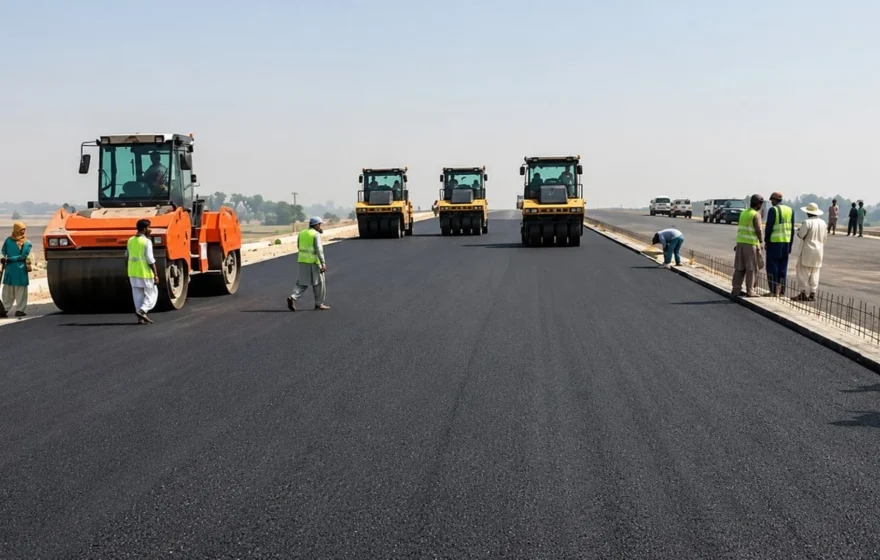
Two of Rawalpindi’s busiest roads are open to traffic again after full reconstruction, giving daily commuters some relief from the potholes, dust and broken surfaces that had made driving through the area a daily ordeal. Federal Parliamentary Secretary for Information and Broadcasting Barrister Danyal Chaudhry formally inaugurated the rebuilt Rawal Road and Band Khanna Road on Friday, telling the ceremony that the government intended to keep fixing the city’s crumbling urban infrastructure rather than patching it up and moving on.
Rawal Road runs from Ali Nawaz Chowk to Murree Road, one of the main arteries feeding into the heart of the garrison city, while Band Khanna Road serves a densely populated stretch where homes, shops and small businesses sit almost on top of the carriageway. When either road breaks down, the congestion spills onto Murree Road, into Satellite Town and across the surrounding neighbourhoods, turning short trips into long ones.
Speaking at the inauguration, Chaudhry said construction of the Gangal to Expressway Link Road would also be completed soon, a project he described as important for improving traffic flow and connectivity across the district. The link road is meant to give traffic another route towards the Expressway, easing the pressure on the roads that currently carry most of the load between Rawalpindi’s older neighbourhoods and the newer developments on its edges. For residents who spend part of every day stuck at the same choked junctions, even a single new connection can change the shape of a commute.
The parliamentary secretary used the occasion to place the roadworks inside a much larger development push. He said the governments led by Prime Minister Shehbaz Sharif and Punjab Chief Minister Maryam Nawaz Sharif were pursuing development projects in healthcare, education and municipal infrastructure across Rawalpindi, and that the road programme was one visible part of that effort.
Chaudhry also turned to questions beyond the roads themselves. He acknowledged the sacrifices of Pakistan’s armed forces in defending the country’s sovereignty and security under the leadership of Chief of Army Staff General Asim Munir, and said national unity and security required collective responsibility. He added that the government would not tolerate attempts to destabilise the country or incidents such as the May 9 violence, and that he would continue raising issues related to public welfare and infrastructure development at legislative forums.
The two roads reopened on Friday are only the first part of a far bigger programme. The Rawalpindi Municipal Corporation has approved the rehabilitation of nine major roads across the city under a development package worth around Rs1.6 billion, and the work has been handed to the Communication and Works Department because the civic body does not have the capacity to carry out projects of this scale on its own. The Divisional Development Working Party has directed that all nine projects be completed by December 31, 2026, a tight deadline that leaves little room for the delays that have dogged Rawalpindi’s roadworks in the past.
The figures behind the package show how expensive even short stretches of urban road have become. The two-kilometre section of Rawal Road from Ali Nawaz Chowk to Murree Road is being rebuilt at a cost of about Rs241.9 million, while the 2.4-kilometre Band Khana Road carries a price tag of roughly Rs214.4 million. The other roads in the same package include Khyaban-i-Sir Syed Road at Rs213.5 million, Bokra Road at Rs226.5 million, 5th Road at Rs138.5 million, Chandni Chowk Commercial Market Road at Rs115.7 million, Railway Workshop Road at Rs247.9 million, China Market to Gordon College Road at Rs138.3 million, and Satellite Town 4th B Road at Rs141 million. The schemes range from about 0.8 to 2.4 kilometres in length, and each one has to be rebuilt from the sub-base up if the new surface is to survive heavy traffic and the monsoon.
That wider programme has already started moving. Days before Friday’s inauguration, Chaudhry laid the foundation stone for the reconstruction of the China Market to Gordon College Road corridor, a Rs138.3 million project being built with a rebuilt sub-base for heavy commercial traffic and underground stormwater drainage to stop the monsoon flooding that regularly swamps Liaquat Road and Naya Mohalla. Beyond the nine-road package, rehabilitation has begun under a development effort worth about Rs6.5 billion, with the Punjab Highway Department assigned 18 roads for repair, and three further projects, including the reconstruction of Chaudhry Bostan Khan Road, have been sent to the Provincial Development Working Party for approval.
For the people who use Rawal Road and Band Khanna Road every day, the real test begins now. A rebuilt road is only as good as its drainage, its markings and the discipline with which heavy vehicles use it, and Rawalpindi has seen too many resurfaced roads break up within a season or two. If the new surfaces hold through the winter and the next monsoon, and if the Gangal link road and the remaining seven roads in the package are finished on the December deadline, the city will have taken a genuine step towards fixing an infrastructure problem that has frustrated its residents for years.
