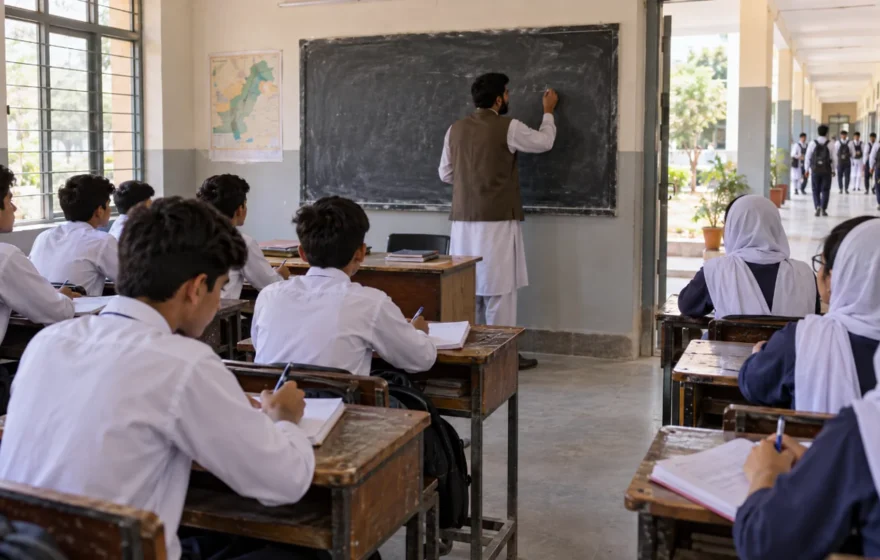
The Punjab Education Foundation has taken a major step by allowing its partner schools to launch matric classes, a move that will benefit millions of students across the province. For many children in these schools, it opens the door to completing their secondary education in the school they already attend, instead of finding a place elsewhere for the final years before their board examinations.
The permission is not open to every partner school. Under the foundation’s decision, a school will only be allowed to run matric classes if it has at least four kanals of land and at least ten rooms. Those two conditions are meant to make sure a school has the space to teach older students properly, and is not squeezing matric classes into a building that is already full. A school that falls short will have to wait until its premises measure up.
The foundation has also made it clear that student fee payments will only be made on the basis of NADRA-verified data, a rule aimed at making sure the money follows real, properly registered children. Partner schools are paid for each student they teach, and payment is released only when the student’s record has been checked against the national database, a safeguard against inflated enrolment figures.
The decision matters because of the sheer scale of the foundation’s network. In just two years, more than four million deserving children have been brought into free classrooms through the Punjab Education Foundation, covering 20,000 partner schools in all 41 districts of Punjab. Total enrolment under the foundation’s programmes has passed four million students, and the record enrolment of 1.1 million new students in the 2024-25 academic year alone was the highest single-year intake in the foundation’s history. The Punjab government committed around Rs25 billion to partner schools in a single academic year and cleared all outstanding dues owed to them.
The foundation’s model is built on a simple idea. Rather than building new schools everywhere, it partners with existing private schools, brings them into a structured framework of accountability and funds them on a per-student basis. The infrastructure already exists in towns and villages across Punjab, and the foundation’s job is to make sure that children from poor families can use it without paying fees. Its flagship Foundation Assisted Schools programme, launched in 2005, now covers around 3,600 partner schools with about 1.87 million students, mostly from economically deprived families. The New School Programme, started in 2007 for poor and far-flung areas, now has 2,309 schools with around 400,000 students, while the Education Voucher Scheme, running since 2006, gives vouchers to parents in slum areas so their children can attend partner schools of their choice.
Quality is checked through annual Quality Assurance Tests, and independent assessments are carried out through the Punjab Examination Commission, with examinations held at separate government schools to prevent manipulation. Partner schools are graded from A-plus to D on test results, infrastructure, teachers’ qualifications and board examination results, and financial assistance can be discontinued if a school fails to meet the standard. For a school to pass its quality test, 75 per cent of the students tested must secure at least 40 per cent marks in all subjects.
The NADRA verification rule fits into the same system of checks. Enrolment is verified through monthly monitoring visits to partner schools, and all students are checked against their B-forms, the child registration certificates issued by NADRA. Schools must update their student records in the foundation’s Student Information System by the 10th of each month, and payments are released on the basis of those verified figures. The foundation also caps enrolment at 500 for primary level, 750 for middle, 1,000 for secondary and 1,250 for higher secondary, so schools are not paid for children they cannot teach properly.
For the children themselves, the chance to study for matric in their own school is about more than convenience. Matriculation is the first major board examination in a Pakistani student’s life, and it decides whether a young person can go on to college. When a school cannot offer matric classes, its students must leave and find a place in another school, and many do not. They drop out instead, especially girls and children from families that cannot afford transport or fees.
Schools that meet the land and room conditions will still need qualified teachers for matric subjects, science laboratories and proper preparation for board examinations, and the foundation’s quality tests will have to make sure the new classes are up to standard. But the direction of travel is clear: 13,000 schools have joined the partnership programme and the foundation’s budget has risen by 250 per cent. Allowing partner schools to take their students all the way to matric is the natural next step, and for the millions of children in those classrooms, it could be the difference between finishing school and leaving it behind.
