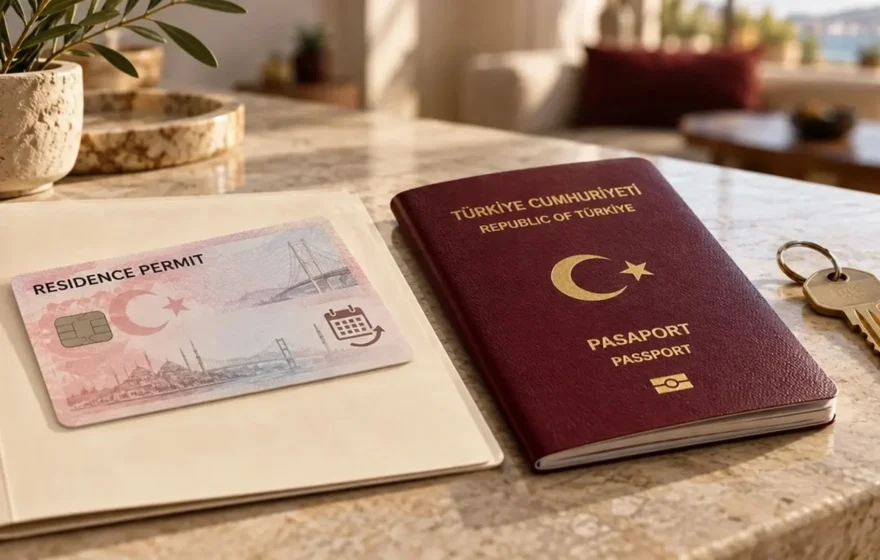
Turkey has opened a new and considerably cheaper route to legal residency for foreign investors, offering a three-year residence permit for an investment of $150,000 without any need to buy property. The scheme, which took effect immediately, is aimed at investors who want a long-term base in the country but have no interest in its housing market or in pursuing Turkish citizenship.
The rules were set out in Presidential Decision No. 11994, signed by President Recep Tayyip Erdogan on November 17 and published in the Official Gazette the following day. Under the decision, a foreign investor who places at least $150,000, or the equivalent in another foreign currency, in one of four approved channels can qualify for a three-year residence permit. Those who invest $200,000 or more can receive a permit lasting five years.
The four qualifying routes are a bank deposit certified by the Banking Regulation and Supervision Agency, known as the BDDK; government bonds guaranteed by the Ministry of Treasury and Finance; shares in real estate or venture capital investment funds approved by the Capital Markets Board, the SPK; and contributions to designated private pension plans regulated by the Insurance and Private Pension Regulation and Supervision Agency, the SEDDK. What the list pointedly leaves out is the most familiar route of all: buying a house or flat does not qualify under the new programme at all.
Investors do not have to lock their money away for the full length of the permit. The decision requires the investment to be maintained for at least half of the permit period, which means 18 months for a three-year permit and 30 months for a five-year permit. After that point the investor is free to withdraw the funds. The permit also covers the investor’s foreign spouse and dependent minor children, so a family can relocate together on a single investment.
There are, however, two firm limits that applicants need to understand. The permit gives no right to work in Turkey, so anyone who wants a job there would still need a separate work permit. And it offers no route to a Turkish passport, as the decision expressly places these permits outside Article 12 of Turkey’s Citizenship Law, the provision that allows citizenship to be granted by presidential decision to qualifying investors. The Ministry of Interior will set out the application procedures, and as of the announcement no dedicated application guide had been published by the Presidency of Migration Management, so there is not yet an official channel through which to apply.
The significance of the move lies in the gap it fills. Turkey already runs a well-known citizenship-by-investment programme, but that is a different and much more expensive proposition, requiring either $400,000 in real estate or $500,000 in financial assets, held for at least three years. The property threshold has not always been that high. When the programme began in 2017 it stood at $1 million, before being cut to $250,000 in September 2018, a reduction that sent application numbers soaring. It was raised to $400,000 in June 2022, where it has remained ever since.
The new residence scheme sits well below all of those figures, and its structure is different in kind as well as in size. The new permit asks for a smaller sum, held for a shorter period, in financial instruments that can be unwound. Serhan Aysever, managing partner at Beyond Global Partners, said the lower requirement could attract a new segment of international investors who are interested in Turkey but do not necessarily wish to pursue citizenship or invest in real estate.
That distinction matters because Turkey’s citizenship programme has also had its troubles. In August 2026 the Ministry of Interior announced that citizenship decisions had been cancelled or withdrawn for 6,134 people, including cases built on fake or inflated property valuation reports. A residence-only route that keeps money in regulated bank deposits, government bonds, licensed funds or the pension system steers foreign capital towards the financial system rather than the housing market.
The timing also fits a wider pattern, as governments around the Mediterranean and Europe have been rethinking golden visas, with several raising prices or restricting property-based routes after criticism that they pushed up house prices for local residents. Turkey’s answer goes in a different direction: it keeps the door open, lowers the price, and takes property out of the equation entirely.
Whether the scheme lives up to that promise will depend on the details still to come, including application procedures, fees, documentary requirements and processing times, none of which have been published yet. There will also be questions about how the investment is verified and whether permits can be renewed on the same terms. For now, Turkey has created a mid-tier product in the global residency market: not a passport, and not a short tourist stay, but a multi-year right to live in the country for a six-figure sum held in mainstream financial assets. If the application process proves straightforward, it could draw a steady stream of applicants who had previously looked at Turkey’s citizenship price tag and walked away.
